Hyperbaric Oxygen Therapy for Recovery at Iboga Wellness Institute
You are reading through the Iboga Wellness Institute treatment overview, you see hyperbaric oxygen therapy listed under supportive modalities, and your first thought is whether that is something your loved one will actually receive or whether it is just another luxury feature added to make the program sound more complete. That is a fair question, and it deserves a straight answer. Hyperbaric oxygen therapy recovery support at Iboga Wellness Institute is not an automatic amenity that every patient receives. It is a physician-directed medical modality, prescribed selectively during the recovery phase after the ibogaine flood dose, and only when the medical team believes there is a clinical reason for it that might be worth exploring.
Ibogaine itself is not approved by the FDA and remains investigational in the United States, which is one reason all treatment, including any hyperbaric session, happens at the licensed medical clinic in Cozumel, Mexico. The Columbus, Ohio office handles admissions, screening, and aftercare coordination only. What follows is a plain-language explanation of what this therapy is, who gets it, why, and what medical oversight stands behind it.
What Is Hyperbaric Oxygen Therapy, and What Does It Actually Do?
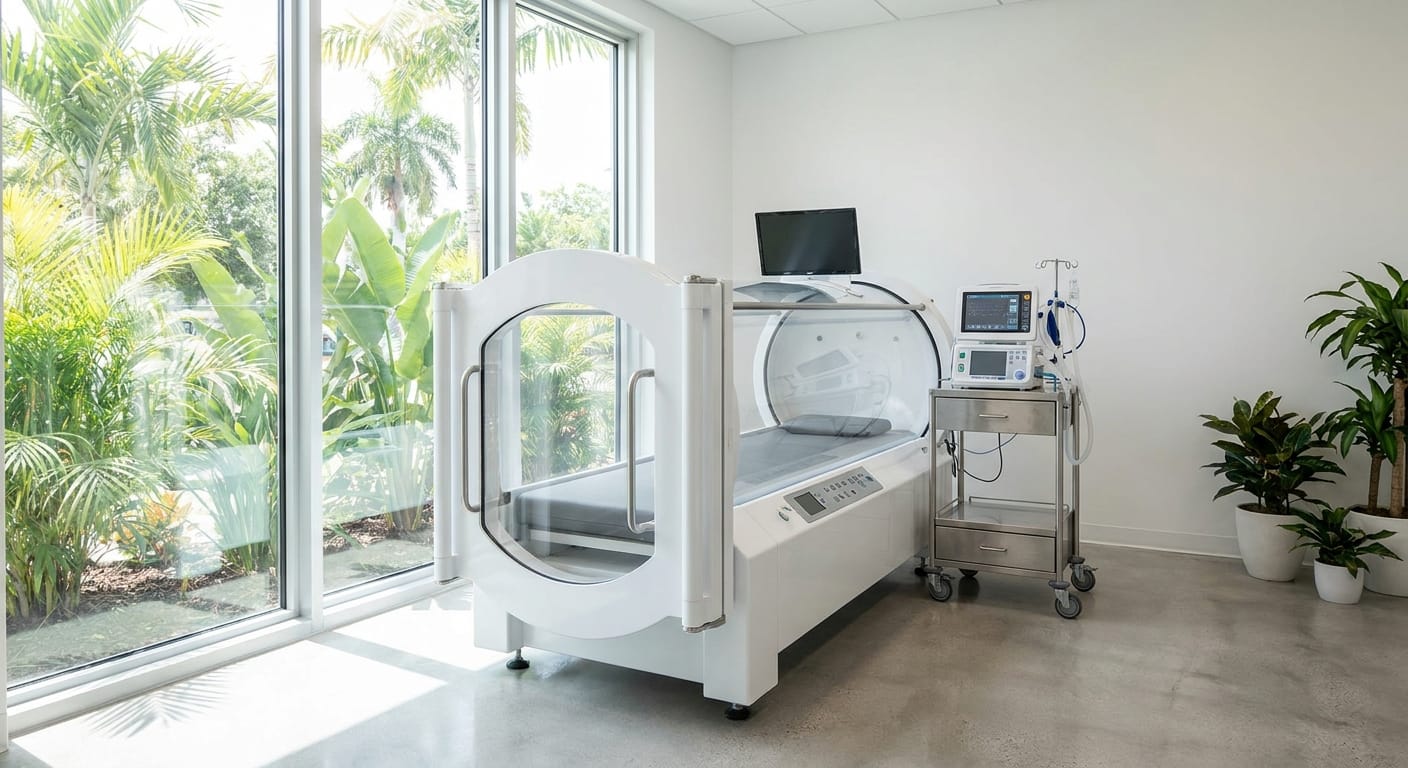
Hyperbaric oxygen therapy, or HBOT, is a medical treatment where you breathe oxygen inside a sealed chamber pressurized above normal atmospheric pressure. The increased pressure lets your body take in more oxygen than it could by breathing ordinary room air, though how this affects any particular person’s recovery can vary.
Think of it this way. At normal air pressure, your red blood cells carry most of the oxygen your body uses, and they can only hold so much. Under increased pressure, extra oxygen dissolves directly into your blood plasma and reaches tissues that may be starved for it. Researchers describe this hyperoxygenation as the core mechanism behind the therapy, delivering oxygen deep into areas that struggle to get enough during normal breathing (NIH). That is why HBOT has an established role in conventional medicine for certain conditions, and why we treat it as a medical intervention rather than a spa feature, though its role in addiction or neurological recovery after ibogaine remains exploratory.
At Iboga Wellness Institute, the general baseline pressure has been around 2.0 ATA, with a therapeutic portion of roughly 90 minutes at pressure, plus additional time for controlled compression and decompression. That said, our medical team does not treat HBOT as a one-size-fits-all protocol. The actual treatment profile, meaning the pressure, the duration, and how many sessions, is individualized based on the person, why the therapy is being used, their medical history, and where they are in recovery. One person may tolerate 2.0 ATA well. Another may need a different approach, or the physician may decide the chamber is not appropriate for them at all. The number on the gauge matters far less than the judgment surrounding it.
Will Your Loved One Actually Receive Hyperbaric Oxygen Therapy Here?
Not everyone who comes to Iboga Wellness Institute receives HBOT. It is offered for certain clients only, prescribed by the medical team based on individual clinical need, not handed out as a standard part of every stay.
We look at the whole person before we consider the chamber. Why are you here? What have you been through? What does your medical history look like, and what medications are in your system? What do your labs and cardiac testing show? Are you here primarily for opioid addiction, alcohol dependence, depression, PTSD, or is there a neurological condition like Parkinson’s or cognitive decline involved? Just as important, how are you actually responding once treatment begins, because a person can look one way on paper and respond very differently in the room.
The clinical interest so far has been with neurological clients, particularly those living with Parkinson’s disease, though we cannot predict how any individual will respond. With a complicated neurological condition, we are trying to build an environment that may support recovery and rehabilitation, and HBOT can become part of that larger approach when the physicians believe it might help. We may also consider it for someone experiencing significant brain fog, fatigue, or slow cognitive recovery after the flood dose, though whether it will benefit any specific person is uncertain. Even then, the logic is never simply “you have brain fog, therefore you get HBOT.” It is a clinical decision that weighs everything else going on with you.
This is where we draw a hard line against a common assumption. When people hear a facility offers HBOT, IV therapy, NAD, and regenerative medicine, they sometimes assume more modalities means better treatment. That is not how responsible medicine works. The value is having these tools available and knowing when to use them, and, just as importantly, knowing when not to. Nobody is placed in the chamber to make a treatment schedule look impressive. The question that governs the decision is always the same: what does this particular person need right now?
What We Check Before Anyone Enters the Chamber
HBOT requires its own medical clearance, separate from the screening that clears you for ibogaine. Before anyone enters the chamber, we confirm you are physiologically stable enough to tolerate a pressurized, high-oxygen environment that day, and we check for conditions that make the therapy unsafe.
There is a clear difference between an absolute contraindication and a red flag. The clearest hard stop is an untreated pneumothorax, meaning trapped air around the lung, because you are entering an environment where atmospheric pressure is changing. That is not something we play around with. Most other concerns require clinical judgment. Significant COPD, emphysema, pulmonary blebs, a history of spontaneous pneumothorax, or unexplained shortness of breath prompt further investigation, sometimes including chest imaging, before anyone enters the chamber. Ears and sinuses matter too, since you are pressurizing the body. A significant upper respiratory infection, severe congestion, recent ear surgery, or an inability to equalize ear pressure can be reason to postpone. There is no need to force something today that can safely happen later.
The cardiovascular picture is especially important for this population, because many clients have recently received ibogaine, and continuous cardiac monitoring is already taken extremely seriously here. An unstable rhythm, concerning ECG changes, significant QT prolongation, uncontrolled blood pressure, or chest pain means HBOT is not the priority in that moment. We also review labs for instability rather than one magic number, so significantly abnormal potassium or magnesium, unstable glucose, dehydration, or other metabolic abnormalities get addressed first. Seizure history matters because oxygen toxicity seizures, while uncommon, are a recognized risk. Certain medications, including some chemotherapy drugs, require specific consideration. And something basic gets checked too: can you tolerate being inside the chamber, or would severe claustrophobia or confusion make it unsafe?
HBOT is an established medical therapy with specific recognized indications, and outside this setting it is even covered by Medicare for a defined set of approved conditions such as certain non-healing wounds and decompression sickness (Medicare). Inside an ibogaine recovery program, it is elective supportive therapy. Our guiding philosophy is simple: stabilize the patient first. If electrolytes still need correction, if the QT interval needs more time to normalize, or if the physician simply does not like how someone looks clinically, HBOT waits. There is no prize for getting someone into the chamber a day earlier.
What We Saw When HBOT Was Added to One Client’s Parkinson’s Recovery
One client with Parkinson’s disease came in for treatment, so this was not someone arriving strictly for addiction. We were looking at his neurological function, his movement, his mental clarity, and his overall quality of life, and how the different pieces of care might work together.
His treatment combined ibogaine with hyperbaric oxygen and integration work. What surprised us was how quickly we seemed to notice a shift in his mental clarity. This client had what we would describe as pretty significant brain fog before treatment. You could see it in how he processed information and communicated. After the hyperbaric sessions were incorporated, there appeared to be a noticeable change. He seemed sharper and more engaged, his thoughts appeared to come together more clearly, and he was more present in conversations. This was not a subtle difference noticed months later. From our perspective, the change in his clarity seemed relatively rapid, and it was observable to staff rather than something the client only reported himself.
We are careful about how we talk about this. This person was receiving multiple interventions at once, including ibogaine, HBOT, neurological rehabilitation, integration, and nutritional support. No one can scientifically isolate hyperbaric oxygen and claim it alone caused what we observed, and that is not a claim we are willing to make. This experience does not prove HBOT treats Parkinson’s, or that combining it with ibogaine will produce any particular result for any other person. What it gave us was an observation meaningful enough to keep documenting, to follow clients longer term, and to keep asking why, rather than getting ahead of the science. When someone struggling neurologically starts coming back online, you pay attention, though we cannot promise similar experiences for others.
Who Operates the Chamber, and Where Does Treatment Happen?
The chamber is operated by personnel with hyperbaric-specific training, under physician-directed oversight, with continuous monitoring throughout each session. All of it happens at the licensed medical clinic in Cozumel, Mexico during the recovery phase, never at the Columbus office.
There is a real difference between being a physician or nurse and having hyperbaric-specific education and competency. Hyperbaric medicine carries its own safety considerations, including oxygen toxicity, pressure injuries, fire safety, emergency decompression, chamber operation, patient selection, and recognizing complications. We hold ourselves to recognized training standards, including the Undersea and Hyperbaric Medical Society’s 40-hour introductory hyperbaric medicine program, which combines classroom education, hands-on training or simulation, and examination, along with appropriately credentialed personnel operating the chamber. As we see it, the chamber itself does not impress anyone. Anybody can buy equipment. What matters is who decides to put a person in it, why, at what pressure, who operates it, who watches the patient, and whether the team knows what to do when something does not go according to plan.
The session itself is a monitored process, not simply lying inside a chamber for 90 minutes. There is a compression phase where the team gradually brings you to the prescribed pressure while communicating with you to make sure you are equalizing your ears and tolerating the change. Then comes the therapeutic portion at pressure, followed by controlled decompression back to normal atmospheric pressure. You are monitored throughout, and vitals are reassessed afterward. This mirrors how conventional hyperbaric medicine describes patients being watched during treatment and examined for pressure-related issues afterward.
The reason all of this happens in Cozumel is straightforward. Because ibogaine is not approved by the FDA and is not legal to administer as a medical treatment in the United States, the treatment program, including the hyperbaric oxygen therapy recovery support that follows the flood dose, takes place at the medical clinic in Mexico. The Columbus office is where you begin, with admissions, medical screening, and aftercare coordination. If you are researching from Ohio and want to understand travel, cost, and what is included, that office is your starting point, but the care itself is delivered in Cozumel by the on-site medical team.
Questions Families Ask About Hyperbaric Oxygen Therapy in Recovery
Does everyone who comes to Iboga Wellness Institute receive hyperbaric oxygen therapy?
No. HBOT is selectively prescribed by the medical team based on individual clinical need, not offered as a standard part of care that every patient receives. We believe strongly that not every person should get the same protocol, and the chamber is used only when there is a clinical reason the team believes might warrant exploring it.
What medical conditions might make someone a candidate?
The clinical interest has been with neurological clients, particularly those with Parkinson’s disease, and patients experiencing significant brain fog, fatigue, or slow cognitive recovery after ibogaine treatment, though we cannot predict who will benefit. Even then, candidacy depends on a full review of diagnosis, medical history, labs, cardiac testing, medications, and how the person is actually responding during recovery.
What are the contraindications for hyperbaric oxygen therapy?
An untreated pneumothorax is an absolute contraindication. Unstable cardiac status, uncontrolled seizures, significant pulmonary issues, abnormal labs, and an inability to equalize ear pressure all require clinical judgment about whether a person is stable enough that day. Severe claustrophobia or an inability to follow instructions can also make the chamber inappropriate.
How long does a session last?
A session may run around 90 minutes at pressure in the 2.0 ATA range, plus additional time for compression and decompression. The actual treatment profile, including pressure, duration, and number of sessions, is individualized by the medical team based on the person and their response.
Who operates the hyperbaric chamber?
Personnel with hyperbaric-specific training operate the chamber, including completion of a recognized program such as the UHMS 40-hour introductory hyperbaric medicine course, under physician-directed oversight with continuous monitoring throughout each session.
Where does hyperbaric oxygen therapy happen during treatment?
All HBOT happens at the licensed medical clinic in Cozumel, Mexico during the recovery phase after ibogaine treatment. The Columbus office handles admissions, screening, and aftercare coordination only.
If your loved one is living with a neurological condition, or if you are trying to understand whether supportive therapies like HBOT might play any role in their recovery, the honest answer will always depend on their specific medical picture. This is the same standard we apply to every decision we make: would we trust this with someone we love? Contact the admissions team at Iboga Wellness Institute to talk through whether a medical history and recovery goals might make someone a candidate for hyperbaric oxygen therapy recovery support as part of a physician-directed ibogaine treatment program. We will tell you plainly whether it fits, including when the right clinical decision is that it does not.
Important legal and safety information: Ibogaine is not approved by the FDA and is not available as a legal medical treatment in the United States. Iboga Wellness Institute provides ibogaine treatment exclusively at its licensed medical clinic in Cozumel, Mexico, under medical supervision. US locations handle admissions, screening, and aftercare coordination only.
Ready to Learn How Hyperbaric Oxygen Therapy Supports Your Recovery?
If you’re exploring every avenue to give yourself the strongest foundation for lasting change, you deserve to understand how hyperbaric oxygen therapy fits into a comprehensive treatment approach at our Cozumel clinic. Our admissions team can walk you through how this therapy integrates with ibogaine treatment and what to expect during your stay.
Individual results vary. Any experience described here reflects one person’s care and is not a promise of any particular outcome.