
Ibogaine Detox Explained: What Medically Supervised Opioid Detox Actually Looks Like
You are trying to sort out whether ibogaine detox is safe, and what your loved one would actually go through, because everything online swings between miracle cure and dangerous experiment, and neither extreme helps you make a decision this serious. You are not looking for a sales pitch. You want the clinical facts, laid out plainly, so you can decide whether this is right for someone who is, at the end of the day, someone’s son, daughter, spouse, parent, sibling, or best friend.
We will give you those facts. We built our program around a single question we ask before we accept anyone: would we trust this with someone we love? If the honest answer is no, we do not proceed. That standard shapes everything below.
What Ibogaine Detox Actually Is, and How It May Affect Opioid Dependence
Ibogaine is a naturally occurring alkaloid found in the root bark of the iboga plant. In a medical setting, it is given as what we call a flood dose, and during that window it may reduce some acute withdrawal symptoms that can make opioid detox difficult for some individuals, and some research suggests it may affect receptor activity associated with patterns of use. Individual experiences vary considerably. For some people who have experienced withdrawal after previous attempts, a reduction in certain symptoms may occur.
Here is the part most articles get wrong. Ibogaine detox is not a single session. It is a weeks-long clinical protocol with three connected phases: comprehensive medical screening before arrival, the flood dose under continuous cardiac monitoring, and structured integration after the dose. Skip any one of those and you do not have a medically supervised ibogaine detox. You have a gamble.
The biological response alone is not the full picture. The medicine may create changes for some individuals, but ongoing recovery involves the choices a person makes afterward. Ibogaine may affect dependence patterns for some people. It cannot make new decisions for someone, rebuild a marriage, or hold a job. That work happens in the days and weeks after dosing, which is why our program treats the flood dose as the beginning of the process rather than the finish line. When you understand ibogaine detox as a protocol rather than an event, the safety requirements and the timeline start to make sense.
Why Ibogaine Detox Starts Weeks Before Anyone Is Dosed
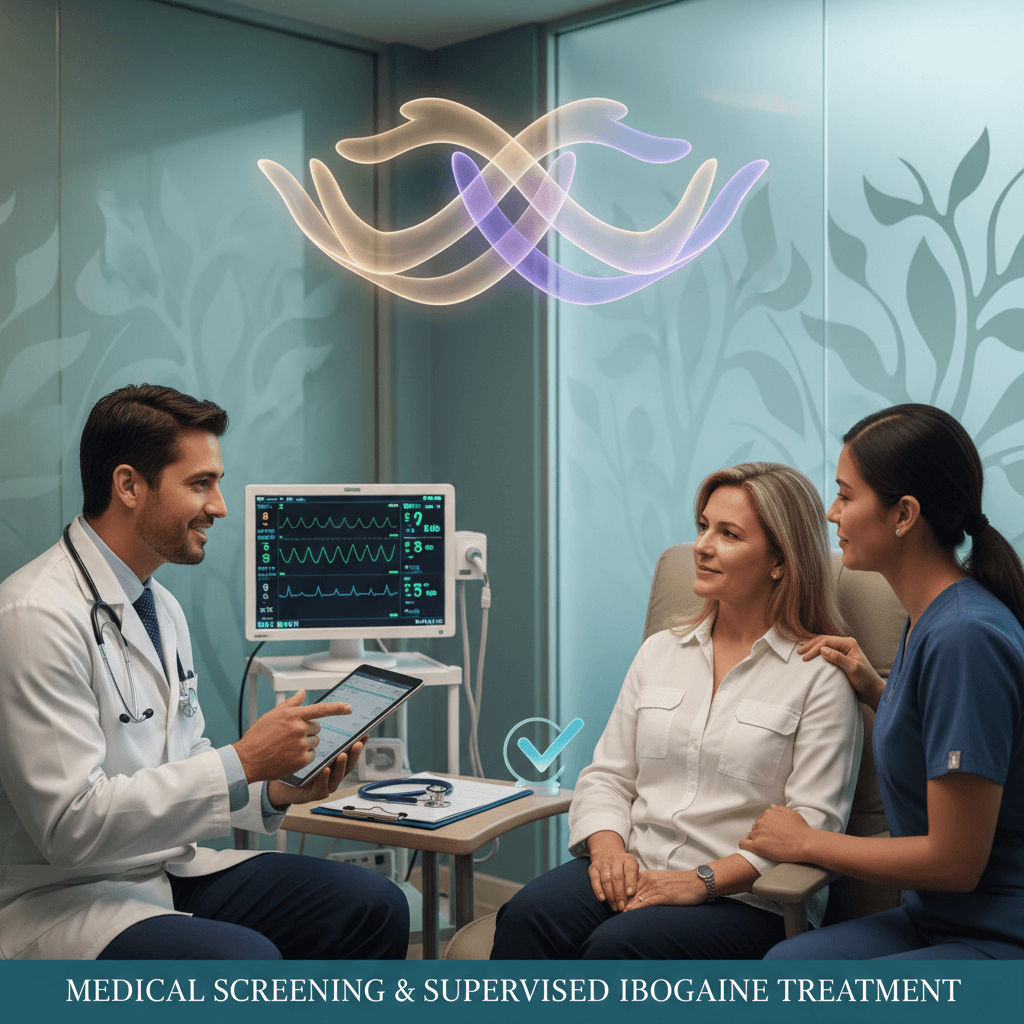
The most important part of ibogaine detox happens before your loved one ever receives the medicine. Ibogaine can prolong the QT interval, the electrical recovery phase of the heartbeat, and in an unscreened patient that risk can become a serious cardiac event. So our screening begins 14 to 30 days ahead of arrival, and it is thorough on purpose.
That pre-arrival workup includes a detailed medical history, a full medication review, and laboratory testing: complete blood count, comprehensive metabolic panel, liver and kidney function, and electrolytes. We run a 12-lead ECG so our physicians can read the cardiac rhythm and measure the QTc interval, targeting below roughly 450 milliseconds for men and 470 for women. We also optimize electrolytes to specific ranges, potassium between 4.2 and 4.8 mmol/L and magnesium at least 2.0 mg/dL, because those levels may help protect cardiac function during dosing. When the picture calls for it, we require an echocardiogram or formal cardiology clearance before we go further. The pharmacology behind this caution is documented in the Journal of Psychopharmacology, which is why we treat cardiac screening as non-negotiable rather than optional.
Then we do it all again. On arrival we repeat the 12-lead ECG, refresh the labs, reassess electrolytes, run urine toxicology, and complete a physician exam, with a second urine drug screen immediately before dosing. Families sometimes ask why we retest what an outside clinic already checked. The answer is a patient we will call Mike. His repeat ECG, taken right before dosing, caught a new-onset arrhythmia that outside testing had missed. That single redundant check changed his care plan. Redundant checkpoint testing is not paperwork. It is the difference between catching a problem and being caught off guard, and it is why we say plainly that safety will always come before filling a bed.
What the 8 to 10 Hour Flood Dose Really Involves
The flood dose itself runs roughly 8 to 10 hours, and for that entire window your loved one is on continuous cardiac telemetry with 24/7 nursing care at the bedside. This is not a person left alone in a room to ride out an experience. Trained nurses watch the heart rhythm in real time, and a physician oversees the protocol from start to finish. If anything shifts, the response is immediate and planned in advance.
One thing surprises many families: for some individuals, acute opioid withdrawal symptoms may be reduced during the flood dose itself. Ibogaine may affect those withdrawal symptoms for some people rather than requiring someone to manage through a separate stack of comfort medications. For some people whose past detoxes involved significant physical discomfort, this experience may feel different. For patients with polysubstance dependence, or those coming off buprenorphine, we handle the transition carefully with a personalized taper completed in the 14 to 30 days before dosing. Sometimes that means moving a long-acting medication to a short-acting opioid about eight days out, so the body is ready.
The reason we can keep the dosing window this controlled is the equipment and the protocols standing behind it. On site we keep emergency medications, advanced cardiac monitoring, oxygen, airway management equipment, defibrillation capability, intravenous medications, and clearly defined emergency response steps that every team member knows by heart. This is exactly what a retreat setting typically does not have, and it is exactly what a medicine with a real cardiac profile demands. We would rather lose a patient than compromise our standards, and that conviction is why we invest in this capability rather than cutting corners to look more affordable.
The Days After Dosing Are a Critical Part of the Process
The window after the flood dose is where recovery work continues, so we treat it with the same seriousness as the dose itself. Medical checkpoints, including vitals, ECG, and QT monitoring, are logged three times a day. Before any deeper emotional work begins, our priority is simple: the patient must be medically stable, comfortable, hydrated, and emotionally grounded. We do not rush past that.
Once that stability is in place, the integration work starts, and it is part of the medical protocol, not an optional add-on. Every patient meets with a psychotherapist for roughly one hour daily. The flood dose may create a neurological and psychological window, a period that some people describe as heightened clarity, and that window is time-limited. Structured sessions, guided journaling, and a plan for what comes next are how any biological changes may be supported with behavioral change. Research summarized in the Journal of Substance Abuse Treatment consistently links structured aftercare and integration to more favorable patterns in some individuals, which matches observations in our own patients.
Nobody leaves without a personalized aftercare plan, and this is where we are unflinching with families. We are building a framework a person may use to support their recovery choices over time. When adjunct support fits the individual, such as hyperbaric oxygen therapy, breathwork, or guided meditation to help a frayed nervous system settle, we layer it in during this phase. The goal throughout is not just a body free of opioids. It is a life they no longer feel the need to escape from.
What Completion and Relapse Actually Look Like After Ibogaine Detox
We will not tell you ibogaine detox guarantees anything, because no honest program can. What we can share is what we observe in our own patients. Roughly 75 percent complete the recommended weekly post-integration program through the first 12 weeks. During the first year, we observe a relapse rate of about 25 percent among engaged participants, and the patients who stay involved in aftercare show different patterns than those who do not.
Read those two numbers together and the whole point of this article comes into focus. Detox alone is not the endpoint. Any changes the flood dose creates may be supported or undermined by what follows. The National Institute on Drug Abuse has long described opioid recovery as a condition that may require continuing care rather than a single intervention, and our observations reflect that understanding.
Consider Zach. He came to us after conventional options had run out. As of this writing he has been sober more than seven months, is back to full-time work as a cook, and has repaired relationships with his family that addiction had strained to the breaking point. His experience involved the dose, plus the integration, plus the choices he kept making week after week. That is what recovery may look like for some people, and it is why we track engagement and continuity rather than just initial completion.
How Iboga Wellness Institute Delivers This in Columbus, OH
Iboga Wellness Institute operates in Columbus, OH as a physician-led ibogaine detox program, with 24/7 nursing care and the on-site emergency capability we described above: defibrillation, airway management, IV medications, oxygen, and advanced cardiac monitoring. Cardiology clearance is required whenever a patient’s history indicates it. As demand has grown, our clinical team has expanded, including bringing on two additional physicians, so that oversight never gets thin.
We serve clients nationwide, but families reach us in Columbus from across the region, traveling in from Pennsylvania, West Virginia, Kentucky, Indiana, and Michigan. In those states the opioid crisis remains severe, and conventional detox and medication-assisted treatment have often already been tried. Many of the people who find us have been through rehab three or four times. They are looking for an approach that may reach what the others could not, delivered with the medical rigor a treatment like this requires.
What holds it all together is the standard we started with. We are not just building a treatment center. We are accountable for real people whose families have already survived years of fear. So we screen hard, we monitor continuously, we integrate deliberately, and we tell the truth about limits, because that is what we would want if the person in that bed were our own. When you ask whether ibogaine detox is safe, the honest answer is that safety depends entirely on how the protocol is run. Run this way, with physician oversight from screening through discharge, it becomes something a family can consider with clear eyes.
Frequently Asked Questions About Ibogaine Detox
How long does the entire ibogaine detox process take, from screening to discharge?
Pre-screening begins 14 to 30 days before arrival, which allows time for lab work, cardiac evaluation, and any needed medication taper. On-site treatment typically lasts 5 to 7 days, covering the flood dose plus post-dosing stabilization and integration. Aftercare then continues on a weekly basis for the first 12 weeks.
Is ibogaine detox safe for someone with a heart condition or on other medications?
Ibogaine can prolong the QT interval and cause serious cardiac events, so comprehensive cardiac screening, including a 12-lead ECG and electrolyte optimization, is mandatory before dosing. Certain heart conditions and certain medications can disqualify a candidate. That is exactly why we screen twice and require cardiology clearance when indicated.
What happens if someone relapses after ibogaine detox?
We observe a relapse rate of about 25 percent among engaged participants during the first year. Structured aftercare and weekly post-integration sessions may support better patterns for some individuals, and some patients return for additional treatment. Relapse is treated as information to respond to, not a verdict.
Can ibogaine detox work for fentanyl or other synthetic opioids?
Medically supervised ibogaine detox may be appropriate for some individuals with fentanyl and synthetic opioid dependence. Screening and preparation may take longer for polysubstance use or buprenorphine dependence, since those cases require a carefully managed taper in the weeks before dosing.
What makes medically supervised ibogaine detox different from a retreat setting?
A medically supervised program includes physician oversight, continuous cardiac telemetry, on-site emergency equipment such as defibrillation and airway management, redundant ECG and lab testing, and psychotherapist-led integration. Unregulated retreat settings typically lack these safeguards, which is where serious risks may emerge.
Does insurance cover ibogaine detox treatment?
Ibogaine is not FDA-approved in the United States, so most insurance plans do not cover it, and payment is typically out of pocket. We provide full cost transparency and can discuss payment options directly, so there are no surprises.
If you are weighing this decision for someone you love, the right next step is not a commitment. It is a conversation. Contact Iboga Wellness Institute in Columbus, OH to schedule a confidential medical screening consultation, so our physicians can review the specific history, the medications, and the cardiac picture, and provide an honest assessment of whether medically supervised ibogaine detox may be appropriate for your situation.
Ready to Learn Whether Ibogaine Treatment Is Right for You?
If you’ve been researching alternatives to traditional opioid detox and still have questions about the medical supervision process, safety protocols, or what your experience might look like, Iboga Wellness Institute in Columbus, OH is here to provide clear answers. Every person’s path is different, and understanding your options is an important first step. Our team can walk you through what medically supervised ibogaine detox involves and help you determine if this approach aligns with your needs.
- Individual risk profiles vary.
- Individual outcomes vary.
- Individual results vary, and not all patients experience the same effects.
- Individual responses to ibogaine vary considerably.
- Not everyone experiences the same degree of symptom reduction.