Are There Any Legal Ibogaine Treatment Centers in the United States for Opioid Detox?
You just typed “legal ibogaine treatment centers United States opioid detox” into the search bar, clicked through three pages of results, and landed on the same uncomfortable truth on every site. So let me answer the question you actually asked, plainly. Are there any legal ibogaine treatment centers in the United States for opioid detox? No. Ibogaine is a Schedule I controlled substance, it is not FDA-approved, and no clinic can legally administer it as medical treatment anywhere in this country. Your next question is not whether that is true, because it obviously is. It is where people actually go when conventional detox and rehab have not worked for them, what “legal treatment in Mexico” really means in practice, and whether the person you love will be safe.
This page answers all three, in the words of Iboga Wellness Institute, an American-owned program based in Columbus, Ohio, that treats patients at its licensed medical clinic in Cozumel, Mexico, and does this every week.
Are there any legal ibogaine treatment centers in the United States for opioid detox?
Ibogaine cannot be legally administered as medical treatment in any US state because it is a Schedule I controlled substance under federal law (21 USC 812). That means the federal government recognizes no accepted medical use for it, and no facility can lawfully give it to a patient here. State laws do not change this. A state can fund a research committee or express public interest, but the treatment itself remains illegal to provide.
Two federal bodies control this. The FDA decides which drugs are approved as medical treatment, and ibogaine has never received that approval for opioid dependence or anything else. The Drug Enforcement Administration controls scheduled substances, and Schedule I is the most restrictive category, the same tier as heroin. So when a website hints at “investigational use” or an “Ohio address” for ibogaine, read carefully. An address in the United States can be a corporate office. It cannot be a place where the flood dose, the single large therapeutic dose of ibogaine, is given.
This matters for you because it filters out a real danger. Anyone claiming to offer ibogaine detox at a US location is either misrepresenting where treatment happens or operating outside the law with none of the medical infrastructure that may help keep a person safer during dosing. The honest answer is not comforting, but it is the starting point. Legal, physician-supervised ibogaine treatment for a US family happens abroad. So when families ask whether there are any legal ibogaine treatment centers in the United States for opioid detox, the truthful reply always points them out of the country.
Where Does Legitimate Physician-Supervised Ibogaine Treatment Actually Happen?
Americans who want legitimate ibogaine treatment travel to licensed medical clinics in countries where the medicine is legal and given under physician oversight. For Iboga Wellness Institute, that place is a licensed medical clinic in Cozumel, Mexico. We are American-owned, and our office in Columbus, Ohio handles admissions, medical screening coordination, and aftercare follow-up, but we do not administer ibogaine in the United States, because we cannot do so legally. Every flood dose happens in Cozumel, under a physician-led team of doctors, a physician assistant, and ICU-trained nurses.
The meaningful legal question for you is not whether it is legal somewhere in the US, because it is not. The question is whether the facility abroad operates inside a legal medical framework with documented safety protocols, or whether it is an unregulated underground operation running on a rented villa and a good story. Those are two very different things that both happen to be located outside the country.
Here is the practical difference our model creates. You are not mailing your son or daughter to a foreign phone number and hoping. You reach a member of the clinical team through a US office, complete screening coordinated from the States, and return to a US-based weekly integration program afterward. The treatment must occur abroad because of the law. Everything around it, the intake, the screening, the coming-home support, is handled by people you can reach in your own time zone. We are building the thing we would want if the person on the table were ours.
What Separates a Licensed Clinic From an Underground Provider?
The single standard that separates a licensed medical clinic from an underground provider is whether the facility repeats full medical screening on-site and is willing to stop, rather than proceeding because a deposit has been paid. Ibogaine carries real cardiac risk, which the National Institute on Drug Abuse documents in its work on the drug’s effects on heart rhythm. That risk is exactly why our screening does not end when someone books.
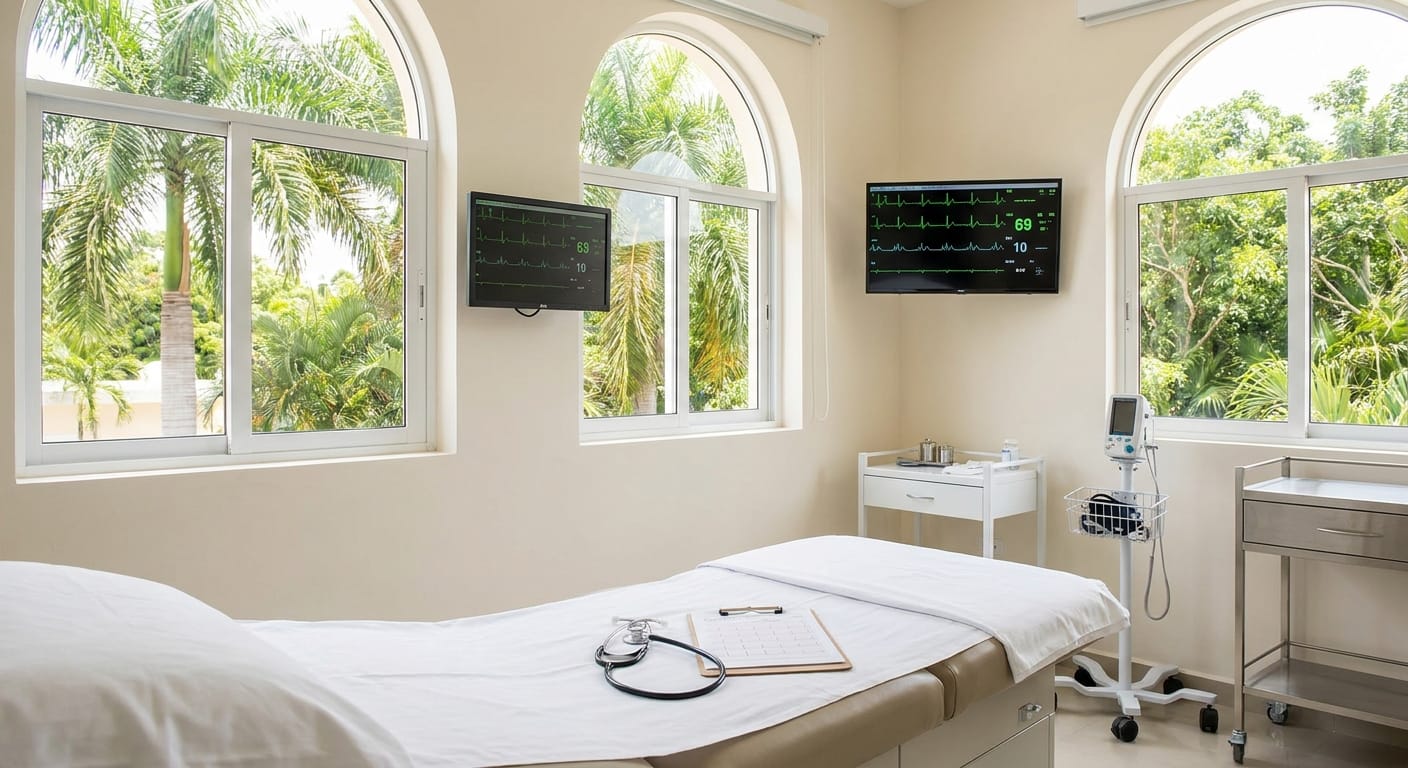
Every prospective patient completes a detailed medical history, a medication review, laboratory testing (CBC, comprehensive metabolic panel, liver and kidney function, electrolytes, magnesium), and a 12-lead ECG. Physicians read cardiac rhythm and the QTc interval, targeting below roughly 450 ms for men and 470 ms for women. A QTc over 460 ms is a hard line where we will not proceed. We correct potassium to a 4.2 to 4.8 mmol/L range and magnesium to at least 2.0 mg/dL before anyone is cleared. Then we repeat all of it on arrival, and again with a fresh 12-lead ECG immediately before the flood dose, regardless of what outside records say. Continuous cardiac telemetry runs throughout, with ICU-trained nurses at the bedside and a physician checking in and immediately available.
These are not brochure words. Consider one patient whose repeat pre-dose ECG showed a new-onset arrhythmia that earlier testing had not captured. Treatment was halted and the patient was referred for further evaluation. Consider another patient whose QTc began to lengthen and was corrected with IV magnesium before we would move forward. We decline or postpone some applicants when risk outweighs potential benefit. Safety will always come before filling a bed. We would rather lose a patient than compromise our standards, and an underground clinic has none of this to lose in the first place.
What Does Traveling to Mexico for Ibogaine Treatment Involve for a US Family?
Traveling for ibogaine treatment means coordinating international medical care, which starts weeks before anyone gets on a plane. If your loved one is on Suboxone or buprenorphine, they may transition to shorter-acting medication before the flood dose, because long-acting opioids can interfere with dosing. Fentanyl and other long-acting opioids may be stepped down first for the same reason. This is medical work, not a suitcase-and-passport decision, and the Columbus office coordinates it before travel.
The standard program is seven days and six nights in Cozumel. That covers private accommodations, chef-prepared meals, airport transportation, 24/7 nursing care during treatment, continuous cardiac monitoring, daily individual psychotherapy sessions of about one hour, post-treatment journaling support, and a personalized aftercare plan. When your loved one comes home, they step into a weekly post-integration program run from the US side. If you want to see what evidence-based, physician-run opioid care looks like in the States for comparison, SAMHSA maintains a public Opioid Treatment Program Directory, which is a useful reference for the conventional pathway many families have already tried before they find us.
What this means for you is concrete. You bring current medical records. You plan for a week abroad, not an afternoon. And you accept that the value here is not a spa week, it is a physician-supervised medical procedure with a therapist beside it and a plan for the day after. Ibogaine may be considered by some people when conventional detox and rehab have not worked for them, and the structure of the week reflects that seriousness.
What Do Outcomes Look Like in a Physician-Supervised Setting?
In a physician-supervised setting, a flood dose may interrupt opioid withdrawal and craving for some individuals during or after the dosing period itself, though this experience varies considerably from person to person and is not guaranteed. Whether that opening becomes lasting recovery depends on the person’s unique physiology, their post-treatment integration, their support system, and many other factors beyond the medicine alone. The medicine may open a door for some people, but lasting recovery comes from the choices a person makes once they walk through it. We say that to every family, because it is the truest thing we know.
One patient we worked with was a veteran with severe opioid dependence and suicidal thoughts who had reached the end of hope. His flood dose lasted roughly eight to ten hours. The next morning he reported feeling clear-minded, with the desperation lifted, and he described being less consumed by cravings and withdrawal than before treatment. More than three years later, according to his self-reported updates to us, he has remained free from active addiction, has worked on rebuilding his relationships, and has rediscovered a sense of purpose. Another patient came to us contemplating suicide and, in his own words months later, has stayed sober while repairing his family relationships. A third patient told us more than seven months after treatment that he has stayed sober, returned to full-time work as a cook, grown closer with his family, and continued showing up to weekly integration.
Notice what those three experiences share. None of them ended at the clinic door. Each person continued working after the flood dose, and that is where their individual recovery path unfolded. We are not promising a miracle. We aim to offer people who have not responded to other treatments a chance at a life they no longer feel the need to escape from, and then to stand beside them while they build it.
How Do You Decide If Ibogaine Is the Right Next Step for Someone You Love?
You decide by asking the same question we ask before we accept anyone. Would we trust this with someone we love? Every acceptance decision is made by the medical team, not by admissions staff, and treatment follows the patient’s physiology rather than a fixed calendar. That means some people we care about are told no, and we tell them anyway.
Ibogaine is not a first-line intervention. It may be considered for people who have not responded to conventional detox and rehab after multiple attempts. It does not fit everyone. We decline or postpone anyone with significant structural heart disease, uncontrolled arrhythmias, prolonged QT syndrome, concerning ECG findings, unstable medical illness, or dangerous medication interactions. One prospective patient received a direct call from our medical director explaining he could not come, because his QTc sat in dangerous territory alongside other risk factors. That call was a harder conversation than a yes, and it was the right one.
So when you evaluate any provider, ask three things. Who makes the final medical decision, admissions or a physician? Do they repeat the ECG on-site immediately before dosing? And will they turn your loved one away if the screening says stop? If a program cannot answer those cleanly, keep looking. The right next step for someone who has not responded to other treatments is not simply the program that says yes fastest. It is the one prepared to say no when your loved one’s heart says so, and to stay with them through the weekly integration that follows, which may influence whether any early relief the treatment provides holds.
Common Questions About Legal Ibogaine Treatment for Opioid Detox
Is ibogaine legal in any US state for opioid detox?
No. Ibogaine is a Schedule I controlled substance under federal law and cannot be legally administered as medical treatment anywhere in the United States, regardless of individual state laws or public research interest. Any provider claiming to give ibogaine at a US location is either mislabeling a corporate office or operating outside the law. If you are searching for any legal ibogaine treatment centers in the United States for opioid detox, that is the answer you will keep running into.
Where do Americans go for legal physician-supervised ibogaine treatment?
Americans travel to licensed medical clinics abroad where ibogaine is legal, most commonly in Mexico. Iboga Wellness Institute is American-owned, coordinates admissions and aftercare from Columbus, Ohio, and administers ibogaine at its licensed medical clinic in Cozumel, Mexico under a physician-led team.
How do I know if an ibogaine clinic abroad is safe and legitimate?
A legitimate clinic repeats full medical screening on-site, runs a fresh 12-lead ECG immediately before dosing, uses continuous cardiac monitoring with a physician present, documents hard safety thresholds like a QTc limit, and declines patients when risk outweighs potential benefit. Underground operations skip all of that.
What does ibogaine treatment in Mexico cost and how long does it take?
At Iboga Wellness Institute, the standard program runs seven days and six nights in Cozumel. That includes private accommodations, meals, airport transportation, 24/7 nursing care during treatment, continuous cardiac monitoring, daily individual therapy, and a personalized aftercare plan. The admissions team can walk you through current pricing and payment options during screening.
Will insurance cover ibogaine treatment for opioid dependence?
Most US insurance plans do not cover ibogaine, because it is not FDA-approved. Some families use HSA or FSA funds or financing options instead. The admissions team can walk through payment options during the screening process so you know where you stand before committing.
How does ibogaine compare to conventional treatment for opioid detox?
A flood dose may interrupt withdrawal and craving for some individuals during or after the dosing period, an effect that some people who have cycled through repeated conventional detox describe as different from anything they experienced before, though experiences vary widely. Whether any benefit lasts depends on the person’s unique physiology, their engagement in post-treatment integration, and many other individual factors, not on the medicine by itself.
If you are researching ibogaine treatment for yourself or someone you love after conventional detox and rehab have not worked, call Iboga Wellness Institute at the Columbus office to speak with a member of the clinical team about whether physician-supervised ibogaine treatment in Cozumel may be appropriate for your situation, what the medical screening process involves, and how to coordinate travel and aftercare. Ask your first question there deliberately. Request a fresh pre-dose ECG on the day of treatment, and listen for whether the medical team, not the sales desk, holds the final yes. That single answer tells you more about a program than any brochure ever will.
Important legal and safety information: Ibogaine is not approved by the FDA and is not available as a legal medical treatment in the United States. Iboga Wellness Institute provides ibogaine treatment exclusively at its licensed medical clinic in Cozumel, Mexico, under medical supervision. US locations handle admissions, screening, and aftercare coordination only.
Take the Next Step Toward Opioid Freedom
If you’ve been searching for ibogaine treatment but concerned about legality and safety in the U.S., you’re not alone in feeling uncertain about your options. Our team can walk you through how our licensed Cozumel medical clinic works, what the treatment process involves, and how we coordinate everything from our Columbus admissions office to make your journey as smooth as possible. Whether you’re in Ohio or elsewhere in the country, we’re here to answer your questions about ibogaine-assisted detox and help you determine if this approach is right for your situation.
Individual results vary considerably. The outcomes described here reflect the self-reported experiences of specific individuals we have worked with and are not typical or guaranteed results. Recovery from opioid dependence is influenced by many factors unique to each person.