
Maybe a counselor used the phrase. Maybe you saw it online late at night, after another program fell through, while searching for a medically oriented option for someone you love. Many people assume “Level 5” refers to a recognized standard of care. In reality, the label tells you very little. The question “What is a level 5 mental health facility?” is a fair one, and this guide from Iboga Wellness Institute answers it. It also covers the questions that tell you far more: who checks the heart, who decides admission, and what happens if a test comes back with a concerning result.
What is a Level 5 mental health facility?
A “Level 5 mental health facility” is not an official national rating in the United States. No federal system licenses mental health facilities on a one-to-five scale. The phrase means whatever the state, insurer, or website using it says it means.
The level-of-care criteria that many US addiction programs and insurers use stop at Level 4. Level 4 is medically managed intensive inpatient care in a hospital-type setting, with physicians available around the clock. That framework has no standard Level 5. States also write their own rules for residential behavioral health programs, as this federal summary of Florida’s residential treatment rules shows. A number used in one state may not mean the same thing anywhere else.
So if someone tells you a place is “Level 5,” ask what they mean. Is a physician involved every day? Who checks the heart before treatment? Who makes the admission decision? Iboga Wellness Institute holds no “Level 5” rating or level designation of any kind. What it can show you is what happens medically, step by step.
A number on a brochure is a label. A screening process is something you can examine.
What are the real levels of care, and which does Iboga Wellness Institute offer?
The real levels of care run from detox and residential care, the most intensive, down to PHP, IOP, and standard outpatient care. Iboga Wellness Institute offers two of them: detox and residential care.
One simple way to picture the levels is to ask how close the care team stays to the person each day:
- Medical detox: Doctors and nurses manage withdrawal and monitor the body’s stability, usually around the clock.
- Residential (inpatient): The person lives on site and receives structured care 24 hours a day.
- Partial hospitalization program (PHP): Full-day treatment on weekdays. The person goes home or to supportive housing at night.
- Intensive outpatient program (IOP): A few hours of structured therapy several days a week while the person lives at home.
- Outpatient care: Regular therapy or medical visits, often weekly or less.
| Level of care | Typical hours per day | Typical days per week | Where the person sleeps |
|---|---|---|---|
| PHP | About 4 to 8 hours | 5 | Home or supportive housing |
| IOP | About 3 to 4 hours | 3 to 5 (often at least 9 hours a week) | Home |
These are general ranges, and they vary by program and state. Treatment goals also differ by condition. Addiction treatment centers on substance use and withdrawal. Mental health treatment centers on mood, trauma, and thinking. A medical conditions program brings the body’s own risks into every decision, including the heart, liver, metabolism, and current medications. That is the focus of the medical conditions program at Iboga Wellness Institute.
Iboga Wellness Institute does not provide PHP, IOP, outpatient care, MAT, or sober living. If one of those may fit your loved one better right now, a primary care doctor, a psychiatrist, or your health plan can point you to local options.
The level of care worth considering is the one that matches the person’s medical picture today.
How does physician-led screening decide who is accepted?
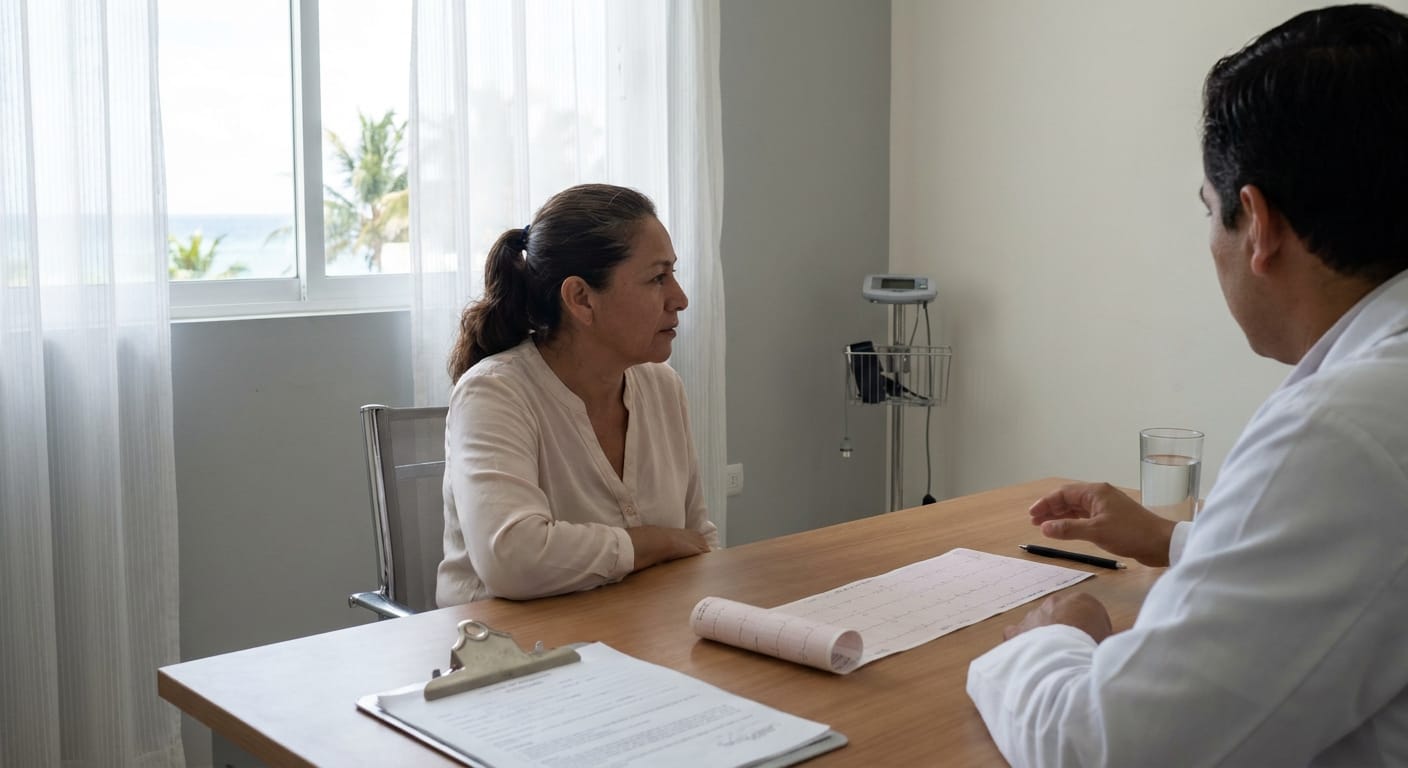
At Iboga Wellness Institute, physicians review a full set of heart, metabolic, and lab results before anyone is accepted, and the medical team, not admissions, makes the final decision. Screening is completed before anyone books travel.
Screening at Iboga Wellness Institute includes:
- A complete medical history and medication review, covering past detox attempts, mental health history, and any known heart problems
- A recent 12-lead ECG with QTc review
- A complete blood count (CBC)
- A comprehensive metabolic panel (CMP)
- Liver and kidney function, including AST, ALT, and bilirubin
- Electrolytes and magnesium
- An echocardiogram, cardiology clearance, or specialty evaluation when the person’s history calls for it
The QTc measures part of the heart’s electrical recovery between beats. Ibogaine can lengthen it, and a long QT raises the risk of a dangerous rhythm called Torsades de Pointes. At Iboga Wellness Institute, a QTc over 460 ms is the hard line. The general guideline is below about 450 ms for men and about 470 ms for women, and physicians review each case on its own. Electrolytes also affect heart rhythm, so physicians target potassium between 4.2 and 4.8 mmol/L and magnesium of at least 2.0 mg/dL.
Some medications can interact with ibogaine. When it is medically appropriate, Iboga Wellness Institute physicians work with the person’s prescribing providers on a taper or detox plan before treatment. Please do not stop any medication on your own.
Patient safety is placed ahead of the treatment itself.
Who makes the medical decisions, and who is declined?
The Iboga Wellness Institute medical team reviews every record, and the medical director gives final clearance on the day of dosing. Some people are declined for heart, liver, kidney, metabolic, or psychiatric reasons, or because of pregnancy, even when they very much want treatment.
The Iboga Wellness Institute team does not claim an ibogaine-specific certification. What it can describe is its process: physician review before acceptance, repeat testing on arrival, and a clearance decision that rests with the medical team alone. That matters most when depression, PTSD, grief, or trauma sits alongside substance use, because those details deserve careful clinical judgment.
The medical team may decline someone for any of these findings:
- A prolonged QTc, structural heart disease, uncontrolled arrhythmias, or new concerning ECG changes
- Significant liver or kidney disease, including cirrhosis
- Uncontrolled diabetes, or obesity combined with other risk factors
- Unstable medical illness or dangerous medication interactions
- Active psychosis or mania, certain bipolar presentations, or an acute suicidal crisis
- Pregnancy
In one case, shared here without identifying details, an applicant with type 2 bipolar disorder, significant obesity, and a QT reading at a concerning level was declined. The Iboga Wellness Institute medical director called the applicant personally and explained the medical reasons. The team’s practice is to put safety ahead of revenue, even when that means not admitting someone.
Iboga Wellness Institute does not treat serious cardiovascular conditions and does not provide emergency psychiatric care.
“Not yet” and “this may not be medically appropriate for you” are answers a responsible program has to be willing to give.
How does a residential stay work day to day, and how long does it last?
The standard stay at Iboga Wellness Institute is 7 days and 6 nights. Some people need a longer, individualized stay of 10 or 14 days because they require extra stabilization or a medically supervised transition.
Many conventional US residential programs last several weeks or longer. This stay at Iboga Wellness Institute is shorter because it is built around one closely monitored treatment, with integration support continuing after the person returns home. Medical readiness sets the length of the stay, not a calendar.
Here is how the stay unfolds:
- Arrival: The Iboga Wellness Institute team repeats the 12-lead ECG and runs labs when appropriate. A physician performs an exam, completes a final medication review, and orders a urine drug screen. If anything has changed, treatment may be postponed.
- Before the dose: The person has a second urine drug screen, electrolyte correction, IV magnesium, and another ECG. The medical director then decides whether to give final clearance.
- The flood dose: This lasts several hours on continuous cardiac telemetry. Nurses stay at the bedside, and a physician checks in every 2 to 4 hours.
- Monitoring: Close monitoring continues for at least 24 to 72 hours. In the first hour, staff focus on medical monitoring, comfort, hydration, and grounding. The integration team then listens and encourages journaling.
- The remaining days: These include daily medical evaluations, therapeutic support and integration sessions, chef-prepared meals, a Maya sweat lodge, and hydration infusions.
- Going home: Each person leaves with a personalized aftercare and integration plan, followed by weekly virtual sessions for at least the first 12 weeks.
Ibogaine is not a cure, and no ethical program can promise a particular outcome or that someone will not return to use. One Iboga Wellness Institute client, Zach, came to us after addiction had taken a great deal from his life. More than seven months later, he reports that he has returned to full-time work as a cook, that his family relationships have improved, and that he still takes part in weekly integration. His experience is his own and is not a typical result. He describes ibogaine as the start of a new chapter rather than the finish line, and he says the work after treatment matters.
An insight without action can become just another memory.
Does insurance cover it, and how do families plan cost and travel?
Insurance does not cover ibogaine, so treatment at Iboga Wellness Institute is self-pay. The program is essentially all-inclusive, with no hidden fees, and the price depends on accommodations.
Insurance still matters for other levels of care. Federal parity law requires many health plans to cover mental health and substance use care on terms no more restrictive than their medical benefits. Marketplace plans must cover substance use disorder services as well. If local PHP, IOP, or outpatient care is part of your plan, check those benefits first. Ibogaine treatment abroad falls outside that coverage.
A 50% deposit reserves dates at Iboga Wellness Institute, and the balance is due a few days before arrival. Families commonly use savings, home equity, retirement funds when appropriate, help from relatives, or third-party medical financing. Talk with a financial advisor before drawing on retirement accounts.
The Iboga Wellness Institute team arranges travel and Cozumel airport transportation. It also holds several pre-arrival meetings with medical, clinical, and concierge staff and walks each person through the arrival plan. Iboga Wellness Institute’s office in Cozumel, Q.R. handles admissions, screening, and aftercare coordination, and all ibogaine treatment takes place at its licensed medical clinic in Cozumel, Mexico.
Booking a flight does not guarantee treatment, because physicians reassess every person on arrival.
What else do families ask before choosing a facility?
Most remaining questions come down to ratings, heart tests, insurance, and legal status. Here are the direct answers.
Is Level 5 an official mental health facility rating?
No. When people ask “What is a level 5 mental health facility?”, the honest answer is that no national US licensing tier uses that name. Ask what care the facility actually delivers and how it screens.
What is the highest level of care in the national addiction care criteria?
Level 4, which is medically managed intensive inpatient care. Some programs use their own labels, so ask each one what its level means.
How does a medical conditions treatment program differ from addiction treatment?
Addiction treatment focuses on substance use and withdrawal. A medical conditions program puts the body’s own risks, such as heart rhythm, liver and kidney function, metabolism, and current medications, at the center of every treatment decision.
What is the difference between residential, PHP, and IOP?
Residential care includes overnight stays. PHP provides full-day care, and the person goes home at night. IOP provides a few hours of care several days a week.
What heart test results can keep someone from being accepted?
A QTc over 460 ms, structural heart disease, or uncontrolled arrhythmias can lead the Iboga Wellness Institute medical team to decline someone.
Does insurance pay for treatment at Iboga Wellness Institute?
No. Insurance does not cover ibogaine, so families rely on self-pay options and financing.
Is ibogaine treatment legal or FDA-approved in the United States?
No. Ibogaine is a Schedule I substance and not FDA-approved, so treatment abroad is investigational.
What should you send the physician team first?
Start with records, not a plane ticket. Whatever answer you find to “What is a level 5 mental health facility?”, the screening process is what you can examine most closely. Ask Iboga Wellness Institute for a medical screening review, and send a recent 12-lead ECG, recent labs, and a complete medication list. The physician team can then tell you whether your loved one may be accepted before you book any travel.
If you can get only one test this week, get the 12-lead ECG. The QTc on that tracing answers the first question a careful program has to ask.
Important legal and safety information: Ibogaine is not approved by the FDA and is not available as a legal medical treatment in the United States. Iboga Wellness Institute provides ibogaine treatment exclusively at its licensed medical clinic in Cozumel, Mexico, under medical supervision. US locations handle admissions, screening, and aftercare coordination only.
Ask Better Questions About Your Next Step
If the “level 5” label left you more confused than reassured, you are not alone, and it is reasonable to want clearer answers before choosing any facility. Our team can talk with you about what our Detoxification Program involves, how screening works, and what to ask any provider about care and safety. Treatment itself takes place at our licensed medical clinic in Cozumel, Mexico, and our admissions office is glad to walk you through it when you call.
- Experiences vary from person to person, and no outcome can be guaranteed.
- If someone is in immediate danger or thinking about suicide, call or text 988 or go to the nearest emergency room.
- Iboga Wellness Institute does not provide emergency psychiatric care.
- Ibogaine is a Schedule I substance in the United States, is not FDA-approved, and its use abroad is investigational and carries real risks.
- This article is for education and is not medical advice.