How Much Does Ibogaine Treatment Cost? Clear Answers Beyond “Ibogaine Treatment Tijuana Mexico”
You found three ibogaine clinics under $6,000, and when you asked what the price included, one said “the treatment,” another listed only the flood dose and a bed, and the third could not tell you who would be monitoring your heart during the 36 hours when ibogaine’s cardiac risk is highest. Maybe you typed “ibogaine treatment tijuana mexico” into a search bar after midnight, because that border city in Baja California is where many clinics cluster, and now you are staring at a spread of prices that make no sense next to each other. You are trying to answer one honest question: what does this actually cost at Iboga Wellness Institute, and does the number on the website match what the person you love will need to be safe?
We are Iboga Wellness Institute, and we treat exclusively at our licensed medical clinic in Cozumel, Mexico, with admissions and screening coordinated from our office in Columbus, Ohio. We wrote this to give you a straight answer, including the parts most clinics leave off the page.
What Does Ibogaine Treatment Actually Cost, and What Does That Number Include?
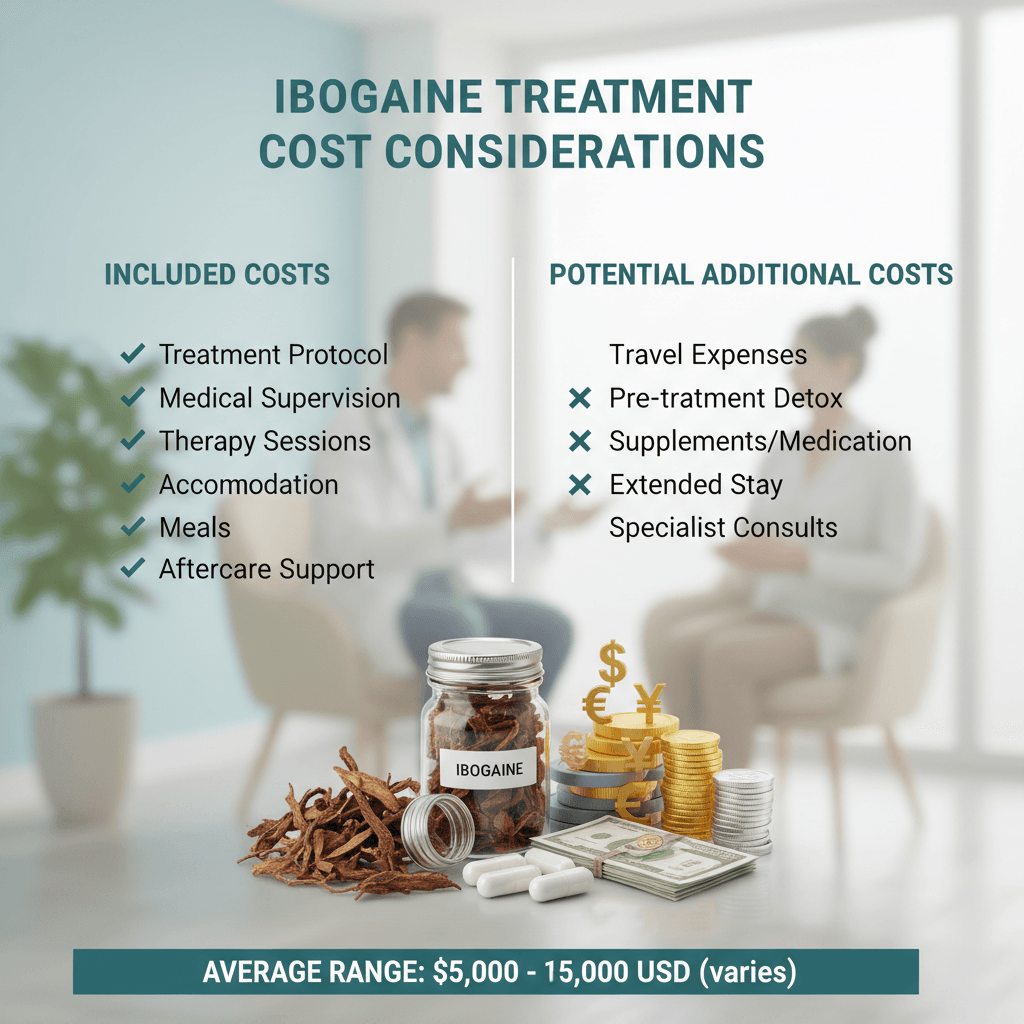
Iboga Wellness Institute’s standard 7-day Addiction & Substance Abuse program starts at $8,500. Longer or medically complex care is individually quoted and may exceed the published starting price. What catches families off guard is discovering how much that starting price actually covers compared to programs that bill piece by piece.
Here is what that single number covers. Before you ever travel, it pays for an extensive medical review: a 12-lead ECG and comprehensive bloodwork, including CBC, CMP, liver and kidney function, electrolytes, and magnesium. It covers repeat testing on arrival, because a lab from three weeks ago is not the same as your body on the morning of treatment, so we run the ECG and labs again, along with a physician exam, medication review, and a urine drug screen. It covers the flood dose itself at Iboga Wellness Institute under physician supervision, with 24-hour nursing care, continuous cardiac monitoring, IV access, electrolyte optimization, IV magnesium, and emergency medications on hand.
The number also covers the human parts that make the medicine hold. That means three preparation sessions before arrival, individual psychotherapy and integration work during the stay, private accommodations, chef-prepared meals, airport transportation, and a range of holistic therapies, massage therapy, a sweat lodge, yoga, somatic therapy, and IV nutritional support (Myers’ Cocktails). It covers structured integration sessions after you go home.
Cheaper programs are not always cheaper. Many advertise a low headline figure and then bill separately for labs, cardiac monitoring, medications, or integration, so the real total climbs on arrival, when you have the least power to say no. When you compare prices, you are not comparing the same thing until you know exactly what each one bundles.
Why the Medical Screening Before You Arrive Earns Its Place in the Price
The screening exists because ibogaine carries real cardiac risk, and the only way to manage that risk is to know your heart and your chemistry before the medicine is ever in your system. That is why every prospective patient completes a detailed medical history, medication review, laboratory testing, and a 12-lead ECG that evaluates cardiac rhythm and heart rate, QTc interval, electrolyte status, liver and kidney function, and CBC.
The targets are specific, not vague. We at Iboga Wellness Institute look for a QTc below roughly 450 ms in men and 470 ms in women, with a hard line at 460 ms, potassium in the 4.2 to 4.8 mmol/L range, and magnesium of at least 2.0 mg/dL, correcting reversible factors first. We repeat the ECG immediately before the flood dose. Findings that stop us include significant structural heart disease, uncontrolled arrhythmias, a prolonged QT interval, active psychosis or mania, and uncontrolled medical illness. Every acceptance decision is made by the medical team, not by admissions, and it is made by physicians who look at the whole clinical picture rather than a single checkbox.
This is where our standard becomes real instead of a slogan. We turn applicants away, even ones ready to pay, when the risk is too high, because safety will always come before filling a bed. We would rather lose a patient than compromise our standards. The screening process itself is designed to prevent tragedy rather than process paperwork, which means reading every ECG strip for arrhythmias, reviewing every medication for interactions, and calculating risk based on the complete person rather than their ability to write a check.
One person dependent on methadone arrived expecting to proceed on schedule. After reviewing his methadone use, medical history, medications, labs, and EKG, the team decided treating him on that timeline was not safe. Instead of forcing the plan to fit the calendar, they required a medically supervised transition and additional stabilization before ibogaine could even be reconsidered. A less careful provider might have focused only on his motivation and his willingness to endure withdrawal. Our Iboga Wellness Institute physicians looked at methadone exposure, QTc, cardiac risk, electrolytes, and drug interactions, and made the harder call.
What Happens During the Flood Dose, and Why Does Cardiac Monitoring Matter More Than the Room?
During the flood dose, you are under continuous cardiac telemetry with ICU-trained nurses at the bedside and a physician immediately available, with IV access already in place, electrolytes optimized, IV magnesium running, and emergency medications stocked. The comfort of the room matters far less than who is watching your heart and how fast they can act.
This is a physician-led program, not a retreat with a facilitator. Our Iboga Wellness Institute Chief Medical Director, Dr. Eduardo Rubio, is an anesthesiologist, a specialty built entirely around managing the body through high-risk physiological events. Dr. Lori Nation brings more than two decades in addiction medicine and psychiatry. The facility operates within the Mexican healthcare system with a relationship with COFEPRIS, the country’s federal health authority, and our protocols reference the magnesium co-administration approach studied in Stanford’s 2024 ibogaine research. Magnesium is not a garnish here. It is part of protecting the heart during the window when ibogaine’s cardiac effects peak.
Ask yourself the question we ask ourselves before every case: would we trust this with someone we love? That question sets the standard for the whole 36-hour high-risk window, and it explains why the monitoring is continuous rather than periodic.
It also explains a decision that cost us a completed program and disappointed a family who had traveled expecting a new chapter. One patient secretly used a narcotic during his stay and experienced a serious medical event. We told him and his family we could not continue treatment. That was not what anyone had paid for or hoped for, but safety came before finishing the plan. The person in front of us was someone’s son, and that mattered more than the schedule on paper.
The Integration Program That Supports What Happens After Treatment
The integration program is what turns a single treatment into a foundation for change, because the medicine may open possibilities, but recovery happens through the work a person does once they leave the clinic. Ibogaine is an intervention, not a complete solution, and any program that frames it as an automatic fix is oversimplifying the recovery process.
Many people arrive carrying traumatic experiences, depression, or alcohol dependence layered on top of the addiction that first brought them, and these underlying conditions are exactly what the integration work addresses over time. Our Iboga Wellness Institute post-treatment structure includes scheduled integration sessions with outcome assessments at one week, one month, three months, six months, and one year. Those checkpoints are not courtesy calls. They track how a person is actually doing over time, so early challenges can be identified before they become significant setbacks. The neurochemical changes ibogaine may create offer a window, not a permanent state. Behavior change work is what builds on that window.
The Iboga Wellness Institute integration team is made of licensed mental health professionals, led by Lindsey White, author of “The Crown and the Root.” Some of our team trained in psychedelic-assisted therapy through CIIS and MAPS-informed pathways. This is skilled clinical work aimed at helping a person build a life they no longer feel the need to escape from, one that may include rebuilt relationships, renewed purpose, and steadier health, though each person’s path will look different.
When you compare the price of ibogaine against the cost of repeated 30-day admissions or maintenance medication that never ends, the year of structured follow-up is often the part that changes the math. We are not promising a single solution. We are building the scaffolding that supports a person’s continued recovery work.
Why “Ibogaine Treatment Tijuana Mexico” Searches Lead to the Border, but This Program Treats in Cozumel
People search “ibogaine treatment tijuana mexico” because Tijuana, in Baja California, became an early hub for these clinics, but Iboga Wellness Institute treats exclusively at its licensed medical clinic in Cozumel, Mexico. Treatment happens outside the United States for one plain reason: ibogaine is a Schedule I controlled substance here and is not FDA-approved, so it cannot be legally administered in Ohio or any other state.
That legal reality is not something we hide, and you should be wary of any program that blurs it. Our Iboga Wellness Institute Columbus, Ohio office handles admissions, medical screening coordination, and aftercare follow-up. It is not a place where treatment happens, because it legally cannot be. All ibogaine care takes place in Cozumel, and the Columbus team exists to walk you through screening, review your records, and stay with you after you come home.
Your total budget needs to account for travel costs beyond the program fee itself. For families in Columbus and across Ohio, plan for flights, passports, and a companion’s travel if someone is coming along. We would rather you see that number honestly now than discover it later. Transparency about cost and logistics is part of the same standard we hold for medical safety, because a family cannot make a sound decision on incomplete information.
How Do You Compare Ibogaine Programs Without Getting Sold, or Hurt?
You compare programs by asking the questions that expose safety gaps and hidden cost, and by watching how quickly and clearly each clinic answers them. A program that gives you vague answers about your heart is telling you something important.
Ask these directly. Who monitors the heart during the flood dose, with what equipment, and for how long? What are the physician’s actual credentials and specialty training? What happens if the labs come back abnormal, and will the clinic delay or refuse treatment? What is included in the quoted price, and what gets billed separately once you arrive? What is the integration structure, how long does it run, and how does the team track whether clients stay engaged?
The answers tell you what the price really buys. A clinic that treats anyone who can pay is prioritizing revenue over the person, and with ibogaine that trade can be dangerous. A clinic willing to turn away a paying applicant is showing you where its priorities sit. That is not a marketing posture for us, it is the reason two of our hardest decisions ended with a family going home without the treatment they came for.
When a headline price sounds too low, the difference usually shows up as something removed: the pre-arrival cardiac workup, the ICU-trained nurse at the bedside, the physician who can act in seconds, or the year of integration that supports continued recovery. We are building more than a treatment center, and the price reflects that. Cheaper options may work differently if the person’s medical conditions allow for less intensive care.
Common Questions Families Ask About Ibogaine Treatment Cost
Does insurance cover ibogaine treatment?
No United States insurer covers ibogaine, because it is a Schedule I substance and not FDA-approved. We operate on a private-pay basis. Iboga Wellness Institute’s standard 7-day Addiction & Substance Abuse program starts at $8,500. Longer or medically complex care is individually quoted and may exceed the published starting price. Your Columbus admissions contact can walk you through the full cost before you commit.
Why is ibogaine treatment in Mexico instead of the United States?
Ibogaine’s Schedule I status and lack of FDA approval make it illegal to administer in any US state. Legal treatment happens at the Iboga Wellness Institute licensed clinic in Cozumel, Mexico, while the Columbus, Ohio office handles admissions, screening, and aftercare coordination only.
What is included in the $8,500 Addiction & Substance Abuse program starting price?
The Iboga Wellness Institute published starting price covers pre-arrival and on-arrival medical screening, the physician-supervised flood dose with 24-hour cardiac monitoring, private accommodations, chef-prepared meals, airport transportation, holistic supportive therapies (massage, yoga, somatic work, IV Myers’ Cocktails), and structured integration sessions tracked through one year.
Can I be turned away even if I can pay for ibogaine treatment?
Yes. The Iboga Wellness Institute medical team refuses treatment when cardiac or psychiatric risk is too high, even for paying clients. Safety will always come before filling a bed, and every acceptance decision is made by physicians, not by admissions staff.
How long does ibogaine treatment take?
The Iboga Wellness Institute on-site program runs seven days and six nights. Plan also for pre-arrival screening in the weeks before, travel time to Cozumel, and structured integration sessions that continue at one week, one month, three months, six months, and one year after treatment.
What makes ibogaine treatment cost more than traditional rehab?
Physician-led cardiac monitoring, extensive pre-treatment screening, 24/7 ICU-trained nursing during the flood dose, international clinic operations, and year-long integration follow-up drive the cost above typical 30-day programs, which do not carry the same medical intensity or ongoing tracking.
Take the Next Step With a Clear Number in Hand
Call the Columbus admissions office at Iboga Wellness Institute to begin the pre-arrival medical screening process, review your specific cardiac and psychiatric history with the medical team, and receive a transparent cost breakdown for the seven-day program in Cozumel. Before you send a deposit anywhere, ask that clinic one question ours will answer without hesitation: who will be watching this heart, minute by minute, for the full 36 hours, and what happens if something goes wrong. The answer to that question is worth more than any headline price.
Important legal and safety information: Ibogaine is not approved by the FDA and is not available as a legal medical treatment in the United States. Iboga Wellness Institute provides ibogaine treatment exclusively at its licensed medical clinic in Cozumel, Mexico, under medical supervision. US locations handle admissions, screening, and aftercare coordination only.
Ready to Learn What Your Treatment Investment Includes?
If cost has been holding you back from exploring ibogaine therapy, you’re not alone in weighing this decision carefully. Our team at Iboga Wellness Institute can walk you through the specific components of our Cozumel program and help you understand what’s included in your investment. Whether you’re in the Columbus area or calling from elsewhere, we’re here to answer your questions about pricing, travel arrangements, and how our medically supervised detoxification program might fit your situation.
Individual responses to ibogaine vary, and no medical intervention can promise identical results for every person who receives it.