
Understanding ibogaine treatment duration
When you start exploring ibogaine for addiction treatment, one of the first questions you probably have is about ibogaine treatment duration. You want to know how long you will be away from home, how intense the experience will be, and how much time you should plan for recovery afterward.
Ibogaine treatment is not a quick, single‑hour procedure. It unfolds across several distinct phases over days and, in some programs, a full week or more. Your ibogaine treatment duration will depend on the type of program, your health, the substances you are using, and how much support is built in for medical monitoring and integration.
Understanding these phases helps you set realistic expectations and choose a program that aligns with your needs. You can also explore related guides such as the length of ibogaine detox program and how many days ibogaine treatment takes for more detailed comparisons.
Key factors that affect how long treatment lasts
Before looking at specific timelines, it helps to understand what shapes ibogaine treatment duration. No two programs are identical, but several common factors influence how long you will stay.
Your current substance use plays a major role. Programs typically look at what you are using, for how long, at what doses, and whether you are taking multiple substances. Clinical programs that treated people between 2012 and 2015 adjusted ibogaine dosing according to patient weight and the severity of polysubstance use, often within a range of about 15 mg/kg plus or minus 5 mg/kg, and paired this with continuous cardiac monitoring and psychological support during a roughly one week residential stay [1]. Higher complexity can mean more time is needed for safe preparation and observation.
Your medical and psychiatric history also shapes the schedule. Heart conditions, certain medications, and co‑occurring mental health issues can all require extra screening, slower pacing, and a longer on‑site stay for safety. A thorough intake often extends the practical duration of your ibogaine therapy program, but it also lowers risk.
Program philosophy and level of care are another major factor. Some centers focus on the core three‑day ibogaine experience itself, while others offer a more comprehensive one week residential model with ongoing monitoring, psychological support, and structured integration. As you compare options, you will see this reflected in the advertised ibogaine therapy length of stay and the described ibogaine program schedule explained.
Finally, your personal goals influence duration. If you want not only detox but also deeper psychological work, relapse‑prevention planning, and help rebuilding daily routines, you will usually benefit from a longer program or a structured aftercare plan once you leave the clinic.
The core ibogaine experience timeline
Despite differences between programs, the psychedelic and detox experience itself tends to follow a similar pattern. This is the heart of what most people mean when they ask how long ibogaine treatment lasts, and it usually unfolds across roughly three days.
Day 1: Preparation and dosing
On the first day of active treatment, you typically complete final checkups, lab reviews, and medical clearance. Staff confirm that your heart, liver, and other systems can safely tolerate ibogaine. Your team also reviews your intentions for the session and walks you through what to expect.
Once you are cleared, you receive your ibogaine dose. In clinical settings, this has often been administered as ibogaine hydrochloride, with individualized dosing based on body weight and substance history, along with live cardiac monitoring and continuous support from medical and psychological staff [1]. You are usually asked to lie down in a comfortable, quiet room with minimal stimulation and to keep your eyes closed as the experience begins.
Within a short period of time, you enter what many programs call the acute or flood phase. This early stage often includes vivid waking dreams, strong visual imagery, and an intense inward focus. Research suggests that this acute phase usually lasts around 4 to 8 hours, within a broader 12 to 36 hour window that encompasses the full psychedelic arc [1]. During this time, staff watch your vital signs closely, help you stay physically safe, and reassure you as needed.
Day 2: Evaluative and reflective phase
After the peak, the experience gradually shifts into what is sometimes described as the evaluative phase. This usually occurs between about 8 and 20 hours after dosing and can extend into the second day. You may feel less overwhelmed by visuals and more able to reflect on memories, patterns, and relationships.
Many people describe a powerful sense of personal insight in this phase. You might revisit key life events, see connections between past experiences and your substance use, or feel a new understanding of how you want to live moving forward. Clinical observations describe this period as one of increased personal insight, often followed by an emerging sense of calm and clarity as the hours pass [1].
Physically, you may still feel very tired or unsteady. Even though the most intense visuals are fading, it is usually recommended that you continue to rest in bed, limit movement, and remain under observation. You are not ready to travel or resume normal activities yet, and your care team continues to monitor your heart, hydration, and overall stability.
Day 3: Residual, drained yet often clearer
As you move further from the initial dose, you enter a residual phase that can begin 12 to 24 hours after dosing and may last one to three days in total. Many people report a sense of mental calm, reduced anxiety, and a quieter mind, even as the body still feels drained or weak [1].
Practical accounts from treatment experiences describe the peak psychedelic portion as roughly 12 hours, with a typical ibogaine treatment experience lasting about three days altogether [2]. After that intense first half day, it is common to need about two more days of rest, as your body recovers and your mind continues processing. You may feel too wired to sleep deeply, even though you are physically exhausted.
People often report that ibogaine rapidly reduces or even eliminates acute opioid withdrawal symptoms during this short treatment window. In one study of 88 patients treated in Mexico, 80 percent said ibogaine eliminated or drastically reduced their opioid withdrawal symptoms quickly during that treatment week [1]. Others share that cravings may stay low for weeks or months after the three‑day experience [2]. Even so, this does not mean your recovery is complete when the visuals end, and this is where the broader ibogaine treatment duration matters.
One week residential ibogaine programs
Many medically supervised ibogaine programs expand beyond the three‑day core experience into a full week of residential care. This format is designed to balance detoxification, safety, and early integration, rather than framing ibogaine as a single night event.
From 2012 to 2015, one Mexican ibogaine clinic delivered treatment as a one week residential program. Patients stayed on site for about seven days, received individualized ibogaine hydrochloride dosing, and were supported with continuous medical heart monitoring and psychological care throughout their stay [1]. This extra time allowed for careful observation before dosing, intensive monitoring during the psychedelic phases, and supportive follow‑up afterward.
This kind of one week model typically includes several distinct phases:
- Pre‑dose assessments and medical clearance
- The ibogaine dosing day and overnight monitoring
- One to two days of close post‑dose observation
- Initial integration support, group or individual sessions, and planning for next steps
Programs built on this structure emphasize that ibogaine is only one part of a multi‑day process. Staff have time to adjust medications, track sleep and mood, address emerging psychological material, and begin relapse‑prevention work. If you want a clear sense of what a week might involve, resources such as the ibogaine therapy program timeline and duration of ibogaine therapy program can be useful.
Longer term follow‑up data from the same residential model found that about 30 percent of participants never returned to opioid use after treatment, and more than half of those who stayed abstinent did so for at least one year [1]. These outcomes suggest that the combination of an intensive but time‑limited ibogaine experience with a structured, week‑long care environment can support meaningful change, although results always vary and there is no guarantee.
How detox and monitoring shape total program length
Ibogaine’s ability to rapidly reduce opioid withdrawal can make it feel like a shortcut. In reality, the detox process is complex, and effective programs build in targeted time for stabilization and observation both before and after dosing. This is where the practical ibogaine detox program length comes into focus.
For many people, the days immediately before ibogaine are used to taper or transition from certain substances, adjust medications that may interact with ibogaine, and address dehydration, nutrition, and sleep. If you arrive medically unstable, a program may extend your pre‑dose stay to reduce risk. This can add several days to your overall ibogaine treatment duration.
After dosing, ongoing monitoring continues. Even if your withdrawal symptoms are dramatically reduced, your cardiovascular system, liver, and nervous system have still navigated a significant stressor. That is why residential programs often recommend at least a few extra days on site, even after it feels like the hardest part is behind you. When you review information on how long ibogaine treatment lasts, pay close attention to how much time is devoted to these pre‑ and post‑dose windows.
The balance between detox length and safety is key. A program that rushes you into ibogaine without adequate screening may shorten your stay but increase your risk. A slightly longer length of ibogaine detox program can create a safer, more stable foundation for the medicine to work.
Why integration and aftercare extend the real timeline
Ibogaine’s direct psychedelic and detox effects are time‑limited, but the psychological and behavioral changes you are aiming for unfold over weeks and months. Many experienced providers describe ibogaine as a catalyst rather than a cure. It can stave off withdrawals, reset certain aspects of brain function, and open a window for deep introspection, yet it does not replace the daily work of recovery [3].
Right after treatment, you may enter a period of heightened neuroplasticity, meaning your brain is temporarily more flexible and open to forming new habits and patterns. Some ibogaine‑informed aftercare programs deliberately use this window to introduce healthier routines, structured therapy, and supportive practices designed to “lock in” new ways of living [3]. Although these services may not be on the same campus as your ibogaine provider, they extend the functional duration of your recovery process.
Integration work can include a wide range of elements, such as:
- Gentle physical detoxification and revitalization practices like sweat lodges, herbal teas, plant‑based supplements, and body therapies
- Emphasis on a healthy diet, movement, and sleep hygiene
- Occasional, carefully considered ibogaine booster doses when appropriate
- Limits on technology and substance use, including reduced phone access, avoidance of processed or sugary foods, and controlled use of safer alternatives like loose organic tobacco instead of regular smoking [3]
Life planning and transition support are also essential. Good aftercare includes help clarifying your direction, strengthening your support network, and arranging a safe environment to return to once you leave structured care [3]. When you consider how long recovery takes after ibogaine, it is useful to think not only in days, but in months of steady follow‑through.
Typical program durations compared
To put these pieces together, it can help to see how different types of ibogaine treatment durations commonly look in practice.
| Program type | On‑site duration | Core ibogaine phase | Focus |
|---|---|---|---|
| Minimal stay | About 3 days | 12 to 36 hours of acute plus residual experience | Basic detox and safety, limited integration |
| Standard residential | About 1 week | 3‑day core within 7 days on site | Medical monitoring, psychological support, initial integration [1] |
| Extended plus aftercare | 1 week on site plus weeks to months of external support | Same 3‑day core experience | Long‑term lifestyle change, therapy, and relapse‑prevention planning [3] |
This table reflects typical patterns, not strict rules. Your actual ibogaine therapy program timeline may differ based on your medical profile, goals, and the philosophy of the provider you choose.
Setting realistic expectations for your timeline
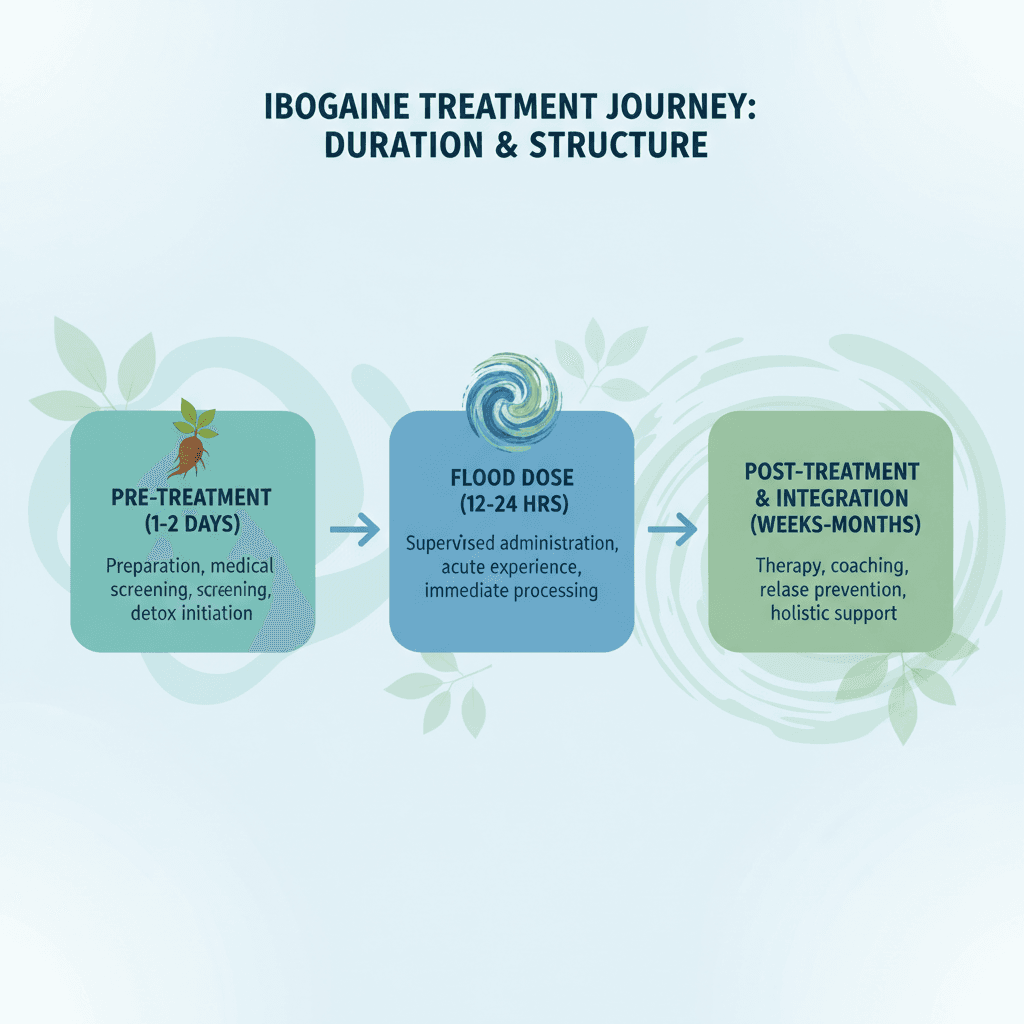
As you evaluate options and plan your life around treatment, it can be helpful to think in layers. The core psychedelic and detox experience usually spans about three days. The total time you are in a residential program is often closer to one week. Your broader recovery journey unfolds across many months.
The most accurate answer to how long your ibogaine treatment duration will be comes from combining all three:
- The intensive 12 to 36 hour psychedelic experience with 3 days of close rest and monitoring
- A surrounding 3 to 7 day residential stay that includes screening, stabilization, and initial integration
- A longer phase of aftercare and lifestyle change that can continue well beyond your time in any facility
When you speak with prospective programs, ask specifically about pre‑treatment requirements, how many nights you will stay, what kind of integration support is included, and what they recommend for follow‑up. Comparing their answers to resources like ibogaine detox program length and ibogaine therapy length of stay can help you see how your needs line up with what each center offers.
By understanding each phase and planning enough time for them, you give yourself a better chance to fully benefit from ibogaine’s potential and to translate a powerful short‑term experience into lasting change.