
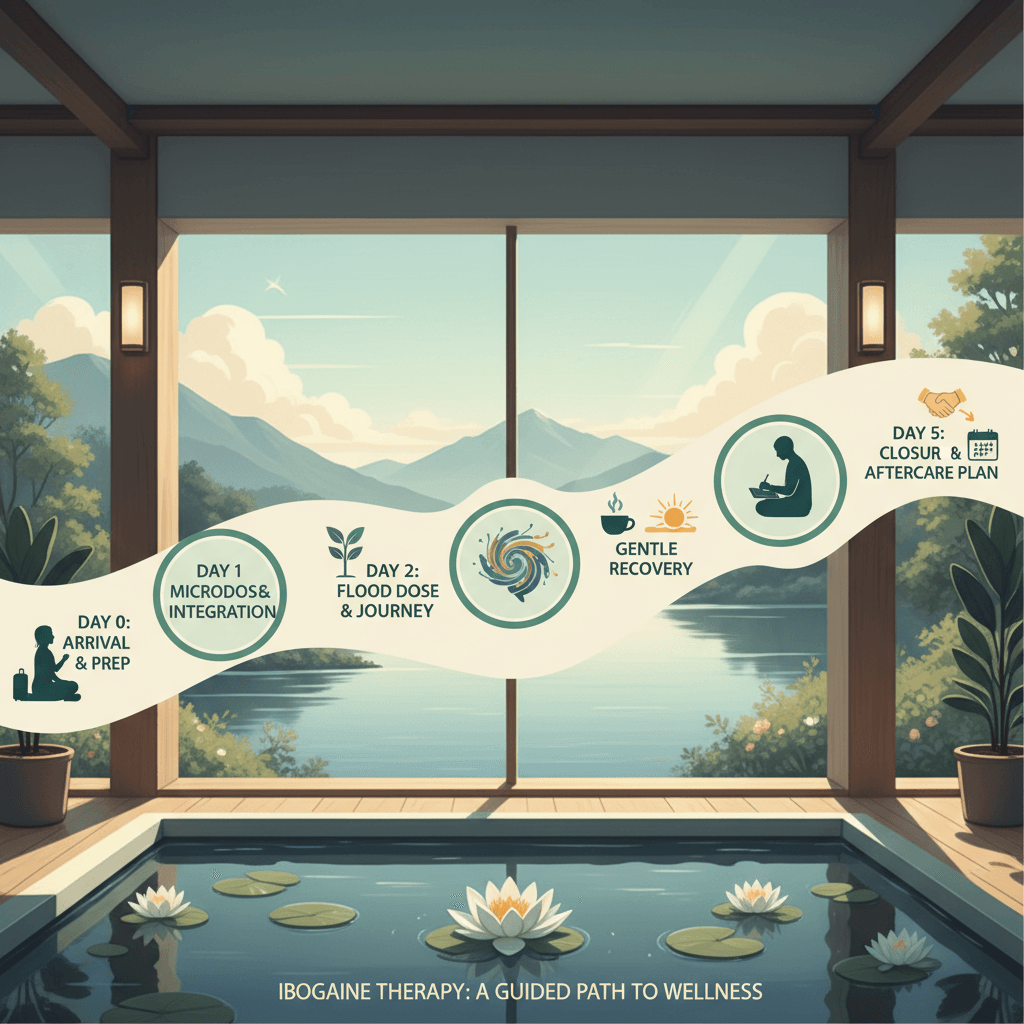
Why ibogaine treatment length matters
If you are looking into ibogaine for addiction, one of your first questions is probably how many days ibogaine treatment takes and how long you will be away from work, family, or other responsibilities. The answer is more than just a number of days. It is about understanding the phases of treatment, how long the medicine affects your body and mind, and how much time you realistically need for detox, medical monitoring, and early integration.
Clinical and observational reports show that the core ibogaine experience unfolds over several days, but effective healing usually involves a structured program that lasts about a week or more, not just a single dosing session [1]. By understanding the full ibogaine therapy program timeline, you can choose a setting that keeps you safe and gives you enough support to stabilize before you return home.
In this guide, you will explore how long ibogaine treatment typically lasts, what happens on each day, and why extended observation and integration support matter for long‑term recovery outcomes.
Core ibogaine experience length
When people ask how many days ibogaine treatment takes, they are often thinking about the dosing day itself. The psychedelic and detox phases of ibogaine are intense but relatively short. Most reports show a pattern that unfolds over 1 to 3 days, followed by additional days of recovery.
Typical 3‑day treatment arc
One common way to describe the ibogaine experience is as a roughly three‑day process from dosing through the most acute recovery:
- The peak ibogaine experience, with vivid, dreamlike inner visions, usually lasts around 12 hours. People generally spend this time lying down with their eyes closed and may feel unable or unwilling to move around much [2].
- After the peak, you are often physically drained and need about two more days of rest. Your mind may still feel very active, and it can be hard to sleep even though your body is tired [2].
- Overall, the treatment session, including the acute psychedelic phase and the immediate recovery phase, tends to span around three days from start to finish [2].
During this window you might face fears, trauma, and painful memories that arise in the visionary portion of the experience. This psychological work usually concentrates in that first 12‑hour period but can continue to resonate throughout the three‑day arc [2].
Because the acute experience and early recovery blend together, it can feel like one long, extended session rather than clearly separated days.
Phases of ibogaine effects
To understand how ibogaine treatment duration works in practice, it helps to look at the phases of the medicine itself. A single full dose of ibogaine often produces several distinct stages that unfold over one to three days [3].
Visionary phase
In the first 4 to 8 hours after dosing, many people enter a visionary or oneirogenic (dreamlike) state:
- You are usually awake but lying down with eyes closed.
- You may see vivid images from your past, symbolic scenes, or emotionally charged stories.
- Physical movement usually feels difficult, and you are monitored closely by medical staff [1].
This is where much of the psychological intensity occurs, including confronting fears and traumatic memories within the three‑day treatment window [2].
Evaluative and introspective phase
After the initial visions begin to fade, you typically move into a more reflective phase that can last 8 to 20 hours or longer:
- Sensation and perception start to feel more normal.
- You may review the material that came up earlier and gain insights or new perspectives.
- You can often talk quietly with staff, but you are still in active treatment, and walking or standing up may feel unstable [4].
This evaluative phase is a key part of the treatment. You are not simply recovering from a drug experience. You are sorting through what you saw and felt, often with the support of therapists or trained staff.
Residual stimulation and early recovery
After about 24 to 36 hours, the acute psychedelic effects usually resolve, but milder symptoms can continue for another 24 to 72 hours [4]:
- Residual stimulation, insomnia, or restlessness
- Possible nausea or headaches
- Mood swings, irritability, or short‑term depressive feelings
This residual phase is one reason why you are typically monitored for at least 1 to 3 days after ibogaine administration. Clinical reports note that withdrawal symptoms for opioids often resolve within 24 to 72 hours post‑treatment, which fits the same overall time frame [4].
Even when the most intense part is over, you have not fully returned to baseline. You still benefit from a controlled environment and medical oversight.
In many programs the full arc of acute effects, introspection, and lingering stimulation extends over several days after a single dose, even though the most intense visions may only last for 4 to 12 hours [3].
Program options by length
While the medicine follows a biologically driven timeline, ibogaine therapy programs structure your stay to add safety, preparation, and integration around that core 1 to 3 day window. When you ask how many days ibogaine treatment takes, you are really asking how long the entire program lasts, not just the dosing session.
Single‑day and 2‑ to 3‑day treatment formats
Some centers describe their ibogaine hydrochloride session as a focused 6 to 12 hour treatment:
- The actual dosing and peak effects take place in one intensive day.
- Many patients then need an additional one or two days to recover before they feel ready to move forward on their sobriety journey [5].
In marketing language, this can sound like a “one day” treatment. In practice, you should plan on at least several days from intake through early recovery. You also need time beforehand for medical evaluation and possible pre‑detox, which adds more days to the total ibogaine detox program length.
One‑week residential programs
A more comprehensive model is a residential program lasting about one week. For example, a clinical protocol in Mexico used a one‑week residential stay that included:
- Pre‑treatment physical examinations and screening
- The ibogaine dosing session itself, which lasted between 12 and 36 hours
- Continuous cardiac and vital sign monitoring during and after dosing
- Several days of post‑treatment observation and psychological support [1]
Although the acute ibogaine effects were concentrated within 1 to 3 days, the total ibogaine therapy length of stay at the facility was structured as approximately one week [1].
This model gives you:
- Time to stabilize medically before going home
- Opportunities for initial therapy and relapse‑prevention planning
- A safer buffer in case side effects last longer than expected
When you review any ibogaine therapy program timeline, notice whether it builds in this kind of pre‑care and aftercare, not just the dosing night.
Comparing treatment timelines
You can think of the different layers of ibogaine treatment duration in three overlapping time frames:
| Time frame | What it usually includes | Typical length |
|---|---|---|
| Acute dosing and peak experience | Visionary and evaluative phases, intensive monitoring | 6 to 36 hours [6] |
| Early recovery and residual effects | Rest, stabilization, resolution of withdrawal symptoms | 1 to 3 days total from dosing [7] |
| Full residential program | Screening, dosing, monitoring, psychological support | About 1 week for many structured programs [1] |
Understanding these layers can help you sort out what different clinics mean when they talk about ibogaine treatment duration or advertise a “rapid detox” process.
Why extended observation is important
It can be tempting to look for the shortest possible ibogaine detox program length. However, clinical reports emphasize that the medicine carries real medical risks and that extended observation is a safety requirement, not a luxury.
Medical monitoring over several days
Ibogaine can affect heart rhythm and blood pressure. Rigorous clinical oversight over multiple days is needed to monitor and manage potential side effects [8]:
- Before dosing, you need a medical exam and cardiac screening.
- During dosing, you need continuous or frequent monitoring of heart rate, blood pressure, and oxygen saturation.
- After dosing, you still need monitoring for at least 24 to 72 hours because acute effects and residual stimulation can persist.
The one‑week residential model used in the Mexico study was designed specifically to wrap this oversight around the dosing session and its after‑effects [1].
If you are reviewing different programs, look at how they define the ibogaine treatment duration in terms of actual monitored time on‑site. Ultra‑short stays or outpatient dosing without adequate observation can increase medical risk.
Detox and withdrawal resolution
Another reason extended observation matters is detox. For opioid and alcohol use, ibogaine is often administered in a single full hallucinogenic dose that aims to interrupt withdrawal. Clinical studies have reported that opioid withdrawal symptoms often resolve within 24 to 72 hours after ibogaine treatment [4].
During this time you may experience:
- Fluctuating comfort levels as your body resets
- Changes in sleep patterns, appetite, and mood
- Periods of fatigue alternating with stimulation
Being in a monitored environment through this 1 to 3 day detox arc gives you:
- Medication support for nausea, insomnia, or pain when appropriate
- Reassurance that your vital signs remain stable
- Professional help if withdrawal symptoms become unexpectedly severe
This is why any realistic assessment of length of ibogaine detox program will go beyond the hours on the medicine itself and include days of structured clinical support.
Integration and recovery time after dosing
Even once you are medically stable enough to leave a facility, your ibogaine journey is not finished. The question is not only how many days ibogaine treatment takes on site, but also how long recovery continues once you return home.
Psychological integration
Because the ibogaine experience can be difficult to put into words, many providers encourage you to journal or record your visions and insights during the days afterward. This helps you remember details that might fade and supports long‑term integration [2].
In the first days and weeks:
- You may feel mentally stimulated but physically drained.
- Old memories and themes from the session can keep resurfacing.
- You might have new clarity about your life, relationships, or triggers.
Having a plan for therapy, peer support, and lifestyle changes gives these insights a place to land. Reviewing resources on how long recovery takes after ibogaine can help you set realistic expectations for this phase.
Fatigue and readjustment
Physically, you may need several days to a few weeks to feel fully back to your usual energy level:
- Sleep can remain irregular.
- Focus and concentration may come and go.
- Emotional sensitivity is common.
Even though the core ibogaine program schedule is usually measured in days, it is wise to allow more time in your calendar for gentle reintegration. Many people benefit from:
- A reduced work schedule for at least a week after returning home
- Extra support from family or trusted friends
- Continued medical follow up with a local provider
Thinking of ibogaine as the start of a recovery process, rather than the whole process, can help you make better decisions about your overall duration of ibogaine therapy program and the supports you line up afterward.
Planning your stay and schedule
When you look at different ibogaine options, you will see a range of timelines and promises. To decide what fits you, it helps to break the total time commitment into stages.
Before you travel
In the days or weeks before arriving at a clinic, you may need:
- Medical evaluations, like EKG and blood work
- Adjustments to current medications
- A taper or stabilization plan if you are on opioids or benzodiazepines
Some programs help coordinate this remotely. Others perform most screening after you arrive, which may lengthen your ibogaine therapy length of stay by a few days.
On‑site timeline
A realistic ibogaine program schedule explained might look something like:
- Day 1: Arrival, intake, medical screening, and orientation
- Day 2: Final clearances, pre‑medication, and rest
- Day 3: Ibogaine dosing and start of acute experience
- Day 4: Continuing acute and evaluative phases, close monitoring
- Day 5: Residual stimulation, early integration, light therapy or coaching
- Day 6: Ongoing recovery, discharge planning, and relapse‑prevention work
- Day 7: Final check, transition plan, and travel home
This is only one example, but it reflects the one‑week structure used in clinical settings where ibogaine‑assisted detoxification takes place in a residential environment with medical and psychological support before, during, and after dosing [1].
When you compare how long ibogaine treatment lasts across different providers, ask them to walk you through each day in similar detail so you know exactly what to expect.
Choosing the right length for you
Ultimately, how many days ibogaine treatment takes for effective healing depends on your health, substance use history, and support system. However, you can use several general guidelines as you decide.
Shorter formats that emphasize a single 6 to 12 hour session may fit people with:
- Strong medical stability
- Limited withdrawal risk
- Robust support and treatment lined up at home
More extended stays of around one week or longer are often better for people who:
- Have complex medical or psychiatric histories
- Are detoxing from opioids, alcohol, or multiple substances
- Need time to stabilize and plan next steps before returning to daily life
As you evaluate your options, it can be helpful to read through resources such as how long ibogaine treatment lasts and ibogaine detox program length so you understand how different programs structure length and support.
By looking beyond the dosing night and focusing on the full arc of preparation, dosing, medical monitoring, and integration, you give yourself a clearer view of what ibogaine can realistically offer and how much time you need to protect your safety and your recovery.