
Understanding ibogaine treatment laws
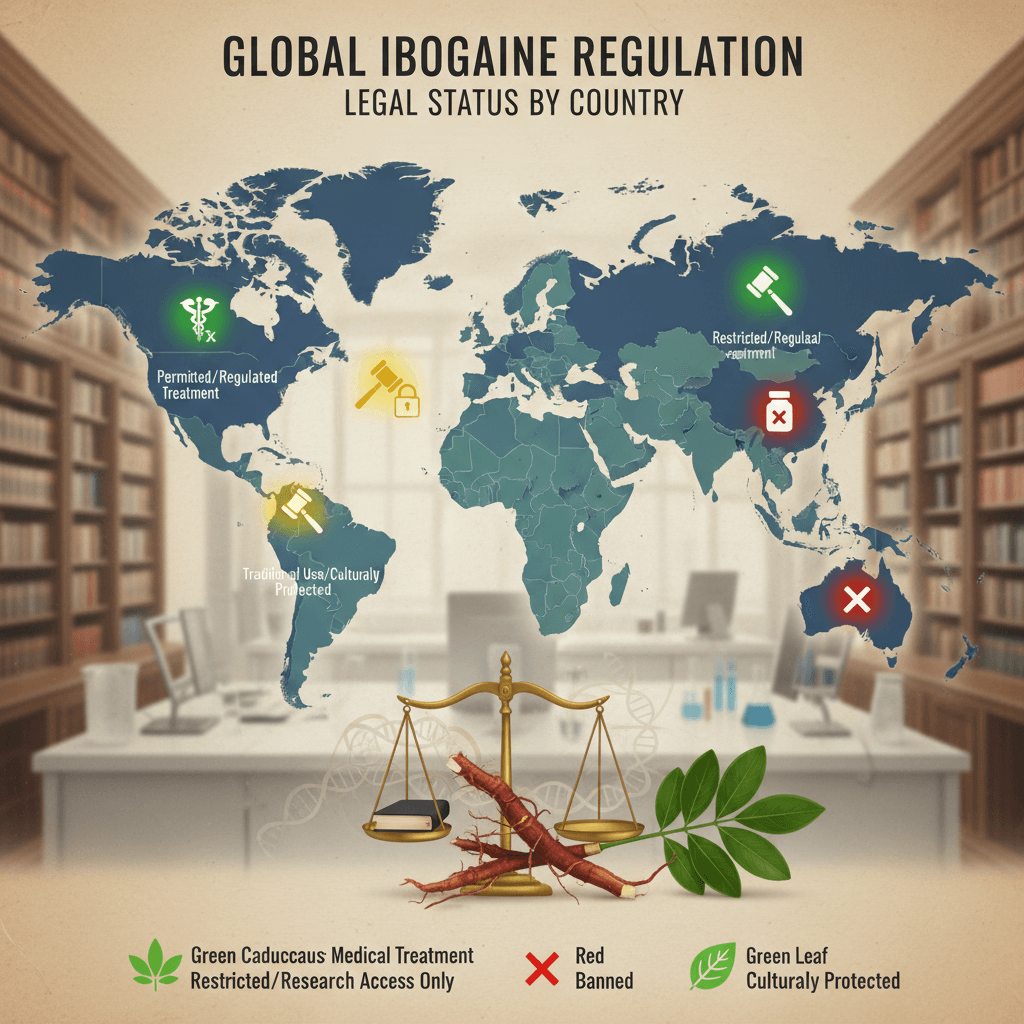
If you are exploring ibogaine as a potential treatment, understanding ibogaine treatment laws is essential for both your safety and your legal protection. Ibogaine has a complex legal status worldwide, and the rules in one country can be very different from those in another.
You will see ibogaine described as a promising option for addiction treatment, especially for opioid use disorder. At the same time, you may read about serious medical risks and strict regulations that limit access. Both of these realities are true. Your goal is to navigate between them in an informed, careful way.
Before you make any decision, it helps to be clear on three things: how ibogaine is regulated, why many ibogaine clinics operate outside the United States, and what legal responsibilities you have if you travel for treatment. Resources like ibogaine treatment legality explained and ibogaine regulation worldwide can also support your research as you read through this guide.
Why ibogaine is heavily regulated
Ibogaine is a psychoactive substance derived from the root bark of the African shrub Tabernanthe iboga. It has been used traditionally in West and Central Africa in spiritual and initiation ceremonies.
In modern times, ibogaine drew attention because of reports that a single treatment could sharply reduce withdrawal symptoms and cravings in people with opioid and other substance use disorders. However, regulators across the world have focused just as much on the risks as on the potential benefits.
Safety concerns and medical risks
You need to understand that ibogaine is not a benign medicine. Multiple regulatory bodies highlight serious safety issues, especially related to the heart.
Clinical and case reports have documented:
- Sudden cardiac death and life threatening complications, often linked to ibogaine use in people with pre existing health conditions or concurrent opioid use [1]
- Toxicity that requires strict medical supervision, careful patient selection, and continuous monitoring during treatment [1]
A clinical study in the Netherlands followed 14 opioid dependent patients who received a single 10 mg/kg dose of ibogaine hydrochloride. Researchers found:
- Clinically relevant but reversible QTc prolongation in every participant
- Half of the patients had QTc intervals over 500 ms, which is associated with a higher risk of potentially fatal cardiac arrhythmias [2]
Even though no episodes of torsades de pointes were observed in that 24 hour monitored period, the authors strongly advised that ibogaine administration be restricted to well controlled medical settings with strict cardiac monitoring, and specifically warned against underground or unsupervised use [2].
Given these cardiovascular concerns, the same authors questioned whether presumed clinical benefits outweigh the risks and recommended that ibogaine treatment laws be built around tightly regulated, medically supervised use rather than informal or unregulated access [2].
This risk profile is one of the main reasons ibogaine is prohibited or tightly controlled in many countries, and why your choice of setting and medical supervision matters more with ibogaine than with most other therapies.
Limited clinical research and Schedule I classification
Regulators are also responding to a lack of large, controlled clinical trials. According to reviews cited by the US Drug Enforcement Agency and medical references, no formal controlled clinical studies have been completed that fully establish ibogaine’s effectiveness and safety profile. Its classification as a Schedule I substance in the United States significantly restricts research and clinical use, even though there are many anecdotal and observational reports of anti addictive effects [1].
This combination of potential benefit, demonstrated risk, and limited high quality data explains why ibogaine laws look very different across countries. Some nations prohibit it completely, some allow narrow medical use, and others leave it largely unregulated but still subject to general health and consumer protections.
If you want more on the historical and policy reasons behind this, you can visit why ibogaine treatment is not legal in the us and is ibogaine legal.
Ibogaine treatment laws in the United States
If you live in the United States, the first thing you need to know is that ibogaine is illegal at the federal level.
Federal classification and consequences
The US Drug Enforcement Agency (DEA) lists ibogaine as a Schedule I substance under the Controlled Substances Act. It has been in Schedule I since 1970, in part following reports of fatalities linked to initiation rituals in Gabon [1].
Schedule I status means federal law considers ibogaine to:
- Have a high potential for abuse
- Have no currently accepted medical use in treatment in the United States
- Lack accepted safety for use even under medical supervision
Possession, distribution, manufacture, or use of ibogaine in the US is a criminal offense, with penalties that can include fines, arrest, and imprisonment [3].
So if you are in the United States:
- You cannot legally receive ibogaine treatment here
- No clinic in the US can lawfully administer ibogaine, even under medical supervision
- You risk serious legal consequences if you attempt to buy or use ibogaine domestically
For more detail on domestic policy, you can review ibogaine legality in the united states.
State level interest in research
Despite the federal ban, some US states have shown interest in exploring ibogaine through tightly regulated research pathways. For example, state legislation such as New York Senate Bill S1817 and Texas HB 3717 aims to facilitate clinical trials and research access, although this does not change the overall federal classification [3].
For you as a patient, this means that legitimate research trials may appear in the future, but routine ibogaine treatment will still not be legally available in the US unless federal law changes.
Why ibogaine treatment centers operate abroad
Because ibogaine is illegal in the United States, many people seeking treatment look to other countries where ibogaine laws are less restrictive.
Clinics have been established in several locations where national law either permits controlled medical use or does not regulate ibogaine as a specific controlled substance. For example, references note clinics in places such as Panama and the island of St. Kitts, where legal frameworks allow supervised medical use despite prohibition in the US [1].
If you are considering this route, it is essential to understand that legality in another country does not automatically guarantee medical safety. As noted in the Dutch study and other reviews, ibogaine treatments for addiction are offered worldwide, often without any medical supervision, even though there is limited evidence of effectiveness and significant concerns about cardiac events and other complications [2].
This is why focusing only on where ibogaine is legal is not enough. You also need to verify that a program follows strict medical protocols.
You can start your high level research with where is ibogaine legal, then use the country specific information below as a deeper guide.
Countries with medical or semi legal ibogaine access
Different countries regulate ibogaine in very different ways. In some places, ibogaine is a prescription medication in hospital settings. In others, it is unregulated but still subject to general health standards. The summaries here will help you understand the basic legal framework in several commonly discussed destinations. For a broader overview, you can also see ibogaine legal status worldwide and countries where ibogaine treatment is legal.
Canada
In Canada, ibogaine is not available as a standard prescription medication. It is restricted for sale and distribution, and access is possible only through Health Canada’s Special Access Program (SAP) [3].
The SAP allows healthcare professionals to request ibogaine on a case by case basis for serious or life threatening conditions when conventional therapies have failed, are unsuitable, or are unavailable. Access is limited and relatively rare.
For you, this means:
- You cannot simply travel to Canada and book an ibogaine treatment at a regular clinic
- Any legal treatment would need to be part of a carefully approved medical request made by a Canadian physician
- There may be wait times, strict eligibility criteria, and no guarantee of approval
If you are already working with a Canadian doctor, you can ask about SAP options. If you are outside Canada, this pathway is usually not realistic unless you move or establish care there.
Mexico
Mexico is one of the most common destinations for Americans seeking ibogaine treatment. Under current Mexican law, ibogaine is considered an unregulated substance. This means it is not scheduled as a controlled drug at the federal level, and clinics can provide ibogaine treatment without specific ibogaine related restrictions [3].
In practice, this has made Mexico a major hub for ibogaine clinics serving international patients, including many from the United States.
However, you should keep several points in mind:
- The absence of specific regulation does not mean every clinic follows strong medical standards
- There can be wide variation in staff qualifications, screening protocols, and cardiac monitoring
- You still rely on general health and consumer protection laws, which may or may not be strictly enforced
Before you consider any facility, it is wise to research is ibogaine treatment legal in mexico and carefully evaluate whether a clinic has medical oversight, cardiac monitoring equipment, and clear emergency protocols.
Brazil
Brazil represents another model. In the state of São Paulo, ibogaine was legally approved for prescription use in hospital settings in 2016. Since then, regulatory acceptance has gradually expanded to other areas. Ibogaine may be administered under clinical supervision for addiction recovery in certain licensed settings [3].
If you explore Brazil as a treatment destination, you should look specifically for:
- Hospital based programs or clinics that partner with hospitals
- Licensed medical teams familiar with cardiology and addiction medicine
- Documentation of regulatory approval or alignment with regional health authorities
The Brazilian approach might appeal to you if you prefer programs that integrate ibogaine into a conventional hospital environment rather than a purely private retreat model.
New Zealand
In New Zealand, ibogaine is not classified as a controlled substance. Physicians can legally prescribe it, and this has allowed the development of clinics that offer ibogaine assisted therapy within a defined medical framework [3].
For you as a prospective patient, this usually means:
- Ibogaine treatment is tied to medical evaluation and prescription
- Clinics are more likely to operate with clear clinical protocols and oversight
- You may have to meet specific eligibility criteria and undergo diagnostic testing
While travel to New Zealand can be more demanding logistically, the legal clarity and physician led structure may provide additional reassurance if you are looking for a more regulated option.
Other international destinations
In addition to the countries above, ibogaine clinics operate in several other jurisdictions where the substance is not explicitly prohibited or where law permits its medical use under specific conditions. As mentioned, clinics have opened in locations such as Panama and St. Kitts where legal frameworks allow supervised ibogaine treatment despite prohibition in the United States [1].
However, regulations in these places can change, and enforcement practices can vary. You should always verify the current status of ibogaine treatment laws in any country you are considering, and then cross check that information with independent legal or medical advice. A broader perspective is available through ibogaine regulation worldwide and ibogaine legal status worldwide.
Legal travel for ibogaine treatment abroad
If you live in a country where ibogaine is illegal, such as the United States, you may be wondering whether you can legally travel for treatment abroad. In general, you are allowed to travel to another country and receive medical care that is legal in that country, as long as you respect the laws in both places.
However, there are important boundaries:
- You cannot legally purchase, carry, or import ibogaine into the United States
- You must not possess ibogaine during your travel in any jurisdiction where it is prohibited
- You need to ensure that your chosen clinic operates legally under its own country’s laws
Many Americans choose ibogaine programs in Mexico or other countries because of this difference in national laws. To explore common pathways and practical considerations, you can review can americans get ibogaine treatment abroad and ibogaine legal treatment clinics.
Practical steps to protect yourself legally
If you decide to pursue ibogaine treatment abroad, you can reduce legal risk by:
- Confirming the legal status of ibogaine in the destination country using up to date official or reputable legal sources.
- Ensuring you will not transport ibogaine across borders. Treatment should occur entirely in the country where it is legal or unregulated.
- Keeping documentation of your travel purpose, clinic contact information, and medical records organized in case questions arise.
- Speaking with an attorney if you have pending legal matters or are on probation or parole. Traveling for ibogaine under those conditions can create additional complications.
Legal risk is only one part of your decision. You also need to pay close attention to medical screening and safety standards.
Medical safety and ethical considerations
Global ibogaine treatment laws are shaped in large part by safety concerns. The same issues should shape your personal decision.
As reviews point out, ibogaine treatments are offered around the world, often without any medical supervision, despite limited evidence of effectiveness and well documented risks such as cardiac events [2]. Regulations that exist often require strict medical oversight, including ECG monitoring and careful patient selection, precisely because toxicity has been documented [1].
What to look for in a clinic
If you choose to pursue treatment, you give yourself the best chance of a safe outcome when you prioritize:
- Comprehensive pre treatment screening, including heart evaluation, medication review, and lab testing
- Continuous cardiac monitoring during and after dosing, with equipment and staff trained to respond to arrhythmias
- Clear exclusion criteria that protect high risk individuals, for example people with certain heart conditions or those on medications that prolong the QT interval
- Transparent emergency protocols and nearby hospital access
It may feel discouraging if a clinic determines that ibogaine is not safe for you. However, a program that sometimes turns people away on medical grounds is usually acting responsibly.
Balancing potential benefits and risks
Regulators in the Netherlands concluded that the clinical risks of ibogaine, especially its high cardiac risk profile, may not be outweighed by presumed benefits, and they recommended restricting ibogaine to controlled, monitored settings [2].
You are ultimately responsible for weighing those same factors for yourself. A realistic approach includes:
- Recognizing that ibogaine is not a guaranteed cure and that relapse is still possible
- Planning for follow up care and ongoing support after your return home
- Considering non psychedelic and evidence based treatments that are available locally, which can also be combined with or used instead of ibogaine
It can help to discuss your options with an addiction specialist, even if that clinician cannot directly recommend ibogaine because of local laws. You may still receive valuable guidance on risk management, aftercare, and alternative therapies.
Using legal information to guide your next steps
Understanding ibogaine treatment laws allows you to move from general curiosity to informed planning. As you evaluate your options, you can:
- Use country specific information to identify where ibogaine is available under medical supervision
- Confirm that any clinic you consider is operating legally and in line with local regulations
- Protect yourself from legal risk by avoiding possession or use of ibogaine in jurisdictions where it is prohibited
- Prioritize programs that treat ibogaine as a serious medical intervention, not just a wellness retreat
If you are early in your research, you may find it helpful to start with ibogaine treatment legality explained and is ibogaine legal, then explore countries where ibogaine treatment is legal to narrow your search.
Your safety, your legal protection, and your long term recovery all matter. By taking the time to understand global ibogaine laws and the reasons behind them, you can make choices that align with both your goals and your well being.