
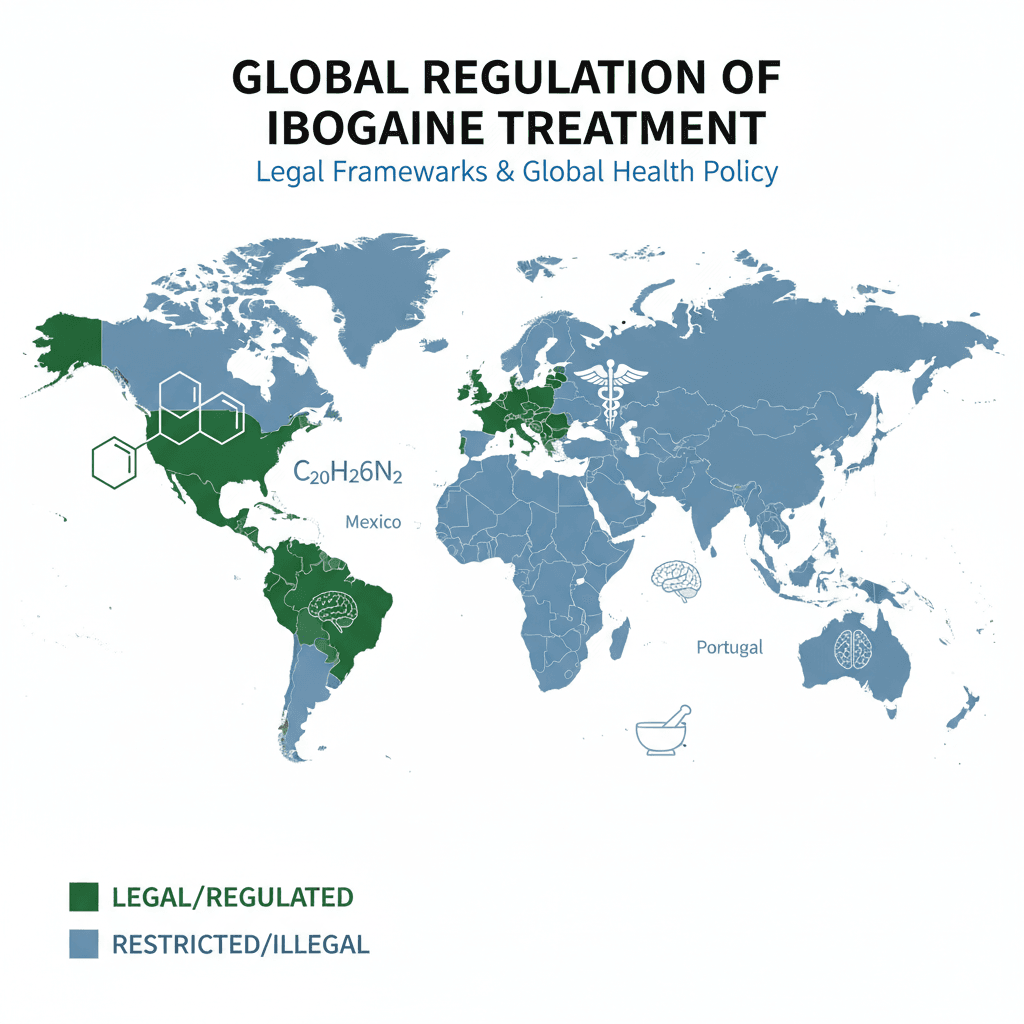
Understanding ibogaine and why legality matters
If you are researching where ibogaine is legal, you are likely weighing serious decisions about addiction treatment for yourself or someone close to you. Ibogaine is a psychoactive compound derived from the root bark of the African shrub Tabernanthe iboga. It has drawn attention because some people report that a single treatment can significantly reduce opioid withdrawal and cravings.
At the same time, ibogaine carries medical risks, including heart complications and, in rare cases, death. Because of these risks and its psychedelic properties, governments regulate it very differently. In some countries ibogaine is a prohibited drug. In others it is unregulated or available only within narrow medical frameworks.
Understanding where ibogaine is legal, where it is tolerated, and where it is tightly controlled helps you evaluate your options more clearly. It also helps you travel and seek care without unintentionally breaking the law. For a broader overview, you can also review how ibogaine legal status worldwide is evolving.
Key legal categories you should know
Across countries, ibogaine typically falls into one of four broad categories. Knowing these gives you a quick way to compare your options.
-
Prohibited / Schedule I
Ibogaine is treated similarly to drugs considered to have a high potential for abuse and no accepted medical use. Possession, sale, and clinical use are generally illegal. -
Controlled but medically accessible
Ibogaine is a controlled substance, but limited medical or research use is allowed under specific programs or in hospital settings. -
Unregulated but not approved
Ibogaine is not specifically scheduled or controlled. This means it is not banned, but it is also not officially approved as a medicine. Clinics may operate within a legal gray area, subject to general health and business regulations. -
Prescribable medicine under regulation
Ibogaine is recognized as a medication that licensed clinicians can prescribe, usually under strict protocols and in controlled medical environments.
The sections below walk through where ibogaine sits in each key region and how that affects your ability to seek treatment safely and legally.
Ibogaine legal status in the United States
If you are in the United States, you face the strictest limits on ibogaine access.
Federal prohibition
At the federal level, ibogaine is classified as a Schedule I substance. This category is reserved for drugs considered to have a high potential for abuse and no currently accepted medical use. As of 2026, ibogaine remains prohibited at the federal level, which means:
- You cannot legally prescribe, dispense, or possess ibogaine for personal use.
- Licensed medical providers are unable to offer ibogaine treatment in standard clinical settings.
- Research is highly restricted and requires special approvals.
Ibogaine’s Schedule I status is one of the core reasons why ibogaine treatment laws are so fragmented and why many providers operate outside the United States.
Several state legislatures, including New York and Texas, have introduced or are evaluating bills to allow research into ibogaine’s therapeutic use for substance use disorders. However, this does not change the fact that it remains a Schedule I substance at the federal level for now. [1]
If you want a deeper dive into domestic rules, you can review ibogaine legality in the united states and why ibogaine treatment is not legal in the us.
What this means for you
If you are an American considering ibogaine therapy:
- You cannot receive legal ibogaine treatment inside the United States.
- You may explore clinics abroad, but you need to understand how to travel and return home while staying within the law.
- You should not attempt to import ibogaine or bring it back with you.
You can learn more about cross-border options in can americans get ibogaine treatment abroad.
Canada: restricted access through special programs
In Canada, ibogaine is more accessible than in the US but still tightly controlled.
Ibogaine is not available as a standard prescription medication. Instead, it can only be accessed through Health Canada’s Special Access Program, which permits health care providers to request certain non-market drugs for serious or life-threatening conditions when conventional treatments have failed or are unsuitable.
As of 2026, ibogaine is considered restricted and is only available through this program, indicating a cautious but open stance toward its potential therapeutic benefits. [1]
For you, this means:
- You are unlikely to find open, consumer-facing ibogaine clinics in Canada.
- Any legal ibogaine use would generally be part of a carefully supervised medical context, initiated by a licensed practitioner using the Special Access Program.
- Traveling to Canada specifically for ibogaine treatment is complicated because access is not guaranteed and depends on case-by-case approval.
Mexico: a major destination for ibogaine treatment
Mexico is one of the most significant countries for people who are asking where ibogaine is legal and practically available.
Regulatory status
Ibogaine is currently unregulated in Mexico. It is not listed as a controlled substance, which means there are no specific federal laws banning its possession, distribution, or clinical use. As a result, clinics can legally provide ibogaine treatment without special government restrictions. [1]
This regulatory environment has made Mexico a major destination for individuals from the United States, Canada, and Europe who cannot access ibogaine at home.
For more detail on how this works in practice, you can explore is ibogaine treatment legal in mexico.
What this means for your treatment options
Because ibogaine is unregulated rather than formally approved, the quality and safety standards of clinics can vary widely. You are responsible for carefully evaluating any provider you consider. As you research, look at:
- Medical screening and cardiac monitoring protocols
- On-site emergency equipment and nearby hospital access
- Experience and credentials of medical staff
- Post-treatment integration and follow-up support
Mexico’s accessibility is one reason many of the most visible ibogaine legal treatment clinics operate there. However, legality does not automatically equal safety. You still need to assess whether a clinic’s standards align with your health needs and risk tolerance.
Brazil: prescription use in hospital settings
Brazil represents a different model. Instead of leaving ibogaine unregulated, it has chosen to integrate it into medical practice under strict rules.
Ibogaine was first legalized for prescription use in hospital environments in São Paulo in 2016. Over time, this regulatory approval has gradually expanded nationwide. As of 2026, doctors in Brazil can prescribe ibogaine for addiction treatment, but only under clinical supervision and typically inside hospital or medical settings. [1]
For you, this means:
- Ibogaine can be legally administered, but usually not in casual retreat centers or informal environments.
- Treatment is medicalized and tends to involve more structured protocols, including thorough screening and monitored dosing.
- Access typically depends on working with Brazilian medical professionals rather than booking a stay at a private wellness retreat.
Brazil may be an option if you are looking for ibogaine in a setting where its use is formally recognized as a medical therapy and embedded within the health system.
New Zealand: prescribable but closely supervised
New Zealand has taken yet another approach that may interest you if you want medically supervised psychedelic therapy in a smaller, regulated setting.
As of 2026, ibogaine is not classified as a controlled substance in New Zealand. Physicians can prescribe it at their discretion, which has enabled legal ibogaine-assisted therapy clinics to operate. [1]
For people considering treatment:
- Ibogaine can be obtained legally through licensed health professionals.
- Clinics tend to operate with medical oversight and are subject to general health and safety regulations.
- New Zealand’s smaller market may limit the number of available providers, but it offers a model where ibogaine is integrated into clinical practice rather than unregulated retreat-style centers.
If you are prioritizing a setting that is legal and medically supervised, New Zealand may be worth evaluating alongside Brazil.
Comparing ibogaine regulation in key countries
To help you quickly see where ibogaine is legal or accessible, you can use the table below as a reference. It summarizes the countries highlighted in the research you are reviewing.
| Country | Legal classification (as of 2026) | Practical access for treatment |
|---|---|---|
| United States | Federally prohibited, Schedule I | No legal clinical treatment, research only under strict federal control [1] |
| Canada | Restricted, Special Access Program only | Limited case-by-case medical access, not general clinical offering [1] |
| Mexico | Unregulated | Broad clinic availability, standards vary by provider [1] |
| Brazil | Legal as a prescription drug in hospital settings | Medically supervised treatment in approved hospitals and clinics [1] |
| New Zealand | Not a controlled substance, prescribable by professionals | Legal ibogaine-assisted therapy through authorized clinics [1] |
If you want a broader list that goes beyond these countries, you can consult countries where ibogaine treatment is legal and ibogaine regulation worldwide.
Why so many ibogaine clinics operate abroad
If you are wondering why ibogaine clinics cluster in countries like Mexico, Brazil, and New Zealand rather than in the United States or Canada, the reasons are primarily regulatory.
Regulatory barriers at home
In the United States, ibogaine’s Schedule I status blocks regular medical use. Clinicians risk criminal penalties and license loss if they attempt to offer ibogaine, even to patients with severe addiction who have not responded to other treatments.
Canada’s Special Access Program provides a narrow pathway but does not create a broad, stable market. This means there is little incentive for clinics to build large-scale, public-facing ibogaine services within Canada’s borders.
These restrictions have led many North American patients to look abroad when asking where ibogaine is legal and realistically available.
More flexible frameworks abroad
In contrast:
- Mexico allows clinics to operate legally because ibogaine is unregulated.
- Brazil has recognized ibogaine as a prescribable drug in hospital settings, which encourages structured medical programs.
- New Zealand permits prescriptions at the discretion of medical professionals, supporting a smaller but legal clinical ecosystem.
These environments create space for clinics to advertise ibogaine openly, build specialized programs, and receive international clients.
How patients legally travel for ibogaine treatment
If you are in a country where ibogaine is illegal or tightly restricted, you may be considering travel to access care. Understanding what is legal and what is not can help you avoid unnecessary risk.
Traveling to the clinic
Generally, you can legally travel to another country where ibogaine is legal or unregulated for treatment, as long as:
- You do not carry ibogaine with you across the border.
- You respect the entry rules of the destination country, including visa requirements.
- You receive ibogaine only within the legal framework of that country, such as a licensed clinic or hospital.
For example, many Americans fly to Mexico for ibogaine treatment. They typically:
- Arrive at a major airport such as Tijuana, San Diego (then cross the border), or Cancun.
- Travel directly to a licensed or established ibogaine clinic.
- Complete treatment, rest, and then return home after the program ends.
Returning home
The critical legal boundary is importation. When you re-enter a country where ibogaine is prohibited or tightly controlled:
- You must not bring any ibogaine or iboga products back with you.
- You should avoid mailing ibogaine to yourself from abroad.
- You should be honest on customs forms and avoid misdeclaring restricted items.
Receiving medical treatment abroad is generally legal, but importing a controlled or prohibited substance is not. Articles like can americans get ibogaine treatment abroad and ibogaine treatment legality explained can help you think through these details in more depth.
Safety, standards, and choosing a clinic
Even in countries where ibogaine is legal or unregulated, regulations alone do not guarantee your safety. When you evaluate where ibogaine is legal, you should also consider how carefully it is practiced in each setting.
Here are a few factors to look for when you review potential clinics:
- Medical screening. You should receive a thorough health evaluation, including heart and liver assessments, before treatment.
- On-site monitoring. Continuous cardiac monitoring and direct supervision during the active ibogaine experience help identify complications early.
- Emergency preparedness. The clinic should have resuscitation equipment and clear protocols for transferring you to a nearby hospital if needed.
- Staff qualifications. licensed physicians, nurses, or paramedics with experience in cardiac and emergency care should be part of the team.
- Aftercare and integration. Support after treatment helps you integrate insights and maintain changes over the long term.
Because regulations differ, some clinics will exceed local minimum standards. Others may operate with basic or inconsistent protocols. Your decision should weigh both legal status and clinical quality.
Resources such as ibogaine legal status worldwide, ibogaine legal treatment clinics, and ibogaine treatment laws can help you compare options and ask informed questions.
Putting it all together for your situation
When you ask where ibogaine is legal, you are really asking two related questions: where you can receive treatment without breaking the law, and where you can do so in a way that respects your health and safety.
In summary:
- The United States treats ibogaine as a Schedule I drug, so you cannot legally access treatment domestically.
- Canada restricts ibogaine to the Special Access Program, which limits availability.
- Mexico leaves ibogaine unregulated, creating broad access but variable clinic standards.
- Brazil legalizes ibogaine as a prescription medication in hospital settings, offering supervised medical treatment.
- New Zealand allows doctors to prescribe ibogaine, which supports legal ibogaine-assisted therapy clinics.
If you are considering treatment abroad, you can also look at is ibogaine legal for a clear overview and countries where ibogaine treatment is legal for additional destinations.
Your next step might be to:
- Clarify your own medical history and risks with a trusted physician.
- Decide whether you are prepared to travel for treatment.
- Use the resources linked here to compare legal environments and identify clinics that operate with high medical standards.
By understanding both the legal landscape and the practical realities on the ground, you can make a more informed decision about whether ibogaine treatment fits into your path toward recovery.