
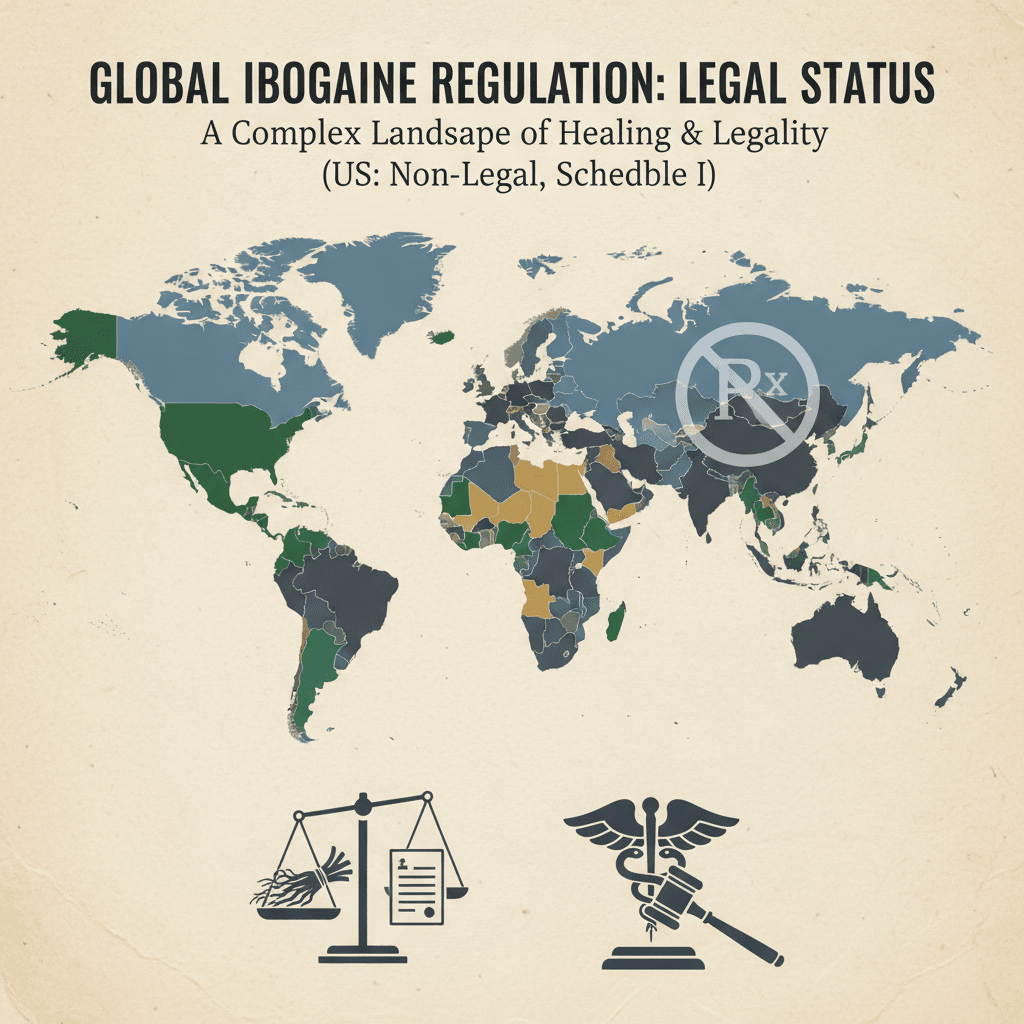
Understanding why ibogaine treatment is not legal in the US
If you are exploring ibogaine as a potential treatment for addiction or mental health conditions, one of the first questions you may ask is why ibogaine treatment is not legal in the US. The short answer is that ibogaine is classified as a Schedule I controlled substance at the federal level, which means it is considered to have a high potential for abuse and no currently accepted medical use in the United States. This legal status shapes everything from research access to where you can receive treatment and why so many ibogaine clinics operate abroad instead of inside US borders.
You can get a broader view of how ibogaine is handled in other countries by reviewing ibogaine legal status worldwide and ibogaine regulation worldwide. Understanding the US position is easiest when you look at how ibogaine got scheduled, why regulators see it as risky, and what is changing, if anything, in current law.
How ibogaine became illegal in the United States
To understand why ibogaine treatment is not legal in the US today, you first need to look at the history of how it was criminalized during the modern war on drugs.
Ibogaine is a psychoactive alkaloid derived from the root bark of the African shrub Tabernanthe iboga. It was brought into Western medicine in the mid‑20th century and used experimentally for various purposes, including as a stimulant and as a potential treatment for substance use. In the 1960s, rising concern about psychedelic drugs led US lawmakers to restrict many psychoactive substances.
Ibogaine was placed under federal control in the late 1960s and then formally classified under the Controlled Substances Act of 1970 as a Schedule I substance, along with drugs such as heroin and LSD. Schedule I status is reserved for substances that the federal government defines as having a high potential for abuse and no currently accepted medical use, and this classification sharply limited both legal use and research access to ibogaine in the United States [1].
This decision was made before modern clinical studies of ibogaine’s potential to treat opioid and other addictions had been completed. As a result, later research efforts have had to work around a legal framework that assumes ibogaine has no accepted medical value, which is one core reason ibogaine treatment itself remains illegal.
Schedule I status and what it means for you
When you ask why ibogaine treatment is not legal in the US, the central issue is ibogaine’s classification as a Schedule I controlled substance. Under federal law, Schedule I drugs are defined as having:
- A high potential for abuse
- No currently accepted medical use in treatment in the United States
- A lack of accepted safety for use under medical supervision
Ibogaine meets this classification on paper in US law. The Drug Enforcement Administration and the Food and Drug Administration both treat ibogaine as a substance that currently cannot be prescribed, dispensed, or administered outside very narrow, federally approved research protocols. As of 2025 and into 2026, it remains illegal to possess, prescribe, or administer ibogaine in regular clinical practice in the United States [2].
In practical terms, this means:
- No physician in the US can legally write a prescription for ibogaine.
- No licensed facility in the US can openly offer ibogaine detox or ibogaine-assisted therapy.
- Importing or manufacturing ibogaine for treatment use is prohibited without special federal licenses.
- Researchers must navigate stringent approvals to even study ibogaine in controlled trials.
Advocates argue that ibogaine does not truly fit the Schedule I definition, because it does not appear to produce classic patterns of compulsive use and because emerging data suggests possible medical benefits for addiction treatment. However, until federal agencies accept robust evidence of safety and efficacy and move to reschedule ibogaine, its current classification is the main legal barrier to treatment access in the US [3].
You can see how this classification plays out in more detail on ibogaine legality in the united states and ibogaine treatment laws.
Safety concerns that shape US policy
Another key reason why ibogaine treatment is not legal in the US is concern over safety, particularly serious cardiac risks. While ibogaine has shown potential benefits in reducing withdrawal symptoms and interrupting addictive patterns, it also has a documented history of severe adverse events.
Case reports and reviews have linked ibogaine to fatal cardiac arrhythmias, prolonged QTc interval, sudden death, and cardiac arrest [4]. More than 30 deaths over roughly four decades have been associated with ibogaine, often in settings without adequate medical supervision [5]. These events have made regulators cautious about allowing ibogaine into standard clinical practice.
A 2022 observational study of opioid-dependent patients highlighted several important concerns. In that study, half of the participants who received ibogaine experienced QTc prolongation beyond 500 milliseconds, which is a level associated with a markedly increased risk of life‑threatening arrhythmias such as torsades des pointes [6]. The same study also documented bradycardia, reduced blood pressure, and transient but severe cerebellar ataxia in all patients, reinforcing ibogaine’s potential to cause dangerous physiological changes.
Researchers have also found that ibogaine can inhibit cardiac hERG channels, which play a central role in heart repolarization. Interference with these channels is closely linked to arrhythmia risk [4]. In addition, genetic differences in how people metabolize ibogaine through the CYP2D6 enzyme mean that some individuals are naturally at higher risk of toxic effects, especially if they are taking other medications that affect this pathway [6].
From a regulatory perspective, these safety issues are not minor. They indicate that ibogaine can be dangerous without strict screening, continuous medical monitoring, and emergency cardiac care on site. Until large, controlled clinical trials show that these risks can be reliably managed, agencies like the FDA are unlikely to endorse ibogaine as a safe treatment option, which keeps the substance in Schedule I and blocks legal treatment access.
Limited clinical research and evidence gaps
Even though ibogaine has attracted interest as a possible treatment for addiction since the 1980s, the evidence base is still limited compared to what US regulators typically require. This evidence gap is another reason why ibogaine treatment is not legal in the US.
In 1993, the FDA approved a Phase I clinical trial to study ibogaine in humans. However, that trial was never completed due to contractual disputes, funding problems, and ongoing safety concerns [4]. Since then, most of the available data has come from small observational studies, open‑label trials, and reports from clinics operating outside the US. Many of these studies suggest reductions in withdrawal and cravings for opioids and other substances, and some preliminary data point to benefits for PTSD symptoms, but the sample sizes are small and study designs are often less rigorous than the FDA typically expects [7].
The Partnership to End Addiction notes that there is still a lack of sufficiently controlled clinical trials proving ibogaine’s safety and efficacy for substance use disorders. Existing studies often produce mixed or inconclusive results, and the serious side effects seen in some cases further complicate interpretation [5]. Because of this, regulators maintain that ibogaine does not have an accepted medical use, which is central to keeping it in Schedule I.
The FDA has also signaled that approval of ibogaine for substance use disorder treatment is unlikely in the near term. According to expert assessments, there may be a delay of up to a decade or more before enough rigorous research is completed to support a rescheduling or approval, even if future trials are positive [5]. Until that kind of evidence exists, you should expect the legal landscape inside the United States to change slowly, not rapidly.
If you want a high‑level summary of these legal and research dynamics, you can review ibogaine treatment legality explained and is ibogaine legal.
Federal law, state experiments, and local decriminalization
At the federal level, ibogaine remains a Schedule I controlled substance, and that status overrides most attempts to legalize treatment. However, you may hear about state-level bills or city decriminalization efforts and wonder how they affect access.
Some US cities, including Oakland, have moved to decriminalize certain plant and fungi‑based psychedelics, sometimes including ibogaine. Decriminalization in this context usually means making enforcement of possession laws the lowest police priority or removing local penalties for personal possession. Even when that occurs, ibogaine remains illegal under federal law, and there is still no legal pathway for clinics to administer ibogaine treatment in those jurisdictions [1].
Several states have taken a different approach, focusing on research rather than immediate access. Legislators in states like New York and Texas have introduced bills to fund or authorize clinical trials of ibogaine for substance use disorder treatment, such as New York Senate Bill S1817 and Texas HB 3717 [2]. Other states, including Arizona, California, Colorado, and Mississippi, have examined or advanced legislation to support FDA‑regulated ibogaine studies for addiction and neurological conditions [8].
These efforts are important because they may eventually generate the level of evidence federal agencies require to reconsider ibogaine’s status. However, they do not make treatment widely legal today. Most of these laws are focused on enabling carefully controlled trials, not opening ibogaine clinics to the general public. For your purposes as a potential patient, state research bills may signal growing interest but do not yet create a clear path to legal ibogaine treatment in the US.
Why many ibogaine clinics operate abroad
Because of the combination of Schedule I status, safety concerns, and research barriers, many treatment providers who believe in ibogaine’s potential operate outside the United States in jurisdictions where ibogaine is either legal, regulated for medical use, or not specifically controlled.
Countries such as Mexico, Brazil, South Africa, and New Zealand are commonly referenced as places where ibogaine therapy is legal, tolerated, or unregulated, which allows clinics to operate under local law [2]. Regulations vary by country, and some locations have begun to develop more formal oversight structures for ibogaine treatment, including medical screening and in‑clinic monitoring requirements.
For many people living in the US, this international patchwork means that if you are seriously considering ibogaine, you will likely be looking at clinics abroad. You can get a structured overview on where is ibogaine legal and explore countries where ibogaine treatment is legal to better understand your options.
Clinics outside the US may still differ significantly in quality, safety protocols, and medical staffing. The absence of US FDA oversight does not necessarily mean poor care, but it does place more responsibility on you to evaluate each provider carefully. The same cardiac and neurological risks that concern US regulators also exist in other countries, so strong medical screening and continuous monitoring are essential regardless of legal status.
Ibogaine’s legality in another country does not automatically translate into safety or quality. You still need to look closely at the clinic’s medical standards, emergency capabilities, and track record.
To begin comparing locations and legal environments, you might find it useful to review ibogaine legal treatment clinics alongside ibogaine legal status worldwide.
Traveling abroad for ibogaine treatment
Given that ibogaine treatment is not legal in the US, many Americans explore the possibility of traveling internationally to access therapy. This route is common enough that some clinics specifically market to US residents and provide guidance on travel logistics.
From a US federal perspective, it is illegal to possess or import ibogaine into the United States. However, traveling to a country where ibogaine is legal or unregulated and receiving treatment there is typically governed by that country’s laws, not US law, as long as you are not transporting ibogaine back into the United States. Many Americans therefore book treatment abroad, complete their program, and return home without carrying the substance itself.
You can find focused guidance in resources like can americans get ibogaine treatment abroad and is ibogaine treatment legal in mexico. These can help you understand not only the legal considerations but also how different countries structure ibogaine care.
If you are considering travel, you may want to think about:
- The legal status of ibogaine in your destination country and any specific regulations around medical use.
- The clinic’s medical standards, including pre‑treatment cardiac screening, continuous monitoring, and emergency response capabilities.
- How your recovery plan will continue once you return home, especially since there are no legal ibogaine follow‑up services in the US.
- The impact of travel on your physical and emotional state, particularly if you are detoxing from opioids or other substances.
While international travel creates a path to ibogaine that is not available inside the US, it does not eliminate the underlying medical risks, and it adds layers of logistical and aftercare planning.
Advocacy, future research, and what may change
If you are wondering whether the answer to why ibogaine treatment is not legal in the US might change in the coming years, it helps to look at current advocacy and research efforts.
Organizations such as Americans for Ibogaine focus on educating lawmakers, supporting policy reform, and encouraging federal authorization of rigorous clinical trials. Their goal is to generate enough high‑quality evidence to justify rescheduling ibogaine and eventually creating regulated treatment pathways [3].
Preliminary data from research groups, including a Stanford‑connected initiative, suggest potential benefits for PTSD and substance use withdrawal, particularly when ibogaine is administered in controlled medical environments outside the US [7]. However, these findings are still early and do not yet meet the threshold regulators require.
Despite growing interest and the emergence of more sophisticated safety protocols abroad, experts like Dr. Thomas Kingsley Brown have expressed skepticism that fully legal ibogaine treatment will be available in the United States in the near future. They point to persistent regulatory barriers, ongoing safety concerns, and the slow pace of drug scheduling changes at the federal level [1].
For you, this means that while the research landscape is moving and advocacy is active, you should not plan around rapid legalization in the US. Instead, you may want to base your decisions on the current reality: ibogaine treatment remains illegal domestically and is available primarily through clinics operating in other countries.
Bringing it together as you evaluate your options
When you step back, the core reasons why ibogaine treatment is not legal in the US come into focus:
- Ibogaine is a Schedule I controlled substance, defined by federal law as having high abuse potential and no accepted medical use.
- Regulators are concerned about serious safety risks, especially life‑threatening cardiac arrhythmias and neurological side effects documented in both case reports and clinical studies.
- There is still a lack of large, well‑controlled clinical trials demonstrating both safety and effectiveness for addiction or mental health conditions, which keeps ibogaine within Schedule I.
- Federal law restricts possession, prescription, and administration, and state or local experiments are currently limited to research efforts or narrow decriminalization that does not create legal treatment access.
Because of this, many people in the US look beyond national borders to explore ibogaine, researching where is ibogaine legal and identifying countries where ibogaine treatment is legal. Clinics abroad may provide access, but you still need to weigh legal, medical, and practical considerations carefully.
If you choose to keep researching, you can deepen your understanding by reviewing ibogaine legal status worldwide and ibogaine legal treatment clinics. These resources can help you place the US position in a global context so that you can make informed, realistic decisions about your next steps.