
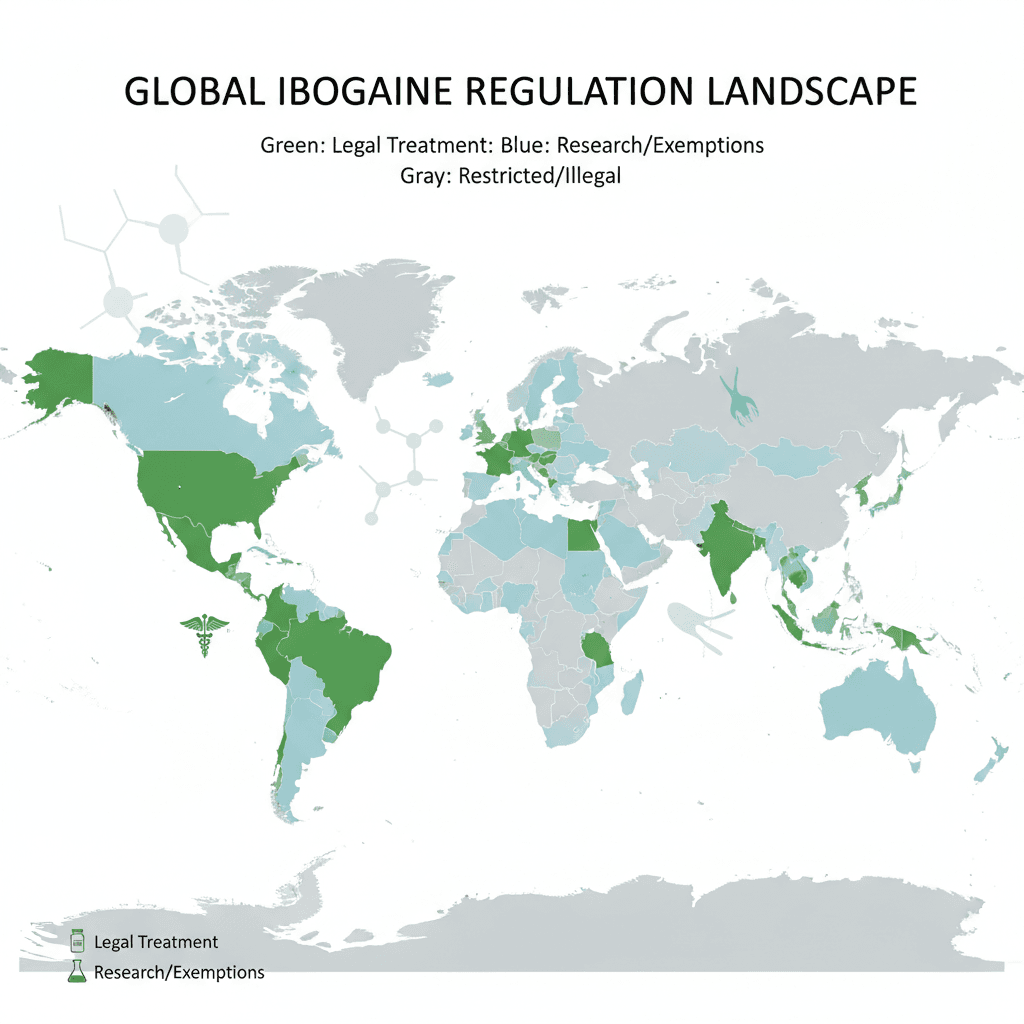
Understanding why ibogaine law varies by country
If you are trying to understand the countries where ibogaine treatment is legal, you are not alone. Ibogaine sits at the intersection of addiction medicine, psychedelics, and international drug control, so its legal status varies widely from one country to another.
Some governments classify ibogaine as an illegal drug. Others treat it as a prescription-only medicine. In some places it is not specifically regulated at all, which allows clinics to offer ibogaine treatment in a gray or unregulated zone. These differences explain why so many ibogaine treatment centers operate internationally rather than in the United States, and why you often need to travel for care.
If you want a broader overview of how countries handle this medicine, resources on ibogaine legal status worldwide and ibogaine regulation worldwide can help you frame the big picture.
Key categories of ibogaine legality
Before looking at specific countries, it helps to understand the main legal categories you will see. When you examine where ibogaine is legal, most jurisdictions fall into one of four groups:
- Illegal or Schedule I style bans
- Controlled but prescribable under strict rules
- Fully legal or not controlled as a drug
- Unregulated or not specifically addressed by law
These labels are simplified and every country has its own terminology. However, this framework can help you read national laws and clinic marketing claims with more clarity. For detailed explanations of these concepts, you can explore ibogaine treatment laws and ibogaine treatment legality explained.
1. Illegal or Schedule I style bans
In some countries ibogaine is treated similar to other prohibited substances with no accepted medical use. In these jurisdictions you typically cannot possess, prescribe, sell, or administer ibogaine legally, even inside a medical setting.
According to the Partnership to End Addiction, ibogaine is illegal in the United States and classified as a Schedule I substance. It is also illegal in Belgium, France, Ireland, Israel, Italy, Norway, Sweden, and Switzerland as of January 2024 [1].
If you live in one of these countries, you will not find licensed ibogaine clinics locally. This is one of the main reasons individuals in the US and parts of Europe look abroad for treatment. If you want more detail on the US situation specifically, you can read about why ibogaine treatment is not legal in the US and ibogaine legality in the united states.
2. Controlled but prescribable under strict rules
A smaller group of countries classifies ibogaine as a controlled substance that can still be prescribed by a doctor under specific conditions. In these places, ibogaine is not available over the counter and recreational use remains illegal, but treatment in a clinical or hospital setting may be permitted.
The Partnership to End Addiction notes that Brazil, Canada, Denmark, Hungary, and South Africa treat ibogaine as a controlled substance that can be legally obtained with a doctor’s prescription as of early 2024 [1].
Experience Ibogaine highlights that:
- Brazil legalized ibogaine for prescription use in hospital settings starting in 2016, with regulatory approval gradually expanding under clinical supervision as of 2026 [2].
- South Africa classifies ibogaine as a Schedule 6 substance, which means it can be prescribed with strict medical oversight, making it one of the few African countries to formally recognize ibogaine in modern medical treatment contexts as of 2026 [2].
In this category, ibogaine treatment usually happens in hospitals or specialized medical centers rather than retreat-style facilities. Regulations may demand cardiac monitoring, pre-treatment screenings, and formal research or trial protocols.
3. Fully legal or not controlled as a drug
In a few countries, ibogaine is not listed as a controlled substance, which, in practice, makes it legal to possess and use, subject to general health regulations. This does not always mean that governments actively promote ibogaine treatment, but it does make it easier for clinics and doctors to operate.
The Partnership to End Addiction reports that ibogaine is legal in Australia, Finland, New Zealand, and Uruguay, allowing its use without prohibition in these countries as of January 2024 [1].
In New Zealand more specific guidance is available. Experience Ibogaine notes that ibogaine is not classified as a controlled substance there, which allows it to be prescribed at the discretion of a medical professional and enables clinics to legally offer ibogaine-assisted therapy as of 2026 [2].
Even when ibogaine is not controlled, responsible providers still follow safety protocols, informed consent standards, and medical best practices. For you as a patient, this often translates into access to clearly regulated clinics with closer oversight.
4. Unregulated or not specifically addressed
In some countries ibogaine is not mentioned in drug laws at all. This creates an unregulated or gray area where ibogaine is not explicitly legal or illegal. Clinics may operate under general business and health regulations, but there may be no specific standards that govern ibogaine therapy itself.
Experience Ibogaine reports that ibogaine treatment is legally unregulated, allowing clinics to provide ibogaine therapy without restrictions. This lack of specific regulation has made an attractive destination for individuals seeking alternative addiction treatments as of 2026 [2].
The Partnership to End Addiction also notes that some countries, including the Netherlands, Germany, and Gabon, have no specific legal regulations for ibogaine. As a result, ibogaine use is effectively legal and unregulated in those locations as of early 2024 [1].
Unregulated environments can expand access quickly, but they may also create wide variation in clinic quality and safety standards. If you are considering treatment in an unregulated country, you need to evaluate providers carefully. The page on ibogaine legal treatment clinics can help you think about what to look for.
Country-by-country overview of ibogaine treatment
The following sections summarize the countries where ibogaine treatment is legal or available in some form, based on the categories above. Laws change, so you should always verify the current status before making decisions, but this will give you a practical starting point.
Unregulated but widely available
One of the most visible countries in ibogaine treatment discussions because of its proximity to the United States and its unregulated legal environment.
Experience Ibogaine notes that ibogaine treatment is legally unregulated. Clinics can provide ibogaine therapy without direct ibogaine-specific restrictions, which has made a major destination for people seeking alternative addiction treatments as of 2026 [2].
For US residents, this often raises specific questions about travel, customs, and returning home. Resources like is ibogaine treatment legal and can americans get ibogaine treatment abroad explain what you can and cannot do legally when crossing borders for treatment.
If you consider a Mexican clinic, it becomes especially important to ask about:
- On-site medical staff and emergency protocols
- Cardiac and liver screening before treatment
- Dosing methodology and monitoring during sessions
- Integration and follow-up care once you return home
In an unregulated context, the clinic itself sets the standards, so you have to assess those standards directly.
Brazil: Hospital-based, prescription ibogaine
Brazil has taken a different path by integrating ibogaine into hospital-based care under medical supervision.
Experience Ibogaine reports that Brazil legalized ibogaine for prescription use in hospital settings beginning in 2016, with regulatory approval gradually expanding and recognizing its potential in addiction recovery under clinical supervision as of 2026 [2].
The Partnership to End Addiction also lists Brazil among the countries where ibogaine is a controlled substance that can be obtained with a doctor’s prescription [1].
This framework typically means:
- Ibogaine is administered in hospital or medical clinic settings, not informal retreats.
- Patients go through standardized screening and medical evaluation.
- Doses and treatment protocols may be part of clinical research or approved hospital programs.
Spain and Brazil are also conducting Phase II clinical trials to evaluate the safety and effectiveness of ibogaine for treating substance use disorders, which reflects growing interest in regulated medical use as of 2024 [1].
If you want a more medically formal environment and you are comfortable with hospital care, Brazil can be an option worth exploring, although language and travel logistics are important to consider.
South Africa: Schedule 6 with strict oversight
South Africa is one of the few African nations that has given ibogaine an official place in its medical system.
Experience Ibogaine notes that South Africa classifies ibogaine as a Schedule 6 substance, which means it can be prescribed with strict medical oversight. This status makes South Africa one of the few African countries to formally recognize and use ibogaine in modern medical treatment contexts as of 2026 [2].
The Partnership to End Addiction also includes South Africa in the list of countries where ibogaine is a controlled substance available by prescription [1].
Schedule 6 classification generally implies:
- Ibogaine is recognized as having medical uses but also a significant risk profile.
- Only authorized professionals can prescribe and administer it.
- Record keeping, storage, and reporting requirements are strict.
If you are considering South Africa, you will want to look specifically for clinics or medical practices that clearly explain how they comply with Schedule 6 regulations and what safeguards are in place.
New Zealand: Legal, prescribable treatment
New Zealand occupies a unique spot, with ibogaine formally allowed under physician oversight.
Experience Ibogaine explains that New Zealand does not classify ibogaine as a controlled substance. As a result, ibogaine can be prescribed at the discretion of a medical professional, and clinics can legally offer ibogaine-assisted therapy as of 2026 [2].
The Partnership to End Addiction further notes that ibogaine is legal in New Zealand, along with Australia, Finland, and Uruguay, allowing its use without prohibition as of January 2024 [1].
For you, this legal structure often means:
- Clinics can operate transparently under national health regulations.
- Physicians can integrate ibogaine into broader addiction treatment plans.
- There may be better coordination between ibogaine providers and mainstream healthcare services.
Travel to New Zealand is more involved for North American and European patients, but some choose it for the combination of legality, medical oversight, and relative regulatory clarity.
Portugal: Decriminalization and a permissive environment
Portugal is widely known for its progressive drug policy, and ibogaine is included in that broader framework.
Experience Ibogaine notes that Portugal decriminalized possession of all drugs, including ibogaine, in 2001. While this does not legalize sale or clinical use, it does create a permissive environment for potential ibogaine integration as of 2026 [2].
Under decriminalization:
- Personal possession is treated as an administrative or health issue, not a criminal one.
- Distribution and commercial sale can still be restricted or illegal.
- Clinical ibogaine programs may still require separate regulatory approval.
If you are considering Portugal, it is important to understand that decriminalization does not automatically equal formal medical authorization. You will need to verify whether any ibogaine provider you are looking at is operating within health regulations, research frameworks, or only in a gray area.
Other countries with legal or unregulated ibogaine
The Partnership to End Addiction provides a broader snapshot of other jurisdictions where ibogaine is either legal, prescribable, or unregulated:
- Ibogaine is legal in Australia, Finland, New Zealand, and Uruguay, allowing use without prohibition as of January 2024 [1].
- Brazil, Canada, Denmark, Hungary, and South Africa classify ibogaine as a controlled substance that can be obtained with a doctor’s prescription [1].
- Some countries, such as the Netherlands, Germany, and Gabon, have no specific legal regulations for ibogaine, which makes its use effectively legal and unregulated as of early 2024 [1].
In Spain and Brazil, Phase II clinical trials are underway to evaluate ibogaine’s safety and effectiveness for treating substance use disorders, showing a shift toward evidence-based regulation rather than outright prohibition [1].
You can find a consolidated perspective on these jurisdictions in resources like where is ibogaine legal and is ibogaine legal.
Laws change regularly. You should always confirm the latest regulations with official government or medical sources in the country you are considering before you travel or book treatment.
Why many ibogaine treatment centers are abroad
If you live in the United States, you might wonder why most ibogaine clinics you find online are in Central or South America, Europe, or Africa. The answer is primarily legal.
In the US, ibogaine is a Schedule I substance, which means it is considered to have no accepted medical use and a high potential for abuse. This classification blocks legal clinical use and makes it impossible for standard addiction treatment centers to offer ibogaine-assisted therapy. To understand this in detail, you can explore why ibogaine treatment is not legal in the us.
Because of these restrictions, providers who want to work with ibogaine set up clinics where it is legal, prescribable, or unregulated. Particularly common because it is geographically close and has no specific ibogaine regulations, but you will also see clinics or research initiatives in Brazil, South Africa, Portugal, New Zealand, and other countries listed earlier.
For you, this means that accessing ibogaine treatment usually involves:
- International travel
- Careful review of legal rules in both your home country and the treatment country
- Thoughtful planning for post-treatment support after you return
The article can americans get ibogaine treatment abroad walks through many of these practical questions.
Traveling abroad for ibogaine treatment safely and legally
If you are seriously considering ibogaine treatment abroad, you need to look at two sets of laws: the rules in the country where the clinic operates, and the rules in the country you are returning to.
Key issues include:
- Whether ibogaine is controlled, prescribable, legal, or unregulated in the treatment country
- Whether you are allowed to receive controlled substances there as a non-resident
- What you can legally bring across borders, including medications or plant material
- How your home country treats participation in overseas ibogaine programs
Most people travel to receive ibogaine on-site at a clinic, and they do not transport ibogaine themselves. You should never attempt to import ibogaine back into a country where it is illegal or tightly controlled.
From a safety perspective, you will also want to ask potential clinics questions such as:
- What medical screenings do you require before treatment?
- Which physicians or medical staff are on-site during dosing?
- How do you handle cardiac risk, liver issues, and medication interactions?
- What aftercare or integration support do you provide or coordinate?
Legal access does not guarantee safe practice, so you need to evaluate the clinic’s standards as carefully as you evaluate the country’s regulations.
Using legal information to choose your options
Understanding the countries where ibogaine treatment is legal gives you a starting map, but it is only one part of your decision process. You also need to weigh:
- Medical risk and your personal health history
- The quality and transparency of specific clinics
- Travel distance, cost, and language barriers
- Availability of follow-up care once you return home
As you research, you may find it helpful to compare multiple destinations side by side. Pages such as ibogaine legal status worldwide and ibogaine treatment legality explained can help you organize that information.
If you are at the early stage of exploration, starting with a broad overview of ibogaine regulation worldwide and ibogaine legal treatment clinics can clarify what is realistic for your situation.
Laws, regulations, and clinical standards will continue to evolve as more research is completed. Staying informed and asking direct questions of any provider you consider will help you use this changing legal landscape in a way that prioritizes both your safety and your long-term recovery goals.