
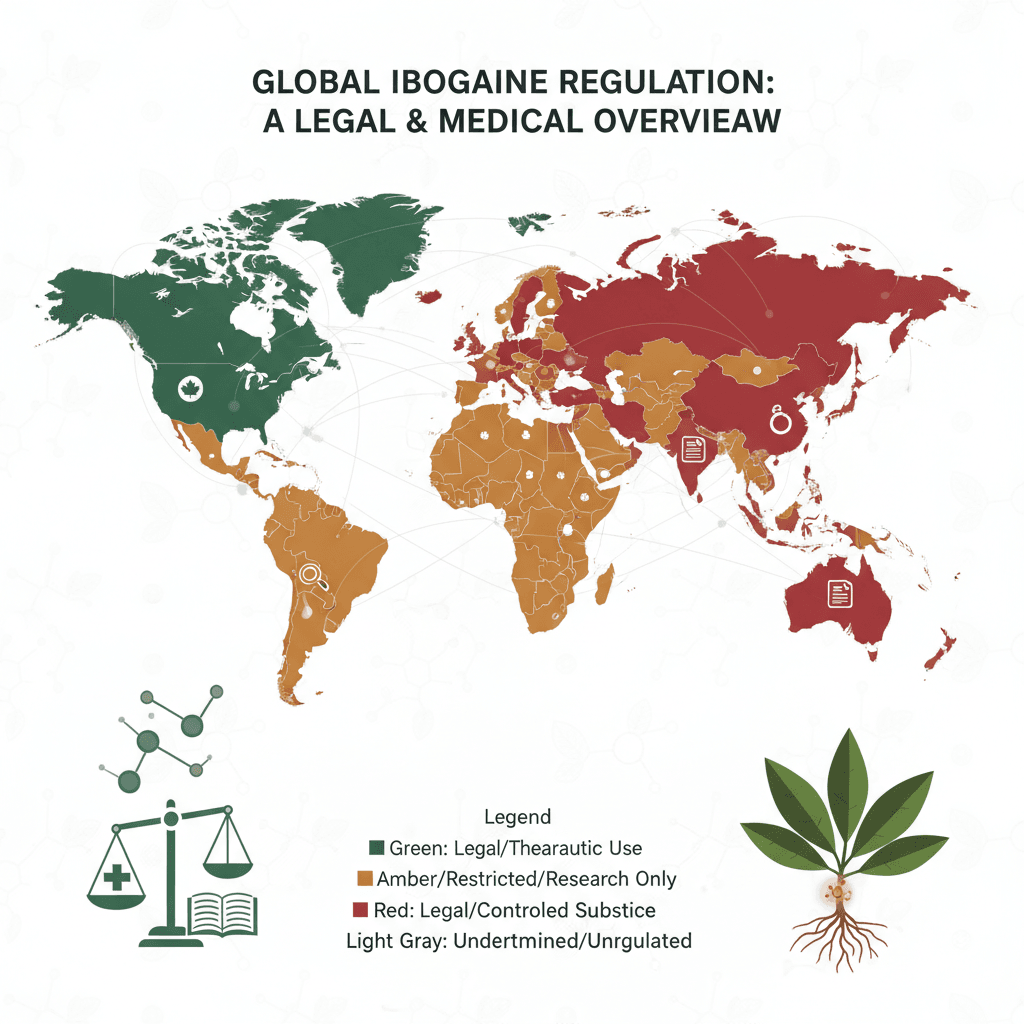
Understanding ibogaine legal status worldwide
If you are exploring ibogaine treatment for addiction or mental health, one of your first questions is usually about ibogaine legal status worldwide. Laws vary widely from country to country, and these differences shape where clinics can operate, how treatment is supervised, and what risks you may face when traveling for care.
Ibogaine is considered a promising but controversial medicine. Some countries treat it like any other illegal drug. Others allow it on a prescription basis, and a few have no specific regulations at all. Understanding this landscape helps you make informed and safer choices about if and where to seek treatment.
This guide walks you through the legal categories you will encounter, highlights key regions, and explains why so many ibogaine treatment centers operate internationally rather than in the United States.
How ibogaine is classified around the world
Ibogaine is a psychoactive alkaloid derived from the root bark of the African shrub Tabernanthe iboga. Legal systems tend to classify it in one of a few ways.
Common regulatory categories
Around the world, ibogaine is typically treated within these broad categories of control:
- Prohibited as a controlled substance
- Prescription only or restricted medical access
- Unregulated or not specifically scheduled
- Decriminalized possession but unclear medical status
The exact rules in each country will determine whether clinics can advertise, whether physicians can prescribe ibogaine, and how authorities treat possession and personal use. You can explore a more general overview in resources like ibogaine regulation worldwide and ibogaine treatment laws, but below you will find country specific context.
Ibogaine in the United States
For many people researching ibogaine legal status worldwide, the starting point is the United States.
In 2026, ibogaine is federally classified as a Schedule I substance in the United States. This means it is considered to have a high potential for abuse, no accepted medical use, and a lack of accepted safety for use under medical supervision. Possession, distribution, and use are illegal at the federal level, and ibogaine cannot be prescribed or offered as a standard medical treatment [1].
Some states, such as New York and Texas, have proposed legislation to facilitate research into ibogaine as a potential therapy for substance use disorders. However, these proposals are research focused, not clinical. You cannot access legal ibogaine treatment in licensed U.S. clinics at this time. You can read more detail in ibogaine legality in the united states and why ibogaine treatment is not legal in the us.
Because of these restrictions, many clinics providing ibogaine treatment to Americans operate in other countries. If you live in the U.S., this is why you often end up researching can americans get ibogaine treatment abroad as part of your decision process.
Canada: Restricted prescription access
Canada takes a different approach from the United States, but ibogaine is still not broadly accessible.
Ibogaine is restricted to prescription only status under Health Canada’s Special Access Program. This program allows physicians to request access to certain non approved drugs for patients with serious or life threatening conditions when conventional therapies have failed, are unsuitable, or are not available. In practice, however, access to ibogaine under this program is limited and rarely granted, and is used primarily in research or very controlled therapeutic contexts [1].
This means you will not find ibogaine widely offered in Canadian treatment centers, and any legitimate medical use is tightly supervised.
Mexico: A major destination for ibogaine treatment
Mexico is one of the most frequently discussed locations when you research where ibogaine treatment might be available.
Mexico has no specific federal regulations on ibogaine. It is not explicitly scheduled or banned at the national level, and there is no dedicated regulatory framework focused on ibogaine. As a result, clinics can provide ibogaine treatments without direct ibogaine specific legal restrictions, provided they comply with general health and safety laws [1].
This legal environment has made Mexico a prominent destination for individuals seeking alternative addiction therapies, including people traveling from the United States. Many centers emphasize medically supervised detox, cardiac monitoring, and psychological support. However, oversight and quality standards can vary. Before you travel, it is important to research is ibogaine treatment legal in mexico and carefully vet any clinic you consider.
You can also explore broader lists of countries where ibogaine treatment is legal, which often highlight Mexico alongside a small number of other destinations.
Brazil: Limited medical legalization in São Paulo
Brazil offers a partial example of medical acceptance.
In the state of São Paulo, the medical use of ibogaine was legalized in 2016 for prescription use in hospitals. Under this framework, ibogaine can be prescribed by licensed physicians and administered in a hospital environment. Over time, this regulatory approval has gradually expanded within medical contexts as authorities recognize ibogaine’s potential in addiction treatment, especially for substance use disorders [1].
This is not a nationwide free for all. Access is structured around medical oversight, hospital based protocols, and specific state level regulations. If you are considering Brazil, your focus should be on whether a hospital or physician is formally authorized to provide ibogaine, not on informal or underground retreats.
Europe: Mixed bans, regulation, and decriminalization
In Europe, ibogaine legal status worldwide becomes especially complex because each country has its own approach.
Many European countries have banned ibogaine outright, often citing safety concerns and limited high quality clinical evidence. Others permit treatment under carefully controlled conditions. A few countries decriminalize possession of many drugs, including ibogaine, but do not automatically authorize medical use.
Countries with ibogaine bans
In several European countries, ibogaine is banned or strictly prohibited. This group includes:
- Belgium
- France
- Norway
- Sweden
- Ireland
In these countries, possession, sale, and clinical use are generally illegal, and you will not find legal ibogaine clinics operating openly [1].
The Netherlands: Regulated clinical settings
The Netherlands, in contrast, permits ibogaine treatment but expects it to occur in regulated clinical environments.
Clinics that work with ibogaine are increasingly expected to follow medical guidelines, adhere to safety protocols, and meet regulatory standards similar to other non conventional treatments. While ibogaine is not treated like a mainstream approved medicine, the Dutch framework allows supervised treatment in controlled settings rather than pushing it entirely underground [1].
If you are considering traveling to the Netherlands for ibogaine, you will want to confirm that any clinic operates within this regulatory landscape and follows medically informed protocols.
Portugal: Decriminalized possession
Portugal is widely known for its drug decriminalization model. Since 2001, the country has decriminalized possession of all drugs, including ibogaine, for personal use. Decriminalization means possession is treated as an administrative matter, not a criminal offense, when quantities remain under certain limits.
However, decriminalization is not the same as medical legalization. While personal possession of ibogaine is decriminalized, this does not automatically translate into regulated ibogaine clinics or prescription status. If you are thinking about Portugal, you should treat it as a jurisdiction with tolerant possession rules but unclear pathways for supervised treatment [1].
Other global regions and emerging models
Beyond North America, Mexico, Brazil, and Western Europe, ibogaine legal status worldwide remains fragmented. Many countries either do not explicitly mention ibogaine in their drug codes or implicitly treat it as part of broader psychedelic or controlled substance categories.
In some places, this creates a gray area where small private retreats may operate without explicit authorization or prohibition. In others, conservative drug laws likely encompass ibogaine, even if it is not named. When a country is not listed clearly among where is ibogaine legal, you should assume there is legal uncertainty and seek up to date local legal advice.
Why many ibogaine clinics operate abroad
When you look at ibogaine legal status worldwide, a pattern emerges. Many people with opioid use disorder or other substance issues live in countries that prohibit ibogaine as a Schedule I or equivalent controlled substance. At the same time, a few countries allow clinics to operate under lighter or more flexible regulation.
This combination pushes ibogaine treatment into an international, destination based model. You may live in one country, but travel to another to receive treatment from a clinic that operates legally there. This is especially common for U.S. residents, who often fly to Mexico or other jurisdictions with more permissive ibogaine rules.
The result is a patchwork of:
- Individuals in restrictive countries who cannot legally access ibogaine at home
- Clinics in more permissive countries that specialize in serving international clients
- Ongoing research efforts that may eventually reshape laws in stricter jurisdictions
You can see this dynamic reflected in guides such as ibogaine legal treatment clinics and ibogaine treatment legality explained, which often emphasize international options.
Traveling abroad for ibogaine treatment
If you live in a country where ibogaine is prohibited, you may consider traveling abroad to a country where treatment is allowed or unregulated. This decision has both legal and practical implications.
Legal considerations when traveling
You are generally allowed to travel from a country with strict laws, such as the U.S., to another country where a particular treatment is legal. However, you must respect the laws of both your home country and your destination. A few key points:
- You cannot legally transport ibogaine from a country where it is allowed back into a country where it is prohibited.
- You can still face legal issues if you attempt to import ibogaine, possess it on return, or receive shipments by mail.
- Your treatment abroad must follow the laws of the country where the clinic is located, including any medical supervision requirements.
Before you travel, it is wise to verify your destination’s current rules through official government or consular sources, as well as through credible legal summaries such as those maintained by organizations like Experience Ibogaine.
Practical and safety considerations
Legal status is only one part of the decision. Because ibogaine carries medical risks, especially for individuals with heart conditions or other health issues, you should evaluate:
- Whether the clinic offers medical screening, cardiac monitoring, and emergency support
- The credentials of doctors or nurses overseeing your care
- Aftercare planning and integration support once you return home
A country that has light regulation might allow many clinics to operate, but you still need to assess quality and safety. Legal does not automatically mean safe.
Comparing ibogaine legal models
To help you see how different regulatory models affect your options, the table below summarizes common approaches across a few representative jurisdictions, based on the research above.
| Region / Country | Legal classification | Practical access to treatment | Notes |
|---|---|---|---|
| United States | Schedule I controlled substance, illegal federally | No legal clinical treatment, research only in very limited settings | Some states exploring research legislation, but not patient access [1] |
| Canada | Prescription only under Special Access Program | Very limited, case by case medical or research use | Requests must be approved by Health Canada, not routine treatment [1] |
| Mexico | No specific ibogaine regulation | Widely available in private clinics serving international clients | Clinics must follow general health laws, but ibogaine itself is not specifically restricted [1] |
| Brazil (São Paulo) | Legal for medical use in hospitals with prescription | Hospital based treatment under physician supervision | Gradual regulatory expansion recognizing addiction treatment potential [1] |
| Netherlands | Permitted in regulated clinical settings | Available in some specialized clinics | Focus on clinical protocols and safety standards [1] |
| Portugal | Decriminalized possession of ibogaine | Personal possession not criminal, medical status limited | Decriminalization does not equal formal clinical approval [1] |
| Belgium, France, Norway, Sweden, Ireland | Banned | No legal clinics | Safety and evidential concerns cited by regulators [1] |
This comparison can give you a clearer sense of why certain countries, particularly Mexico and parts of Brazil and the Netherlands, appear frequently when you search for ibogaine treatment options.
How to evaluate ibogaine clinics in legal jurisdictions
Once you understand ibogaine legal status worldwide, the next step is identifying clinics that operate both legally and responsibly. When a country allows ibogaine in some form, you still need to look at:
-
Legal legitimacy
Does the clinic comply with national and local laws related to medical practice, controlled substances, and health facility licensing. -
Medical oversight
Is there a licensed physician supervising treatment. Are full medical assessments, ECGs, and lab work required before dosing. -
Emergency preparedness
Does the facility have protocols for cardiac events or other complications. Is there rapid access to a hospital if needed. -
Transparency and documentation
Are you given clear consent forms that explain legal status, risks, and alternatives. Can staff answer questions about how they comply with local laws.
Resources like ibogaine legal treatment clinics can help you start this evaluation process, but you should also conduct your own due diligence and, when possible, consult a medical professional at home before you travel.
Staying informed as laws evolve
Ibogaine legal status worldwide is not fixed. Researchers, clinicians, and policymakers are actively debating its risks and potential benefits, particularly in the context of opioid use disorder and other substance dependencies. Proposals in places like New York and Texas illustrate that the conversation in the United States is changing, even if clinical access is not yet available.
Over time, you may see:
- Expanded research exemptions in restrictive countries
- More structured medical programs in countries like Brazil and the Netherlands
- Clearer regulations or oversight for clinics in unregulated environments such as Mexico
Because of this, any decision you make about ibogaine should rely on up to date information rather than assumptions or outdated guides. Returning to resources like ibogaine regulation worldwide, ibogaine treatment laws, and neutral legal summaries such as those from Experience Ibogaine can help you track changes.
If you are weighing ibogaine as part of your recovery path, it may also be useful to discuss your plans with a trusted healthcare provider or counselor. Even if they cannot recommend ibogaine directly, they can help you understand medical risks, prepare for travel, and plan for aftercare when you return home.
By taking time to understand the legal landscape, verifying clinic legitimacy, and prioritizing your safety, you can navigate this complex area more confidently and make decisions that align with both your personal goals and the laws that apply to you.