
Understanding ibogaine and its legal status
If you are asking yourself, “is ibogaine legal,” you are not alone. Interest in ibogaine as a potential treatment for addiction and trauma has grown quickly, while its legal status remains complex and highly uneven worldwide. In some countries ibogaine can be prescribed in hospital settings. In others, it is totally prohibited as a controlled substance.
Because of this patchwork regulation, many ibogaine treatment centers operate internationally, and you may find yourself considering travel to another country to access care. Before you do, it is essential to understand how ibogaine is classified where you live, where you might travel, and what that means for your safety and legal risk.
As you read, you can use related resources such as where is ibogaine legal, ibogaine regulation worldwide, and ibogaine treatment laws for deeper detail on specific regions.
What ibogaine is and why it is regulated
Ibogaine is a psychoactive alkaloid derived primarily from the root bark of the African shrub Tabernanthe iboga. Traditionally, it has been used in spiritual and initiation ceremonies in Gabon and surrounding regions. In the last several decades, ibogaine has drawn attention because of reports that it can significantly reduce withdrawal symptoms and cravings associated with opioid and other substance use disorders.
Emerging research from academic centers, including a 2024 dataset from Stanford University, suggests that ibogaine may help reduce symptoms of substance withdrawal and post traumatic stress disorder, although medical screening is crucial due to potential heart risks and other side effects [1].
Regulators around the world focus on three main issues when they decide how to classify ibogaine:
- Its powerful psychoactive effects
- Documented medical risks, especially cardiac complications
- Early but promising data for addiction and trauma treatment
The result is not a single global rule, but a spectrum that ranges from full prohibition to tightly controlled prescription use. To navigate that spectrum, you need to look at each country separately.
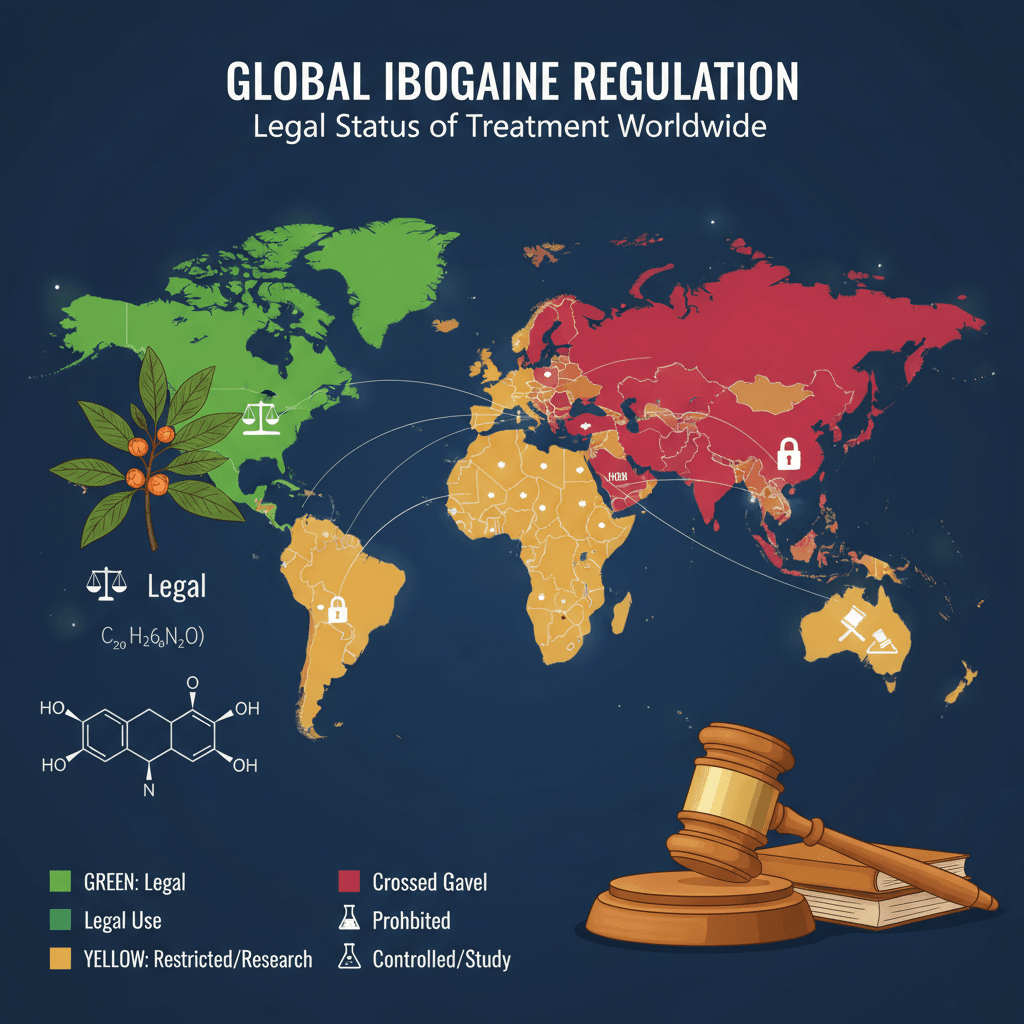
Global overview of ibogaine legality
When you look at ibogaine law country by country, three broad patterns appear:
- Total or near total prohibition, often by listing ibogaine as a high schedule controlled substance
- Restricted medical access, usually by prescription or special authorization
- No specific regulation, which in practice can allow clinics to operate with few legal barriers
Understanding which category a country falls into helps you see why so many ibogaine centers are located outside the United States and Canada and why you hear about people traveling to Mexico or Brazil for care. For a structured comparison, you can also refer to ibogaine legal status worldwide and countries where ibogaine treatment is legal.
The following sections walk through key regions and countries that you are likely to study if you are considering ibogaine treatment.
Ibogaine legality in the United States
If you live in the United States, the question “is ibogaine legal” has a clear answer at the federal level: it is not.
Federal classification and what it means for you
In 2026 ibogaine is classified as a Schedule I controlled substance under United States federal law. Schedule I substances are considered to have a high potential for abuse and no accepted medical use, and possession is illegal with possible penalties that include fines, arrest, or imprisonment [2].
This classification means:
- You cannot legally possess or use ibogaine in the United States outside of tightly controlled research settings
- Licensed doctors cannot prescribe ibogaine, and pharmacies cannot dispense it
- Operating an ibogaine treatment clinic domestically is not legal under current federal rules
If you want a deeper breakdown of how federal law treats ibogaine, you can explore ibogaine legality in the united states and why ibogaine treatment is not legal in the us.
State level research efforts and pilot legislation
While ibogaine remains illegal for medical use, several states are beginning to invest in research and pilot programs. This does not create legal access for you today, but it does show increasing interest in ibogaine’s potential.
Examples include:
- Arizona: In June 2025, Arizona passed House Bill 2871, allocating public funds for FDA approved ibogaine research focused on neurological conditions such as PTSD and traumatic brain injury [3].
- California: In October 2025, California enacted AB 1103, a law that streamlines state approval for federally authorized clinical research on Schedule I substances like ibogaine, especially for PTSD and mental health conditions in veterans [3].
- Colorado: Colorado voters approved Proposition 122, the Natural Medicine Health Act, in November 2022, decriminalizing possession, cultivation, and sharing of ibogaine for adults 21 and older. As of mid 2025, the state is developing regulations that could eventually allow licensed therapeutic use within a broader natural medicine framework [3].
Other states, including Ohio, Texas, and Washington, are funding or exploring committees to study ibogaine’s therapeutic potential under FDA supervision [3].
These developments may eventually open narrowly defined paths to participate in clinical trials. However, they do not mean that personal ibogaine use or informal treatment in these states is legal.
Special case: Mississippi’s clinical trial bill
Mississippi provides a useful example of how some states are trying to move from prohibition toward research without opening general access. As of early 2026, ibogaine is a Schedule I controlled substance in Mississippi, and is illegal for general use [1].
In 2026, the state Senate Public Health Committee advanced HB 314, a bill that would allow clinical trials of ibogaine for opioid use disorder and neurological conditions such as PTSD. If enacted, this legislation would:
- Confine ibogaine use strictly to FDA regulated research
- Require a consortium approach including the state Department of Health, a drug developer, a lead university, and a hospital
- Coordinate Mississippi based trials with similar research in states like Texas [1]
For you, that means ibogaine would remain illegal for personal or unsupervised use, even if clinical studies begin. Access, if any, would be limited to carefully screened study participants.
Canada and its cautious prescription model
If you live in or are considering travel to Canada, ibogaine occupies a different but still restrictive category. Canada lists ibogaine on its Prescription Drug List, which means:
- It can legally be used only under medical oversight, and typically in hospital or clinical settings
- Access is channeled primarily through Health Canada’s Special Access Program
- Special Access Program approvals for ibogaine are rare, so in practice, very few patients receive treatment this way [2]
This regulatory model reflects a cautious but open stance. Canadian authorities acknowledge ibogaine’s therapeutic potential but insist on strict controls around safety, dosing, and patient selection.
If you are considering Canada, you need to understand that there is no general, open market for ibogaine treatment. Instead, you would be looking at rare, case by case approvals, usually driven by a physician request and careful medical justification.
Mexico and other countries with open access
When you research ibogaine clinics, Mexico appears again and again. Understanding why helps you see how global regulation shapes where treatment is actually available.
Why so many ibogaine centers are in Mexico
Mexico has no specific regulations controlling ibogaine. It is not scheduled as a controlled substance at the federal level, so ibogaine clinics can operate legally without direct ibogaine specific restrictions [2].
Practically, this means:
- Clinics across Mexico can provide ibogaine treatment
- Many cater specifically to international clients, including people from the United States and Canada
- You will see a wide range of settings, from medicalized hospital style programs to smaller retreat like environments
Because ibogaine is federally prohibited in the United States, Mexico has become one of the best known destinations for Americans seeking ibogaine therapy. You can read more detail in is ibogaine treatment legal in mexico and can americans get ibogaine treatment abroad.
Other international examples of broader access
Outside North America, ibogaine’s status is equally diverse:
- Brazil: Brazil permits ibogaine use for addiction treatment by prescription in hospital settings. São Paulo began formal regulation in 2016, and acceptance is gradually expanding to other regions of the country [2].
- New Zealand: International advocates note that New Zealand classifies ibogaine as a prescription medicine, allowing medical use under supervision, in contrast with its Schedule I status in the United States [3].
For you as a prospective patient, these countries represent potential destinations where ibogaine can be accessed in structured clinical contexts, rather than in a legal gray zone.
Africa’s unique role in ibogaine regulation
Because ibogaine is derived from the African iboga plant, it holds a unique cultural and regulatory place in parts of Africa. Two countries often discussed in this context are South Africa and Gabon.
- South Africa: Ibogaine is classified as a Schedule 6 substance. This allows for prescription use but with strict medical oversight, which typically means controlled clinical or hospital based settings [2].
- Gabon: As the indigenous home of Tabernanthe iboga, Gabon treats iboga and ibogaine very differently. Ibogaine is socially accepted and legally protected for traditional and spiritual uses, particularly within recognized ceremonial practices [2].
If you are exploring Africa for ibogaine treatment, you need to distinguish between:
- Traditional spiritual or initiatory ceremonies that involve iboga
- Modern, medically supervised ibogaine detox or addiction treatment
The legal frameworks often recognize traditional use more clearly than imported, clinic style treatment for international clients.
Ibogaine’s origin in African spiritual practice shapes how some countries regulate it, blending cultural protection with modern medical controls.
Why ibogaine is illegal or restricted in many places
You might reasonably ask why ibogaine is a Schedule I substance in the United States or a high schedule drug elsewhere when some studies show potential therapeutic benefits. There are several key reasons.
Safety and medical risk
Ibogaine is pharmacologically complex and can carry serious medical risks, especially for people with heart conditions or those taking certain medications. Reported complications include cardiac arrhythmias and, in rare cases, sudden death.
Because of these risks, regulators often take a conservative position and demand robust safety protocols and controlled settings. The 2024 Stanford linked data and international clinical observations that highlight ibogaine’s promise also reinforce the need for thorough cardiac screening and medical monitoring [1].
In many countries, government agencies prefer to keep ibogaine in a strict or prohibited category until more large scale, controlled clinical trials clarify its risk profile.
Limited large scale clinical research
Compared to approved medications for opioid use disorder and depression, ibogaine has relatively few large, randomized controlled trials. Early evidence is promising but not yet decisive. That gap makes agencies reluctant to recognize ibogaine as having an accepted medical use, which is a key requirement for lower scheduling in places like the United States.
This is why you see a wave of new bills and pilot programs focused on research funding. Lawmakers in states such as Arizona and Mississippi are trying to generate the high quality data regulators need to reconsider current restrictions.
Historical perceptions and international treaties
Ibogaine’s legal history is also shaped by earlier concerns about psychedelics more broadly. In the late twentieth century, many countries adopted strict policies toward psychedelic substances, sometimes grouping diverse compounds under broad prohibitions.
In countries that follow international drug control treaties closely, revisiting ibogaine’s status involves not only new science but also political and diplomatic work to revise treaty interpretations or create specific exceptions.
Traveling abroad for ibogaine treatment
Because ibogaine is illegal or heavily restricted in many home countries, you might consider traveling internationally to seek treatment. This is increasingly common, but you need to think carefully about both law and safety. Resources like ibogaine legal treatment clinics and ibogaine treatment legality explained can support this process.
Legal considerations when you travel
When you travel for ibogaine treatment, there are three main legal questions:
- Is ibogaine legal in the destination country? As discussed above, Mexico, Brazil, and some other countries allow ibogaine in clinical or unregulated settings. You need to verify the current status and local requirements.
- Are you allowed to receive treatment as a foreigner? In many countries with ibogaine clinics, international patients are a primary focus. However, you should confirm visa requirements and any health regulations in advance.
- Can you legally bring ibogaine back home? In almost all cases, the answer is no. For example, returning to the United States with ibogaine would violate federal law regardless of where you obtained it.
Generally, traveling to a country where ibogaine is legal or unregulated to receive treatment is not illegal in itself, as long as you do not import or possess ibogaine where it is prohibited. However, you should always consult your own legal counsel if you have concerns about specific travel plans.
For a practical perspective tailored to Americans, you can review can americans get ibogaine treatment abroad.
Safety and quality of care
Legality does not automatically guarantee safety. In countries where ibogaine is unregulated, clinics can operate without standardized medical rules. As you evaluate options, consider questions such as:
- Does the clinic provide full medical screening, including heart evaluations and lab work?
- Are there licensed medical professionals on site around the clock?
- How do they manage emergency situations?
- What aftercare or integration support do they offer once you return home?
Because ibogaine carries real health risks, you should treat clinic selection as a serious medical decision, not just a travel choice.
How to research ibogaine laws responsibly
If you are personally struggling with addiction or PTSD and looking at ibogaine as a possible option, the legal complexity can feel overwhelming. A step by step approach can help you make sense of the landscape.
-
Clarify your home country’s laws
Start by reviewing whether ibogaine is legal where you currently live. For United States residents, that means understanding the federal Schedule I status and any state level research initiatives. The resource ibogaine legality in the united states can be a useful reference. -
Compare international frameworks
Use guides like ibogaine regulation worldwide and where is ibogaine legal to compare countries that allow, restrict, or prohibit ibogaine. Pay attention to whether access is by prescription, special permit, or completely unregulated. -
Distinguish clinical research from open treatment
Clinical trials, such as those proposed in Mississippi, follow strict protocols and limited enrollment. These are not the same as open, ongoing treatment at a private clinic. When you read about new laws or bills, check whether they are research focused or treatment focused. -
Consult medical and legal professionals
Consider speaking with a healthcare provider who understands addiction medicine, as well as a legal professional familiar with drug policy in your jurisdiction. They can help you evaluate both health risks and legal implications. -
Plan for aftercare
If you do travel abroad for ibogaine, you will return home to the same legal environment you left. Make sure you have a clear plan for ongoing support, whether that is therapy, support groups, or other treatments that are legal and accessible where you live.
Bringing it all together
When you ask “is ibogaine legal,” you are really asking several connected questions:
- How do different countries classify ibogaine?
- Where can you legally access ibogaine treatment today?
- What are the risks if you travel or attempt to use ibogaine at home?
In the United States, ibogaine remains a Schedule I controlled substance, prohibited for general medical use, with only tightly controlled clinical research beginning to open in some states [2]. Canada allows highly restricted access through prescription and special programs. Mexico and some other countries provide far more open access, which is why many treatment centers are located abroad. Brazil, South Africa, Gabon, and New Zealand each illustrate different blends of medical control, cultural recognition, and legal tolerance.
Your next step is to match this legal landscape with your own needs, health status, and risk tolerance. By combining careful legal research, medical advice, and thoughtful consideration of your long term recovery, you can make more informed choices about whether ibogaine fits into your path and where you might safely and legally seek care.