
Understanding ibogaine treatment legality explained
When you first start looking into ibogaine, one of the most confusing parts is its legal status. Ibogaine is a psychoactive substance extracted from the African iboga plant and it is being explored for treating addiction and some mental health conditions, but it can also cause powerful hallucinations and dissociation [1]. These effects, combined with serious health risks, are exactly why ibogaine treatment legality is complicated wherever you live.
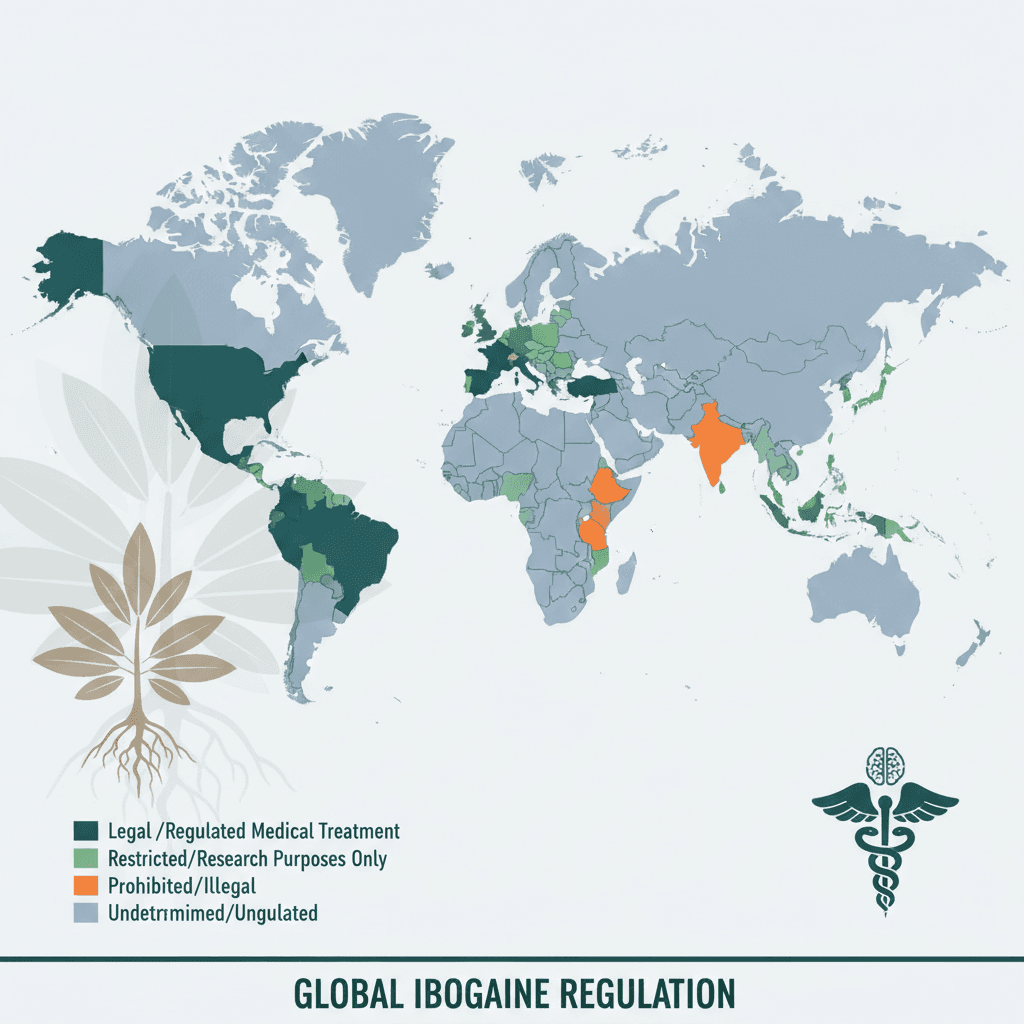
You are navigating a patchwork of national laws, medical regulations, and evolving research. Some countries fully ban ibogaine. Others allow carefully controlled medical use. A few have no clear rules at all, which is why so many ibogaine clinics operate internationally instead of in highly regulated systems like the United States. Understanding this landscape gives you a realistic sense of your options and the risks involved.
If you want a country‑by‑country snapshot, you can also explore resources such as where is ibogaine legal, ibogaine legal status worldwide, and ibogaine regulation worldwide alongside this overview.
Why ibogaine is controversial and tightly controlled
To understand ibogaine treatment legality explained clearly, you need to see why regulators are cautious. Ibogaine is not a typical medication. It is a potent psychoactive with a narrow safety margin.
Safety concerns that drive regulation
Research and clinical observations highlight several serious side effects. Documented risks include low blood pressure, seizures, irregular heartbeat, paralysis, and even death, which directly influence how countries regulate or prohibit ibogaine [1].
A controlled study in the Netherlands looked at 14 patients with opioid use disorder who were given a single oral dose of ibogaine hydrochloride at 10 mg per kg. The study found:
- Clinically relevant but reversible QTc prolongation in all patients
- Half of the participants reached QTc values above 500 ms, a range associated with a high risk of serious cardiac arrhythmias
- All patients developed severe but temporary cerebellar ataxia and could not walk without support, which resolved within 24 hours [2]
Psychological effects in that study were mostly mild to moderate, including wakeful dreaming and vivid memories lasting several hours, but the cardiac and neurological risks were significant enough for the authors to advise strongly against using ibogaine outside well controlled medical settings such as underground or unregulated providers [2].
These data help explain why many regulators are far more concerned about safety than anecdotal reports of benefits.
Limited clinical evidence so far
Although there are promising reports that ibogaine may reduce opioid withdrawal symptoms or cravings and may help with PTSD, large scale, controlled clinical trials are still limited. Experts estimate that it may take up to 10 years before the FDA even considers ibogaine as an approved treatment for substance use disorders, mainly due to safety concerns and lack of robust data [3].
Because the scientific evidence is still emerging, many governments categorize ibogaine as too risky to approve for routine medical use. At the same time, interest in its potential therapeutic benefits is increasing, which is why you see a growing number of clinical trials and state‑level research initiatives.
How ibogaine is treated under international law
One key question you might have is whether there is a unified global rule around ibogaine, similar to what exists for many narcotics.
Ibogaine is not listed on the United Nations International Narcotics Control Board’s Green List or on the List of Psychoactive Substances under International Control, which means it is not subject to a single global control framework as a narcotic substance [4]. There is no coordinated international treaty that dictates how ibogaine must be regulated.
Instead, every country sets its own rules. As a result, you are looking at a patchwork of national laws rather than a unified system [4]. This is why ibogaine can be a prescription medicine in one country, unregulated in another, and a banned Schedule I drug in a third.
If you want a structured overview of how different regions classify ibogaine, you can dive deeper with ibogaine treatment laws and ibogaine regulation worldwide.
Why ibogaine is illegal in the United States
If you live in the United States, the first barrier you face is federal law. Ibogaine is classified as a Schedule I controlled substance, the same category as heroin and some other drugs considered to have high abuse potential and no accepted medical use [3]. At the federal level, it is illegal to possess, manufacture, or prescribe ibogaine outside of very restricted research settings.
Federal status and its implications
As a Schedule I substance:
- Ibogaine is not approved for any medical use
- It cannot be prescribed to you for addiction, PTSD, or any mental health issue
- Clinical research is possible, but must pass stringent federal approvals
Advocates argue that ibogaine does not fit the usual criteria for Schedule I because it is not strongly addictive and appears to have potential therapeutic value for opioid use disorders and PTSD [5].
You can learn more about the specific reasons behind current US restrictions in resources like why ibogaine treatment is not legal in the us and the broader overview ibogaine legality in the united states.
Growing state‑level interest in research
Despite federal prohibition, several US states are pushing to explore ibogaine under FDA supervision. Examples include:
- Arizona, Texas, and Ohio, which have allocated funding or passed laws to support clinical trials of ibogaine for substance use disorders, PTSD, or neurological conditions [6]
- Colorado, where voters passed Proposition 122 in 2022, decriminalizing ibogaine and some other natural medicines for adults and paving the way for regulated therapeutic models [6]
- California, where AB 1103 was passed to streamline approval for federally authorized research on Schedule I and II substances, including ibogaine, to accelerate study of psychedelics for PTSD and other conditions [6]
- Mississippi, where HB 314 advanced in 2026 to allow clinical trials of ibogaine through a consortium of a drug developer, a university, and a hospital, with the specific goal of working toward FDA approval [5]
These measures do not make ibogaine widely legal for medical use. Instead, they create narrow openings for research inside strict legal and regulatory frameworks.
Countries where ibogaine is banned or tightly restricted
Many nations follow a similar path to the United States and treat ibogaine as an illegal or tightly controlled substance. The reasons are usually the same: safety concerns, limited clinical data, and difficulty regulating its unique psychoactive profile.
Countries such as Belgium, France, Norway, Sweden, and Ireland have banned ibogaine due to safety concerns, often reacting to reports of adverse events and fatalities in non‑medical settings [7]. In the United States, ibogaine is Schedule I and completely prohibited outside approved research [3].
In some European nations and others around the world, ibogaine may be classified alongside other controlled hallucinogens, or it may fall under broader psychoactive substance laws. Since there is no unified standard, you must always refer to specific national regulations, which is also the purpose of summaries like ibogaine legal status worldwide.
Where ibogaine may be legal for medical or regulated use
Although many countries restrict ibogaine, others treat it as a medicine or controlled therapeutic substance. In these places, ibogaine can sometimes be prescribed or used in clinical settings under strict supervision.
Prescription or controlled medical use
According to recent summaries, ibogaine is:
- A prescription or controlled medicine in countries such as Canada, Brazil, and South Africa
- Legal or available by prescription in countries like Australia, Finland, New Zealand, and Uruguay, subject to national or provincial regulations [8]
In South Africa and Canada, for example, ibogaine may be allowed within specific medical frameworks or special access programs, usually centered on carefully monitored clinical settings [7].
If you are considering traveling to such a country for treatment, it is important to confirm:
- Whether ibogaine is only available through approved research
- Whether you must be a resident or can access care as an international patient
- What kind of medical oversight and cardiac monitoring are required
You can find more detail on these distinctions in countries where ibogaine treatment is legal and ibogaine legal treatment clinics.
Decriminalized possession and its limits
Some countries have decriminalized possession of many drugs, including ibogaine. Portugal is a well known example, where possession of all drugs, including ibogaine, was decriminalized in 2001. However, decriminalization does not automatically mean regulated medical treatment. It typically means personal possession is treated as an administrative issue rather than a criminal one [7].
If you travel to a decriminalized jurisdiction, you should not assume you can access safe, medically supervised ibogaine therapy. Instead, you may find informal or underground providers that operate without regulatory oversight.
Countries where ibogaine is unregulated or unclear
Some of the most active ibogaine treatment hubs exist in countries where ibogaine is not specifically regulated at the national level. Mexico is one of the best known examples, and this lack of specific national rules has shaped its role in global ibogaine therapy.
Mexico and similar jurisdictions
Mexico remains a central location for ibogaine treatment, in part because ibogaine is not specifically scheduled there. Clinics can legally offer ibogaine treatment without explicit ibogaine restrictions, attracting many international patients, including Americans, who cannot access ibogaine in their home countries [7].
Similarly, some sources note that in countries such as Mexico, the Netherlands, Germany, and Gabon, ibogaine is not fully regulated. This situation has led to a network of unregulated clinics where:
- There may be no standardized dosing or medical protocols
- Product quality control is often uncertain
- Screening for cardiac or neurological risks can vary widely [3]
For a closer look at these patterns and what they mean for you as a potential patient, you can review is ibogaine treatment legal in mexico and where is ibogaine legal.
How clinics operate in unregulated settings
In unregulated environments, clinics often set their own standards. Some invest heavily in medical staff, cardiac monitoring, and evidence‑based screening. Others may provide little more than basic support and rely on anecdotal protocols.
Given the known cardiac and neurological risks, and the study data showing serious but reversible side effects even in controlled settings, using ibogaine outside a medically supervised context is widely discouraged by researchers [2].
If you are evaluating an international clinic in an unregulated country, ask in detail about:
- Onsite or nearby hospital access
- Continuous cardiac monitoring and emergency protocols
- Pre‑treatment screening, including EKGs, lab work, and cardiac history
- Staff qualifications and experience with high‑risk patients
Why so many ibogaine centers are international
Because ibogaine is illegal or heavily restricted in the United States and parts of Europe, many treatment providers base their clinics in countries that either:
- Classify ibogaine as a prescription medicine, or
- Do not specifically regulate ibogaine at the national level
This is why you often find ibogaine centers in Mexico, some parts of Latin America, South Africa, or certain European jurisdictions. They operate where the legal environment allows treatment programs that would not be permitted in more restrictive countries.
The absence of a unified international framework, combined with variations in drug policy, creates the conditions where ibogaine can be banned in one country, controlled as a medicine in another, and unregulated in a third [4].
If you are considering traveling abroad, resources such as can americans get ibogaine treatment abroad can help you think through the practical and legal issues.
Traveling abroad for ibogaine treatment
As someone living in a country where ibogaine is restricted, you may be wondering whether you can legally travel abroad for treatment and then return home. The answer usually involves two separate questions: your destination country’s laws and your own country’s re‑entry rules.
Legal considerations before you travel
You are generally allowed to travel to a foreign country and participate in treatments that are legal there, as long as you follow that country’s laws and do not attempt to bring a controlled substance back across borders.
Key points to consider include:
- You must not transport ibogaine into or out of your home country if it is controlled there
- You are responsible for verifying that ibogaine is legal, regulated, or at least not prohibited in your destination
- Your home country’s laws apply as soon as you cross back into its territory, even if the treatment itself was legal abroad
In the case of Americans, ibogaine is illegal in the United States, but US federal law primarily focuses on possession, distribution, and importation, not on medical procedures that took place entirely in a foreign jurisdiction. You still need to be careful never to carry ibogaine across the border.
Medical and ethical questions to ask
Ibogaine treatment is not just a legal issue. It is also a medical and ethical decision. Before you commit to traveling abroad, ask:
- Will the clinic conduct thorough pre‑treatment screening, including EKG and cardiac risk assessment, given the documented QTc prolongation and arrhythmia risk [2]?
- Does the clinical team have experience with your specific substance use history or mental health diagnosis?
- What aftercare support is available once you return home?
- How transparent is the clinic about adverse event reporting and emergency protocols?
Because ibogaine is still considered experimental in many ways, you are essentially stepping into an emerging field. It is important to approach that step with as much information and caution as possible.
Ongoing research and future regulation
Although ibogaine is currently restricted in many countries, there is active research to explore safer and more controlled approaches. For example:
- The US biotech company Delix Therapeutics received funding from the National Institute on Drug Abuse to investigate DLX‑007, a non hallucinogenic analog of ibogaine, with the goal of treating substance use disorders while reducing safety risks [3]
- Clinical experiences in countries like Mexico and studies from institutions such as Stanford have fueled further interest in ibogaine’s potential to reduce withdrawal symptoms and improve outcomes for people with PTSD, although cardiac risks still require careful medical screening [5]
At the policy level, organizations and advocates in the United States are working to reform federal rules to allow more FDA‑approved research on ibogaine, even though it remains a Schedule I substance as of 2025 [6].
Future regulation will likely depend on:
- The strength and safety profile of new clinical trial data
- Developments in analogs that may offer similar therapeutic effects with lower risk
- Political and cultural shifts in how psychedelics and addiction treatments are viewed
For now, you are working in a legal environment where ibogaine is still largely experimental and, in many jurisdictions, prohibited outside narrowly defined medical or research contexts.
Using ibogaine treatment legality explained to guide your next steps
Understanding ibogaine treatment legality explained in a global context helps you make more grounded decisions. You now know that:
- Ibogaine is illegal or tightly controlled in many countries, including the United States, mainly due to cardiac and neurological risks and limited clinical data
- Some nations allow ibogaine as a prescription or controlled medicine, often in specialized clinics
- Others, such as Mexico, do not specifically regulate ibogaine, which has led to a mix of high quality clinics and unregulated providers
- Traveling abroad for treatment is possible, but you must respect both your destination’s laws and your home country’s re‑entry rules, and you must evaluate safety standards very carefully
Your next step is to combine this legal overview with deeper research into specific jurisdictions and clinics. Internal guides like is ibogaine legal, ibogaine treatment laws, and ibogaine legal treatment clinics can help you move from general understanding to specific, practical choices.
As you weigh your options, keep in mind that no legal status, whether restrictive or permissive, replaces the need for thorough medical evaluation and honest discussion with qualified professionals about both potential benefits and serious risks. Ibogaine may be a part of your recovery path, but it should never be approached casually or without full awareness of the legal and health implications.