
Expertise provided by James Collins, Owner
You called three ibogaine programs for your loved one and got three different answers: five days, seven days, ten days. One said it depends. Another asked about medication history before answering. The third gave a quick estimate. None of them explained why the number changes, and now you are trying to book flights without knowing which answer to believe. This page explains what to expect from ibogaine treatment, phase by phase, and why the number of days is a medical answer, not a sales one.
Here is the honest answer.
At Iboga Wellness Institute, the standard program runs seven days and six nights. Some people need a 10- or 14-day stay. A few need to complete preparation at home before they can travel at all.
That number does not come from a brochure. It comes from what your loved one has been taking, how recently they took it, and what state they are in when they walk through the door.
Why Do Ibogaine Treatment Timelines Vary So Much Between Programs and Patients?
Timelines vary because medical readiness sets how long a safe stay needs to be. When Iboga Wellness Institute is asked what most separates one person’s length of stay from another’s, the answer is consistent: the time a person needs to become medically ready for treatment. That matters most when someone arrives with active substance abuse or dependence, or a complicated medication history.
Here is what that looks like in practice. Picture two people who both call about opioid addiction. One has been using short-acting pain pills, takes no other prescriptions, and has a steady heart rhythm on testing. The other takes a benzodiazepine every night, recently started a new psychiatric medication, and has been using more than one substance. They are seeking help for the same substance use disorder, yet their preparation needs are nothing alike.
The physician-led medical team at Iboga Wellness Institute builds every timeline from three questions: what has this person been taking, how recently did they use it, and how stable are they on arrival? Those answers, not the substance name on an intake form, shape the calendar.
Ibogaine is a powerful psychedelic drug, not a gentle medicine. Researchers reviewing its effects have described real cardiac safety concerns, including changes to the heart’s electrical rhythm. Anything that adds strain to the heart, such as withdrawal, certain medications, or a recent dose change, has to be settled before the session. A program that quotes the same short stay to every caller is assuming everyone arrives ready. Many people do not.
So when a program answers “it depends,” that is not always a dodge. The better follow-up is “depends on what?” A program that can name the factors is showing you how it actually thinks about safety.
What to Expect Day by Day in a Standard Seven-Day Ibogaine Treatment Program
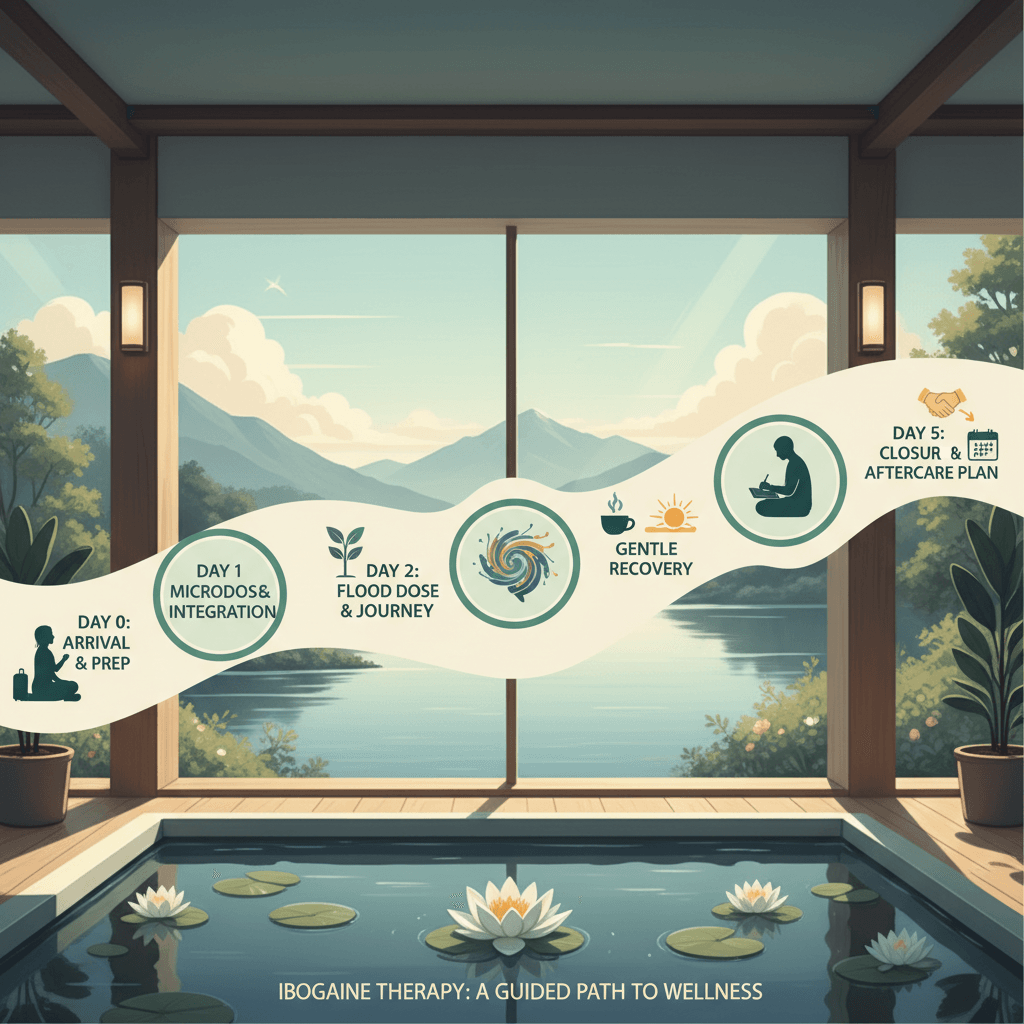
Once the team knows your loved one is ready, the stay follows a clear shape. The seven-day, six-night program at Iboga Wellness Institute is built around one ibogaine flood dose session, but Iboga Wellness Institute is direct with families that the session is only one piece. Evaluation and preparation come before it. Monitoring, rest, and integration therapy come after.
Families are often surprised by this. They picture a week built around a single dramatic day. In reality, much of the work that keeps your loved one safe happens on either side of that day. Here is the general shape of a standard stay:
| Phase | What happens | Why it matters |
|---|---|---|
| Arrival and evaluation | The medical team confirms the pre-arrival review, checks vital signs, and repeats key cardiac checks | Makes sure nothing has changed since screening |
| Preparation | Rest, settling in, and talking through what the session will feel like | A rested body and a calmer mind handle the session better |
| Ibogaine flood dose session | One session with continuous cardiac monitoring and 24/7 nursing, under physician-led care | This is when supervision matters most |
| Monitoring and physical recovery | Close observation as the effects wear off, plus rest and gentle recovery | The body needs time to return to baseline |
| Integration and departure | Guided work to begin making sense of the experience, then planning for home | The insight from the session has to connect to daily life |
The exact day of the session can shift. If your loved one arrives tired, dehydrated, or still having symptoms from recent use, the team may give them more time to settle first. That flexibility is part of the design, not a delay.
The session itself is long and demanding, and people often describe it as tiring and intense. Afterward, many feel physically flat and need real rest. That is why the days after the session are reserved for monitoring and recovery instead of travel.
The final days are where integration begins. Your loved one starts to put words to what they saw and felt, and to connect it to the choices waiting at home. Iboga Wellness Institute wants every person to leave with enough space to recover and start making sense of the experience before they board a plane. That space is what separates a medically supervised program from a dose and a bed.
When Does Someone Need a Longer Ibogaine Treatment Stay?
For some people, seven days is not enough. At Iboga Wellness Institute, a 10- or 14-day program is recommended when someone needs additional stabilization or a medically supervised transition before a session can safely happen. Iboga Wellness Institute is equally clear on a second point: adding days to a booking does not, by itself, make someone eligible for treatment. Certain situations require preparation before your loved one ever gets on a plane.
These are the medical factors that most often extend a stay:
- Active benzodiazepine dependence. Stopping benzodiazepines suddenly can be dangerous and can cause seizures. A person who is dependent may need a slower, supervised transition before an ibogaine session.
- Recent medication changes. A new prescription, a dose change, or stopping a medication in the weeks before arrival can change how the body responds. The team needs time to see where things settle.
- Cardiac considerations. Some people need extra monitoring, more testing, or more time before the heart is in a safe state for a session.
- Substances that cannot be stopped abruptly. Some medications, including certain long-acting opioids and some medications for psychiatric disorders, can affect heart rhythm or carry withdrawal risks. These need a planned approach instead of a hard stop.
When preparation has to happen before arrival, your loved one may need to make changes at home, with their own prescriber, before treatment can be scheduled. And some people are not safe candidates for ibogaine at all. Iboga Wellness Institute does not guarantee treatment to everyone who applies, and when screening shows the risk is too high, the team says so.
That can feel like another door closing, especially after years of programs that did not work. But a program willing to tell you “not yet” or “not this” is a program taking your loved one’s life seriously.
One important caution: please do not let your loved one stop or reduce any medication on their own to speed this up. Every change needs a doctor involved. If your loved one is in immediate danger or talking about ending their life, call 911 or the 988 Suicide & Crisis Lifeline now. Ibogaine is not a crisis service, and urgent care comes first.
How Does Medical Review Decide Your Loved One’s Actual Treatment Timeline?
So how does the team arrive at the right number? Before anyone travels, the physician-led team at Iboga Wellness Institute reviews substance use history, current and recent medications, and heart health, including a 12-lead ECG. Iboga Wellness Institute then gives families a realistic timeline through that medical review and explains exactly what is driving it.
This is a comprehensive medical screening, not a quick intake form. The team looks at which substances your loved one uses, how much, and when they last used, whether that is opioids, pain pills, kratom, or benzodiazepines. They look at every prescription and any recent changes. The 12-lead ECG gives a detailed picture of the heart’s electrical activity, including the QTc interval, which reflects how long the heart takes to reset between beats. Toxicology guidance on ibogaine points to heart rhythm problems as a central safety concern, which is why this test is not optional.
You can make the review faster and more accurate. Before the first call, gather:
- A full list of medications, doses, and the prescriber for each one
- Any changes made in the last few months, and when they happened
- An honest account of recent substance use, including any alcohol, and the date of last use
- Recent medical records, especially anything involving the heart
You may be wondering whether a longer recommendation is just an upsell. That fear is fair, especially if you have been burned before, and you should test it. Ask, “What specifically in my loved one’s history requires the extra days?” Iboga Wellness Institute’s standard is that any family told to plan for a longer stay should hear the specific reason behind it: a medication that needs a supervised transition, a test result that needs follow-up, or a withdrawal risk that needs time.
The same thinking carries into the clinic. Physician-led care, 24/7 nursing, continuous cardiac monitoring during the session, and a 4:1 staff-to-patient ratio all exist so the schedule can follow the person, not a preset calendar.
How Do You Plan Flights and Time Off Work for Ibogaine Treatment in Cozumel?
With a timeline in hand, the practical planning gets much easier. All ibogaine treatment at Iboga Wellness Institute takes place at its licensed medical clinic in Cozumel, Mexico. The Columbus, Ohio office handles admissions, screening, and aftercare coordination only. The safest way to plan is to wait for the medical review timeline, then build in flexibility.
Families often ask why treatment happens in Mexico. In the United States, ibogaine is a Schedule I substance and is not approved by the FDA for treating addiction or any other condition. Its use remains investigational. Iboga Wellness Institute does not provide ibogaine anywhere in the United States. What the US-based institute offers is a place to begin your journey: admissions, screening, and aftercare coordination run from Columbus, with American consumer protections behind the organization.
Treatment takes place in one of three private Cozumel settings that share one clinical standard. The setting may differ, but the monitoring, staffing, and safety protocols do not.
Iboga Wellness Institute knows the reality on the family side: you are booking flights, asking for time off work, and often making this decision in the middle of a hard season. These steps help most:
- Book flights after the review, not before. A changeable return ticket protects you if the stay runs longer than planned.
- Request time off for the longest likely window. If the review suggests seven days, plan for a few more, so a medical decision is never squeezed by a work deadline.
- Arrange caregiving early. Children, pets, and aging parents at home need a plan that can stretch.
- Ask about companions. If you want to travel with your loved one, ask admissions what that looks like and where you would stay.
- Talk about cost before you commit. Iboga Wellness Institute does not accept insurance, so it is worth knowing that up front. Ask admissions to explain the cost for the length of stay your loved one actually needs, and what payment or funding options may be available.
The admissions team believes healing shouldn’t wait for financial readiness. A clear plan with room built in is one less thing to carry.
What Happens After the Ibogaine Session, and Why Can’t the Flight Home Decide?
Part of knowing what to expect from ibogaine treatment is understanding that the session is not the finish line. After it comes monitoring, physical recovery, and the start of integration. The clinical team decides when your loved one is stable enough to travel, not the date on a ticket.
Iboga Wellness Institute holds two commitments at once here. The team has no interest in keeping anyone a day longer than they need. It also refuses to let a booked departure push a clinical decision. If your loved one needs another day of rest or observation, the timeline will not be compressed to make a flight. That is exactly when a flexible ticket earns its value.
Integration is where the session starts to mean something. The program draws on ancient Bwiti tradition alongside modern neuroscience, an approach the institute sums up as “Ancient wisdom. Modern science. Infinite possibilities.” During the stay, your loved one begins to name what came up and what they want to change. Back home, the Columbus office coordinates aftercare support so that work keeps going instead of fading in the first hard weeks.
Families deserve honesty here: responses to ibogaine vary from person to person. One client we worked with described finding clarity that helped them begin to rebuild their life; this reflects their documented experience in a single engagement, not a typical or guaranteed outcome. The changes made afterward in relationships, purpose, and health are just as important as the session itself in shaping what comes next.
The hope is not just that your loved one stops using.
It is that they build toward the goal of lasting freedom, a life they no longer feel the need to escape from.
For a broader overview, see the complete guide to ibogaine treatment, or read about the medical detox program if stabilization is part of your loved one’s picture.
Questions Families Ask Before They Book
Most questions families bring to an admissions call come back to two things: how long, and why. Here are direct answers to the ones the Iboga Wellness Institute team hears most.
How long is the ibogaine treatment session itself?
The ibogaine flood dose is given in a single session. The full stay is longer, because your loved one needs time beforehand for evaluation and preparation, and time afterward for monitoring, rest, and integration. At Iboga Wellness Institute, the standard program is seven days and six nights.
Can I do ibogaine treatment in less than seven days?
Some clinics advertise shorter stays online. A safe stay still has to include pre-treatment evaluation, the session, and post-session monitoring and recovery. Iboga Wellness Institute builds its standard program around seven days so recovery is never rushed.
Why would someone need a 10- or 14-day ibogaine program?
A longer program fits people who need additional stabilization or a medically supervised transition, often off substances that interact with ibogaine or cannot be stopped suddenly. Benzodiazepine dependence, recent medication changes, and cardiac considerations are common examples. Medical need sets the length, not preference.
How do I know if my loved one needs a longer stay before I book?
The medical review at Iboga Wellness Institute looks at substance use history, recent medication changes, and cardiac stability, including a 12-lead ECG. You receive a realistic timeline and the reasons behind it before anyone travels, so you can plan flights and time off with confidence.
Where does ibogaine treatment at Iboga Wellness Institute take place?
All ibogaine treatment takes place at the licensed medical clinic in Cozumel, Mexico, in one of three private settings with one clinical standard. The Columbus, Ohio office handles admissions, screening, and aftercare coordination only. No ibogaine treatment happens at any US location, and ibogaine is not FDA-approved in the United States.
What happens if my loved one is not medically ready when they arrive?
Sometimes preparation has to happen before treatment can go forward. The medical team will explain exactly why and recommend next steps, which may include a longer stay or preparation at home with your loved one’s own prescriber. In some cases, the team may decide ibogaine is not a safe option.
Get a Timeline Built Around Your Loved One, Not a Calendar
The only way to get a real number is a medical review of your loved one’s own history. Contact the admissions team at Iboga Wellness Institute for a confidential medical review. You will receive a realistic timeline based on your loved one’s substance use history and medication background, along with a clear picture of what to expect from ibogaine treatment in their case.
You have already heard three different answers from three different programs. You do not need a fourth guess. You need a team that looks at the actual medications, the actual heart rhythm, and the actual pattern of use, then tells you what it sees and why.
The review is confidential and does not commit you to anything. If the team believes ibogaine is not safe for your loved one, it will tell you that honestly instead of selling you a week.
Clinical care without compromise starts with one conversation.
Before you call, sit down with your loved one and write out every medication, every dose, and the date of last use for each substance. That single page is what turns “it depends” into a number you can plan around.
Important legal and safety information: Ibogaine is not approved by the FDA and is not available as a legal medical treatment in the United States. Iboga Wellness Institute provides ibogaine treatment exclusively at its licensed medical clinic in Cozumel, Mexico, under medical supervision. US locations handle admissions, screening, and aftercare coordination only.
Ready to understand what your treatment timeline will look like?
Every person’s experience with ibogaine is different, and the best timeline for you depends on your situation and goals. If you’ve been weighing whether this approach fits into your life, a brief conversation with our admissions team can walk you through what to expect before, during, and after your time at our licensed medical clinic in Cozumel, Mexico. You don’t need all the answers yet,just the willingness to ask your questions.
Individual experiences with ibogaine vary. Outcomes depend on many factors, including medical history, substance use patterns, and choices made after treatment.