
Why understanding ibogaine treatment length matters
When you are considering ibogaine therapy, one of your first questions is usually how long ibogaine treatment lasts and what that time will actually look like for you. You might be trying to plan time away from work or family, or you may simply want to know how long you will be in a highly altered state and how long medical monitoring continues.
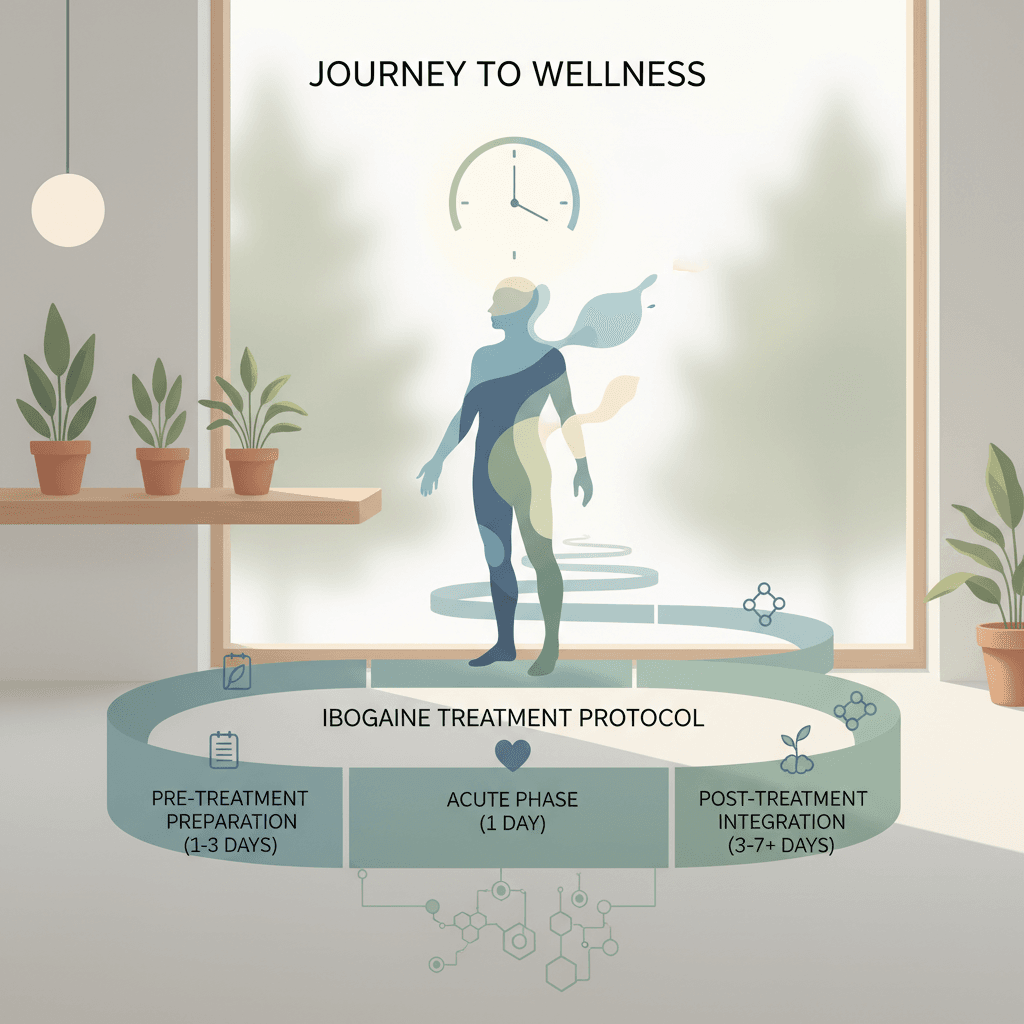
Ibogaine treatment is not a quick, single‑moment event. It is a structured process that unfolds in phases. These include preparation, the 24‑hour treatment session, the immediate recovery period, and a longer integration and aftercare phase. Understanding each of these timeframes helps you set realistic expectations and choose a program whose ibogaine therapy length of stay fits your needs and safety requirements.
Key timeframes at a glance
Before you look at each phase in detail, it can help to see a high‑level view of how long ibogaine treatment lasts from your first day in the program through early recovery.
| Phase | Typical timeframe | What mainly happens |
|---|---|---|
| Pre‑treatment evaluation & prep | Several days to 1 week (sometimes longer) | Medical screening, lab tests, EKG, psychiatric assessment, stabilization |
| Detox & flood‑dose treatment night | About 24 hours | Ibogaine dosing under continuous monitoring, acute experience |
| Immediate “gray day” recovery | Next 24 hours after dosing | Lingering effects, rest, symptom management |
| Early residential stay | Total stay often 5 to 60 days | Supportive care, therapy, booster doses, integration work |
| Physiological ibogaine presence | Several months in your system | Ongoing subtle effects, craving reduction [1] |
| Symptom & function follow‑up | Weeks to months | Monitoring mood, cognition, and functioning changes [2] |
The rest of this guide walks you through each of these phases so you know what to expect and how they add up to the overall ibogaine treatment duration.
How long the ibogaine session itself lasts
When you ask how long ibogaine treatment lasts, you may be thinking specifically about the psychedelic or visionary part of the experience. In clinical and research settings, a typical “flood dose” of ibogaine is around 15 to 20 mg per kg of body weight. That dose usually produces an experience lasting about 12 to 36 hours, and it moves through several distinct phases [3].
Onset of effects
After you take ibogaine, you generally begin to notice effects within 30 minutes to 3 hours. As the medicine takes hold, awareness shifts, visual phenomena may appear, and you may feel changes in body sensations and emotions. The UC Berkeley Center for the Science of Psychedelics notes that the effects of ibogaine typically start in this early window and gradually intensify [4].
During this onset phase, you are usually in bed or in a comfortable recliner in a private room or quiet setting. Medical staff monitor your heart function and vital signs closely to ensure your safety throughout the entire dosing period [1].
Acute visionary phase
The most intense part of the ibogaine experience, sometimes called the acute phase, generally begins 1 to 3 hours after dosing and can last around 4 to 8 hours. In this period, many people experience vivid waking dreams, life review imagery, and powerful emotional insights. You are usually lying still with eyes closed or with minimal movement so your heart and nervous system are not unnecessarily strained.
Even though this phase can feel long and immersive, it is only one part of the larger 24‑hour ibogaine treatment window. Clinicians describe this as the first of three main phases of a flood dose experience [3].
Evaluative and reflective phase
As the intensity of images and visuals decreases, you typically enter what researchers call the evaluative phase. This can begin around 8 to 20 hours after your initial dose. During this time, you may feel more able to reflect on what you have seen and felt, to make connections about your history, your substance use, trauma, or relationships.
Visuals are usually less prominent, but you may notice a strong inner dialogue, emotional processing, and a sense of working through personal material. This period still occurs under medical observation in most structured programs, because your body and nervous system remain in a sensitive state [3].
Residual phase and wakeful clarity
The final phase of the acute treatment window is sometimes called the residual phase. It often begins somewhere between 12 and 24 hours after dosing and can last for 24 to 72 hours. During this time you may notice a reduced need for sleep, a feeling of mental clarity, or mild stimulation. You might also experience disturbed or fragmented sleep and ongoing physical sensitivity.
Clinical descriptions note that the entire sequence of acute, evaluative, and residual phases can cover that 12 to 36 hour window, with some residual effects continuing for several days [3]. UC Berkeley also reports that ibogaine effects peak between about 18 and 36 hours after ingestion, with lingering heightened awareness and disturbed sleep extending up to 72 hours in many people [4].
The structured 24‑hour treatment period
Most medical ibogaine programs organize the core treatment around a 24‑hour block, even though the subjective experience can continue a bit longer. Your ibogaine treatment usually begins in the evening. You complete dosing while staff remain on duty overnight, with continuous heart monitoring and close observation in a private room [1].
The focus of this 24‑hour period includes:
- Careful administration of the flood dose and any test doses
- Continuous EKG or heart monitoring
- Management of nausea, vomiting, or discomfort
- Supportive presence while you move through the visionary or introspective phases
- Safety interventions if any concerning signs appear
The next day, sometimes described as the “gray day,” you are usually past the peak of the experience but still dealing with residual effects. You may feel sensitive to light and sound, emotionally open, somewhat unsteady when walking, or simply deeply tired. Staff help you rest, hydrate, and gradually transition to a more normal state as the acute ibogaine effects subside [1].
If you are focusing on the narrow question of how long ibogaine treatment lasts from a dosing and monitoring standpoint, that answer is generally this 24‑hour core period plus the following “gray day” of recovery, so about 2 days of intensive focus.
How long you stay in an ibogaine program
From a program and logistics point of view, it is more accurate to think in terms of how many days ibogaine treatment takes rather than only the hours of the medicine session. Most centers organize care into a broader arc that includes evaluation, detox support, the ibogaine session, and post‑session integration. Your total ibogaine therapy length of stay can range widely depending on your medical history, substances used, and your goals.
According to one provider, ibogaine treatment itself is a 24‑hour process, but your overall stay at the treatment center can extend from 5 to 60 days, depending on the program you choose [1]. Shorter stays tend to focus on detox and the acute ibogaine session, while longer programs incorporate more preparation, psychotherapy, and aftercare planning.
If you are comparing programs and trying to understand the duration of ibogaine therapy program options available, pay attention to:
- How many days of pre‑treatment screening and stabilization are included
- How many days after your flood dose you remain on site for monitoring
- Whether booster doses and follow‑up therapy sessions are part of the package
- What kind of integration and relapse prevention services you receive before you leave
These details determine not only how long you will be away from home, but also how much ongoing structure supports your transition after the major ibogaine session.
Detox and preparation: days before dosing
If you have been using opioids, alcohol, benzodiazepines, or other substances heavily, detox and preparation are critical parts of how long ibogaine treatment lasts for you. Many programs require that you undergo medical screening, lab work, and sometimes supervised detox before ibogaine is administered.
This preparation period often includes:
- Comprehensive physical exam and cardiac screening
- Laboratory testing and EKG
- Psychiatric and psychological assessment
- Tapering or stabilizing certain medications
- Nutritional support and hydration
If withdrawal symptoms are expected, your length of ibogaine detox program may add several days or more before your actual ibogaine session. In a 2017 study of 88 patients who received ibogaine in Mexico, 80 percent reported that ibogaine eliminated or drastically reduced opioid withdrawal symptoms during treatment, with relief often occurring within hours [3]. Even so, careful planning around the timing of your last use of opioids or other substances is essential for safety.
When you look at the ibogaine detox program length that a center offers, ask how they coordinate detox with ibogaine dosing, how they manage medications, and how they decide when you are stable enough for the flood dose.
Recovery in the days immediately after ibogaine
After the main ibogaine experience concludes, the timeline shifts from acute effects to early recovery and integration. Even though your most intense visionary experiences may be behind you within 24 to 36 hours, your body and mind are still adjusting. UC Berkeley notes that people often report residual effects like heightened awareness, mild stimulation, and disturbed sleep for up to 72 hours after ibogaine [4].
Many programs recognize this and build several additional days of rest and therapeutic support into their ibogaine therapy program timeline. During this early recovery window, you may:
- Sleep irregularly and feel wired but tired
- Experience emotional sensitivity or vulnerability
- Notice shifts in cravings or motivation
- Begin speaking with therapists or guides about what arose during your session
- Join gentle group activities, mindfulness sessions, or light movement as appropriate
Your program’s plan for how long recovery takes after ibogaine will depend on your initial condition and how you respond to treatment. Many centers recommend staying for at least a week after dosing so that you have time to stabilize, begin integration, and create a concrete plan for ongoing support at home.
Extended aftercare and booster doses
Ibogaine’s overall impact often extends beyond the time you are physically in a clinic. One program describes an aftercare plan in which, once you complete your primary ibogaine treatment program, you receive two ibogaine booster doses and two therapy sessions to support ongoing sobriety and integration [1]. These boosters are given at carefully chosen intervals rather than immediately.
It is important to know that ibogaine remains in your system for several months after treatment, which indicates a prolonged physiological presence even though the acute psychedelic effects have passed [1]. Because of this and because of the medicine’s potency, most programs advise that you do not undergo another full ibogaine treatment within 3 to 4 months of the first. Waiting at least this long supports safety and allows you to integrate the changes already in motion.
From a practical perspective, that means your relationship with ibogaine can extend over many months, even if you are only at the center for a few weeks. The question of how long ibogaine treatment lasts then includes this longer arc of physiological effects and scheduled follow‑ups.
Lasting changes in symptoms and functioning
Beyond subjective experiences, recent research has started to track how long ibogaine‑related improvements may last, particularly for trauma and mood symptoms. In a 2024 study from Stanford Medicine, 30 special operations veterans with traumatic brain injuries received ibogaine combined with magnesium at a clinic in Mexico. Immediately after treatment, they showed significant improvements in PTSD, depression, anxiety, and overall functioning, and these gains persisted for at least one month following treatment [2].
In that study, participants’ average disability rating dropped from 30.2, which reflects mild to moderate disability, to 5.1, which corresponds to no disability, one month after treatment. Symptom reductions were also striking. On average, PTSD symptoms dropped by 88 percent, depression symptoms fell by 87 percent, and anxiety symptoms decreased by 81 percent compared to baseline, all within that first month [2].
Formal cognitive testing in the same group showed improvements in areas like concentration, information processing, memory, and impulsivity one month after treatment [2]. Importantly, no serious side effects or heart complications were reported in this study. The most common symptoms during treatment were headaches and nausea [2].
For addiction treatment, a 2017 survey of 88 patients who received ibogaine in Mexico found that 50 percent reported reductions in opioid craving lasting at least one week after treatment, and 25 percent reported craving reductions lasting three months or longer [3]. About 30 percent of participants said they never used opioids again after their ibogaine treatment. Among those abstainers, more than half had been abstinent for at least one year, and almost one third for two or more years at the time of the survey. Overall, 41 percent of all participants reported sustained opioid abstinence for more than six months, and many who did relapse still reported decreased opioid use compared with their pretreatment levels [3].
These findings suggest that for many people, the question of how long ibogaine treatment lasts covers a much longer window than the day of dosing. Symptom relief, functional improvements, and craving reductions can continue for weeks or months after you leave the treatment center, especially if you combine ibogaine with ongoing therapy and support.
Why programs limit repeated ibogaine sessions
Given the possibility of powerful and lasting effects, you might wonder why you cannot simply repeat ibogaine treatment frequently. Most reputable programs deliberately limit how often you can receive ibogaine. Providers commonly advise that you should not undergo additional ibogaine treatment within 3 to 4 months of an initial session because of the medicine’s potency, complexity, and prolonged presence in your system [1].
There are several reasons for this recommended spacing:
- Safety for your heart and nervous system
- Time to observe how your mood, cognition, and cravings shift
- Space to integrate insights and make real‑world changes
- Opportunity to work with therapy, support groups, and lifestyle adjustments
This perspective reinforces the idea that ibogaine is not simply a one‑night event. It is a process that continues to unfold across months, and responsible providers design your ibogaine program schedule explained with that extended timeline in mind.
Connecting treatment length with your goals
When you are preparing for ibogaine therapy, it can help to reflect on how your goals line up with program length. If you are primarily focused on interrupting opioid dependence and minimizing acute withdrawal, you may prioritize a program whose ibogaine detox program length is built around safe detox and a strong medical team. If you are seeking deep trauma work or long‑term psychological healing, you might benefit from a longer stay that includes several weeks of integration and aftercare planning.
As you compare options and try to understand how many days ibogaine treatment takes, consider asking each center:
- How many total days will I be on site from admission to discharge
- How many days are devoted to evaluation and preparation before dosing
- How many days after the flood dose do I remain under medical observation
- What specific integration and therapy services are included after the main session
- How you coordinate ongoing care once I return home
By matching the ibogaine treatment duration to your health history, substance use pattern, and long‑term goals, you give yourself the best chance for meaningful and lasting change.
Putting the timeline together for yourself
If you step back and look at the full picture, how long ibogaine treatment lasts depends on what part of the process you are focusing on:
- The psychedelic and visionary experience generally unfolds over 12 to 36 hours
- The structured medical treatment window is usually about 24 hours plus the following “gray day”
- Your residential or in‑clinic stay often ranges from about 5 days to several weeks, and in some cases up to 60 days
- Physiologically, ibogaine can remain in your system for months
- Psychological and functional changes can continue to evolve over weeks to years, especially when paired with strong aftercare
Understanding these layers helps you move beyond the idea of ibogaine as a single, isolated event. Instead, you can view it as a carefully timed intervention embedded in a broader recovery plan. When you know what to expect from each phase and how they fit together, you are better prepared to choose a program, plan your time away, and fully engage in your own healing process.