
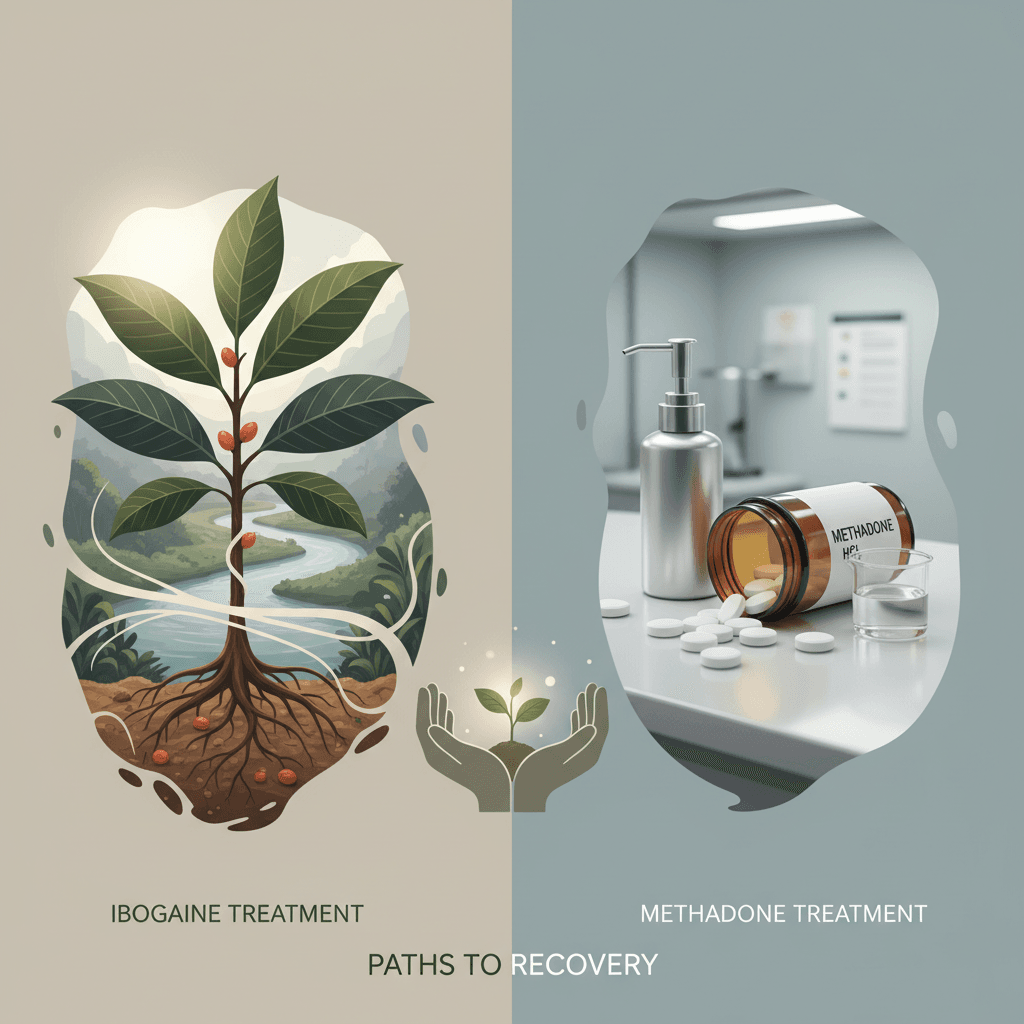
Understanding ibogaine vs methadone treatment
When you compare ibogaine vs methadone treatment, you are really looking at two very different philosophies of addiction care. Methadone is a long term, regulated medication for opioid use disorder that focuses on stabilization and harm reduction. Ibogaine is an experimental, psychedelic plant based compound often used in one or a few intensive sessions with the goal of interrupting dependence and catalyzing deep psychological change.
For you as a person considering your options, it is important to understand how each approach works, what the evidence shows about outcomes, and what risks you may face. This guide walks you through those points so you can have more informed conversations with your treatment team, loved ones, or potential providers. If you are also comparing detox experiences specifically, you may want to review ibogaine vs methadone detox as a companion resource.
How ibogaine and methadone work
Although both ibogaine and methadone are used in the context of opioid use disorder, they act very differently in your body and your day to day life.
Methadone: Long term opioid replacement
Methadone is a full opioid agonist prescribed and dispensed through licensed opioid treatment programs. It attaches to the same receptors that drugs like heroin or fentanyl target, but it does so in a controlled and longer acting way.
In practice, this means you usually take methadone once daily and it:
- Reduces or eliminates withdrawal symptoms
- Diminishes cravings
- Blocks or blunts the effect of other opioids
For many people, this provides stability so you can work, care for family, and participate in counseling or other supports. Methadone treatment is typically ongoing for months or years, and some people remain on maintenance indefinitely.
Methadone does carry medical risks, including potential QT interval prolongation on an electrocardiogram and overdose risk if misused. However, it is an approved medication with standardized dosing, clear protocols, and ongoing monitoring.
Ibogaine: Psychedelic “interruption” approach
Ibogaine is a psychoactive alkaloid derived from the root bark of the African shrub Tabernanthe iboga. It is not approved as a medication for opioid use disorder in the United States, and its use is restricted or illegal in several countries. Nonetheless, some clinics in places like Mexico and parts of Europe offer ibogaine for addiction treatment.
Ibogaine is typically given as a single large dose or a short series of doses. The experience may last 12 to 24 hours or more and involves:
- Intense psychedelic or visionary states
- Physical effects such as ataxia, nausea, and changes in heart rate
- A prolonged period of reflection and integration afterward
From a biological perspective, ibogaine interacts with multiple systems in your brain, including opioid, glutamate, and serotonin receptors. It also has strong effects on cardiac ion channels, particularly hERG potassium channels, which is a major reason for its safety concerns.
What the research says about ibogaine outcomes
Although there is no large scale randomized trial directly comparing ibogaine vs methadone treatment, several observational studies shed light on what you might expect from ibogaine, particularly for opioid use disorder.
Withdrawal relief and short term changes
In a 2017 observational study of 88 people treated with ibogaine for problematic opioid use in Mexico, about 80 percent reported that ibogaine eliminated or drastically reduced their opioid withdrawal symptoms in the acute phase [1]. For many participants, this relief was rapid and subjectively comparable to or greater than what they associated with opioid maintenance therapies like methadone.
The same study reported that 70 percent of participants eventually relapsed to some opioid use. However, relapse did not mean that nothing changed. After ibogaine:
- 48 percent of participants who relapsed still reported reduced opioid use compared to pretreatment
- An additional 11 percent who initially relapsed eventually achieved abstinence [1]
This suggests that even when ibogaine does not produce immediate and permanent abstinence, it may still shift your relationship with opioids and reduce total use.
Long term abstinence and psychological effects
In that same Mexican cohort, 30 percent of participants reported never using opioids again after ibogaine. Among this abstinent group, more than half, 54 percent, maintained cessation for at least one year and 31 percent for at least two years [1]. These numbers are notable, since long term abstinence can be hard to achieve in standard care settings.
The study also found that “responders,” those who reduced or stopped opioid use, reported:
- Lower levels of depression and anxiety
- Higher subjective well being
compared to non responders at follow up [1]. Many participants attributed part of their progress to spiritual or insightful experiences during ibogaine sessions, which implies an important psychotherapeutic or meaning based component that is different from daily methadone maintenance.
At the same time, the authors stressed that more controlled research is needed to confirm these effects and to understand how ibogaine’s biological and psychological actions compare directly with established treatments like methadone [1].
What the research says about ibogaine safety
If you are weighing ibogaine vs methadone treatment, safety should be central to your decision. Methadone is not risk free, but its profile is well characterized and protocols are standardized. With ibogaine, newer data underline serious cardiac concerns.
Cardiac risks and QT prolongation
A descriptive open label observational study in the Netherlands followed 14 people with opioid use disorder on opioid maintenance treatment who received a single oral dose of ibogaine hydrochloride at 10 mg per kilogram body weight [2]. To avoid overlapping QT effects, methadone was discontinued before ibogaine and replaced with morphine.
Key findings from this study included:
- A mean maximum increase in QTc interval of 95 milliseconds
- 50 percent of subjects reached a QTc over 500 milliseconds within 24 hours
- QTc prolongation persisted beyond 24 hours in several subjects [2]
QTc prolongation at that level is a known risk factor for torsades de pointes, a potentially life threatening cardiac arrhythmia. The mechanism appears tied to ibogaine’s potent inhibition of cardiac hERG potassium channels. Methadone can also prolong the QT interval, but in this study all participants had normal baseline QTc values on methadone before switching regimens, which highlights ibogaine’s comparatively greater acute impact on cardiac conduction [2].
Other short term effects
The same Netherlands study noted that ibogaine administration induced:
- Transient bradycardia, a slow heart rate
- Severe ataxia, or loss of coordination, that fully remitted within 24 to 48 hours
- Mostly mild and manageable withdrawal symptoms overall [2]
Despite the manageable withdrawal, three out of fourteen participants returned to morphine treatment within 24 hours, which suggests limited very short term efficacy compared with ongoing opioid maintenance.
Given the combination of significant QTc prolongation, neurological effects, and limited evidence of sustained withdrawal suppression in this small group, the authors recommended against using ibogaine outside of highly controlled medical settings. They contrasted this with methadone, which, while imperfect, is an approved and monitored standard for opioid dependence [2].
Comparing ibogaine vs methadone outcomes
Although the research base is uneven, you can still think about ibogaine vs methadone treatment in a structured way across key dimensions.
| Dimension | Ibogaine (as studied) | Methadone maintenance (typical) |
|---|---|---|
| Primary goal | Rapid detox and interruption of use, deep psychological shift | Long term stabilization, harm reduction, gradual behavior change |
| Dosing model | One or a few high dose sessions | Daily supervised dosing or take home with monitoring |
| Withdrawal experience | Often rapid and significantly reduced for many participants [1] | Withdrawal is avoided by maintaining a stable opioid level |
| Short term risks | Major cardiac risks, QTc > 500 ms in 50 percent in one study, transient neurological effects [2] | Overdose risk if diverted or misused, some QTc risk, respiratory depression if combined with other sedatives |
| Long term outcomes | 30 percent abstinent in one cohort, many others with reduced use and better mood, based on observational data [1] | Strong evidence for reduced mortality, HIV and hepatitis transmission, and criminal activity, outcomes depend on adherence and support |
| Regulatory status | Not approved for OUD in US, offered in some foreign clinics | FDA approved, tightly regulated in certified programs |
This table highlights that ibogaine tends to be framed as a concentrated, transformative intervention with higher acute risk and less firm evidence, while methadone is a gradual, population level strategy backed by decades of data.
Integrating psychological and spiritual dimensions
One of the clearest experiential differences you may notice when you compare ibogaine vs methadone treatment is the role of consciousness altering states and meaning making.
Methadone generally does not involve significant psychedelic effects. While some people feel sedated or experience a mild “high” during dose adjustments, maintenance is usually about feeling normal enough to function. The primary therapeutic work happens in counseling, peer groups, and life changes that surround the medication.
Ibogaine, by contrast, often induces intense visions, revisiting past memories, and insight oriented experiences. In the Mexican observational study, researchers noted that patients’ spiritual and insightful experiences seemed to enhance ibogaine’s effectiveness for opioid use disorder [1]. Many participants reported that these experiences helped them see their lives, trauma, or substance use from a new perspective.
If you have also been exploring other psychedelic or plant based approaches, such as ayahuasca or ketamine, you may find it useful to read more about ibogaine vs ketamine therapy and ibogaine vs ayahuasca for addiction. These comparisons can help you place ibogaine within the broader category of psychedelic assisted therapies, as opposed to traditional medication assisted treatment.
Considering ibogaine vs broader MAT options
When you look at ibogaine vs methadone treatment, you are also touching a larger question: ibogaine vs medication assisted treatment in general. Methadone is one form of MAT, but buprenorphine (including Suboxone) and extended release naltrexone are also common.
Medication assisted treatment has a strong evidence base for:
- Reducing overdose deaths
- Improving retention in care
- Lowering rates of infectious disease transmission
If you are thinking about how ibogaine compares with these options overall, you may want to explore ibogaine vs medication assisted treatment, ibogaine vs buprenorphine treatment, and ibogaine vs suboxone treatment. Each resource looks at how ibogaine’s one time or short series approach stacks up against ongoing medication in terms of safety, adherence, and long term change.
How detox and rehab settings fit in
Neither ibogaine nor methadone exists in a vacuum. Your outcomes depend heavily on the setting, monitoring, and aftercare you receive.
Traditional medical detox centers and rehab programs are designed around approved medications, structured support, and stepwise transitions into outpatient care. If you are trying to understand these differences more clearly, ibogaine vs detox centers, ibogaine vs traditional rehab, and ibogaine vs rehab programs can help you compare typical timelines, staffing, and follow up support.
Ibogaine is usually offered in non standard settings, sometimes framed as retreats or alternative clinics. Given the cardiac risks documented in clinical studies, the Netherlands authors emphasized that ibogaine should not be used outside well controlled medical settings with proper cardiac monitoring and emergency capacity [2]. If you consider ibogaine, you would need to examine carefully how a specific provider manages screening, dosing, continuous ECG monitoring, and medical emergencies.
Questions to ask yourself and your care team
Deciding between ibogaine vs methadone treatment, or deciding whether to include ibogaine at all in your recovery plan, is personal and complex. Reflecting on questions like these can clarify your priorities:
- Are you primarily seeking stability, reduced risk of overdose, and the ability to rebuild your life gradually, or are you drawn to the possibility of a rapid but more experimental “reset” experience?
- How comfortable are you with significant medical risk in exchange for a potentially shorter course of treatment?
- Do you have any known heart conditions, electrolyte disturbances, or other medical issues that would increase ibogaine risk?
- What kind of professional and peer support will you have after any treatment, whether methadone maintenance, ibogaine, or another approach?
- How do your personal beliefs about medication, psychedelics, and spirituality fit with each option?
If you are also weighing other psychedelic modalities beyond ibogaine, it may help to look at broader comparisons such as ibogaine vs psychedelic therapy for addiction. This can give you a sense of where ibogaine sits in relation to better studied substances like ketamine or psilocybin.
Bringing it all together
When you weigh ibogaine vs methadone treatment, you are not choosing between “good” and “bad,” but between different kinds of evidence, risk, and change. Methadone offers:
- Well established reductions in harm and mortality
- A structured daily routine with professional oversight
- Known side effects and long term data
Ibogaine offers:
- Observational evidence of rapid withdrawal relief and meaningful reductions in use for some people [1]
- Potential for sustained abstinence and improvements in mood among responders
- Significant and well documented cardiac risks, including QTc prolongation over 500 ms in half of participants in one modern study, plus neurological side effects that require close monitoring [2]
Your safest path usually involves open discussion with a knowledgeable addiction professional who can review your medical history, your goals, and the regulatory landscape where you live. As you continue your research, resources that cover ibogaine vs detox medication treatment can also help you place ibogaine alongside other medications used specifically during detox.
You deserve a treatment plan that aligns with both the best available evidence and your own values. Taking time to understand these differences is a meaningful step toward building that plan in a way that supports your long term recovery.