
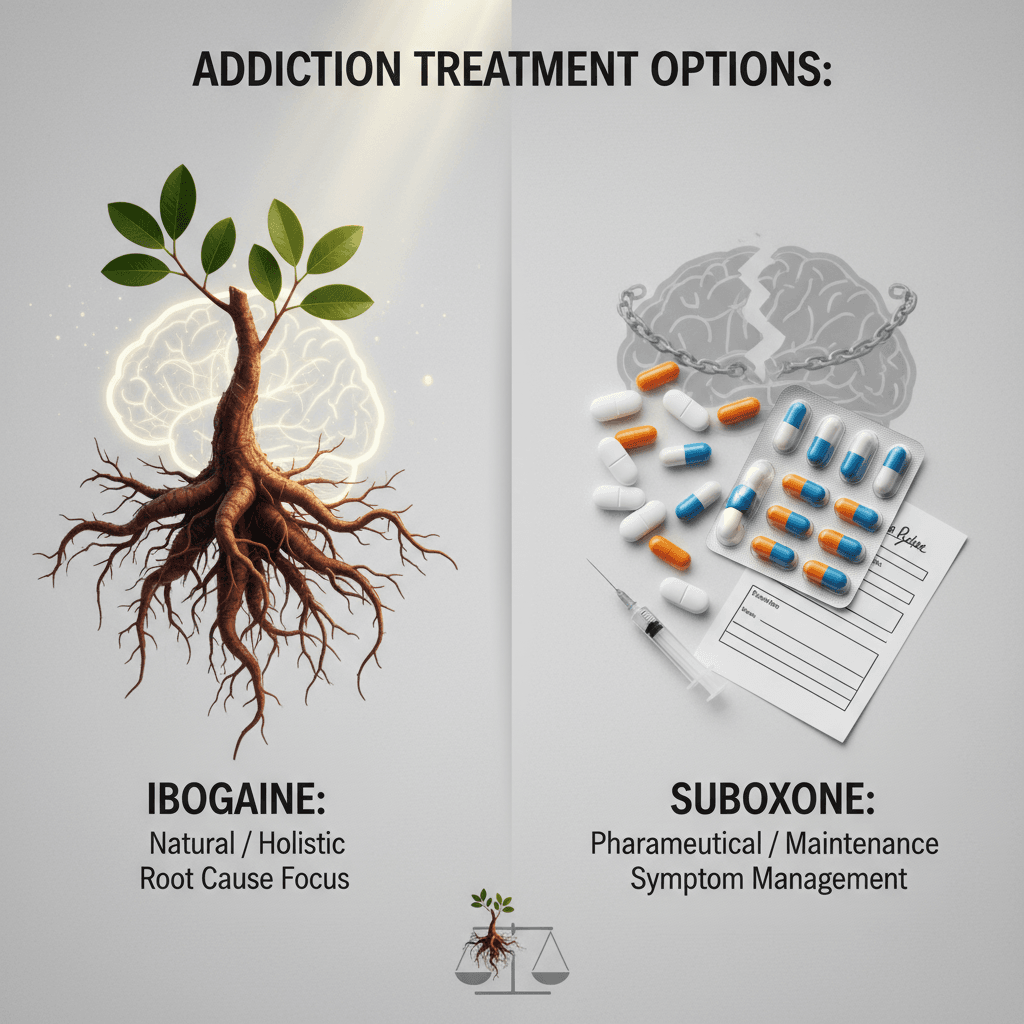
Understanding ibogaine vs Suboxone treatment
When you look at ibogaine vs Suboxone treatment, you are really comparing two very different approaches to opioid addiction. Both aim to reduce withdrawal and cravings, yet they differ in legality, safety, how they work in your brain, and what long‑term recovery might look like.
Ibogaine is a psychoactive substance from the iboga plant native to West Africa. In traditional contexts it has been used for healing and rituals and at low doses it acts as a stimulant while at higher doses it produces powerful psychedelic effects [1]. Because of those properties and its safety concerns, it is controversial as a treatment for opioid dependence.
Suboxone, on the other hand, is a medication that combines buprenorphine and naloxone. It is an FDA‑approved, office‑based treatment for opioid use disorder with a large research base and standardized medical protocols [2].
Understanding how each option works, what the evidence really shows, and what risks you accept is essential before you decide what might fit into your recovery path.
If you are also looking at other options such as methadone, ketamine, ayahuasca, or residential rehab, you may find it helpful to compare them through resources like ibogaine vs methadone treatment, ibogaine vs ketamine therapy, ibogaine vs ayahuasca for addiction, or ibogaine vs traditional rehab.
How ibogaine treatment works
Mechanism and experience
Ibogaine appears to affect multiple neurotransmitter systems, including opioid receptors. It is believed to temporarily reset opioid receptors toward their pre‑addiction state, which may sharply reduce or even stop withdrawal and cravings when taken in high doses [1].
At treatment doses, you can expect:
- A single high‑dose session, usually in a retreat or clinic setting
- A psychedelic or “wakeful dreaming” experience lasting many hours
- Periods of vivid memories and psychological insight that some people describe as life‑review or spiritual
In a 2022 open‑label observational study in the Netherlands, people with opioid use disorder on prior maintenance treatment received a single 10 mg/kg dose of ibogaine‑HCl. They experienced wakeful dreaming and vivid memories, yet not frank delirium, and these psychomimetic effects were generally mild and tolerated [3].
Short‑term effects on withdrawal and cravings
Across observational data you see a consistent pattern. Many people report rapid improvement in acute withdrawal and cravings after ibogaine.
- A survey of 88 people treated with ibogaine in Mexico found that 80 percent said it eliminated or drastically reduced opioid withdrawal symptoms and 50 percent reported reduced cravings, with a quarter of those maintaining reduced cravings for at least 3 months [4].
- In the Dutch study, most participants experienced only mild withdrawal during the first 24 hours after ibogaine. Only 3 of 14 needed to return to morphine maintenance in that period [3].
- A Johns Hopkins observational study, cited by The Recovery Village, reported that 80 percent of 88 subjects experienced drastic or total reduction of withdrawal symptoms and 30 percent remained opioid‑free for years after ibogaine treatment [1].
These are not randomized controlled trials, so you cannot assume the same results for yourself. However, they do suggest ibogaine has real potential to ease acute detox and can, for some people, be a catalyst for long‑term change.
Psychological and spiritual impact
Ibogaine treatment is not only pharmacological. Many people describe it as among the most meaningful experiences of their lives.
In the 2012–2015 Mexican cohort:
- People who responded well to treatment had lower depression and anxiety and higher subjective well‑being than non‑responders
- Responders were more likely to rate the experience as spiritually meaningful and as providing insight into the roots of their addiction [4]
For some, this psychological and spiritual component becomes a turning point, providing motivation and clarity to pursue new behaviors, therapy, or lifestyle changes after the session.
Long‑term outcomes and limitations
In terms of long‑term opioid use:
- In the Mexican study, 30 percent of participants never used opioids again after ibogaine. Among those abstainers, 54 percent had at least 1 year of abstinence and 31 percent reported 2 or more years [4].
- Across all participants, 41 percent reported more than 6 months of abstinence at the time of the survey, and even among those who relapsed, nearly half said their use remained lower than before treatment [4].
These numbers are promising, yet there are key caveats:
- Studies are observational and often rely on self‑reported data
- There are no large randomized controlled trials directly comparing ibogaine with Suboxone, methadone, or other medications
- People who travel to receive ibogaine may be unusually motivated or different from the average person with opioid use disorder
Researchers emphasize that although ibogaine offers a potential single‑dose intervention that rapidly reduces withdrawal and craving and can provide meaningful psychological insight, evidence is still limited and does not replace established treatments such as Suboxone [4].
How Suboxone treatment works
Medication components and brain effects
Suboxone is a combination of:
- Buprenorphine, a partial agonist at the µ‑opioid receptor
- Naloxone, an opioid antagonist that helps deter injection misuse
Buprenorphine partially activates opioid receptors but with a ceiling effect, so its risk of overdose is lower than full agonists. It reduces withdrawal symptoms and cravings while blocking or blunting the effects of other opioids [2]. This is why Suboxone can stabilize your brain chemistry and help you function while you rebuild your life.
Dosing, duration, and medical setting
Suboxone is usually taken daily as a sublingual tablet or film. Treatment usually involves three phases:
- Induction as you transition off short‑acting opioids
- Stabilization while your dose is adjusted
- Maintenance and tapering, which may last months or years
Office‑based treatment with buprenorphine has expanded rapidly. Between 2002 and 2009, prescriptions increased from about 50,000 to over 5.7 million, treating more than 330,000 people in the United States [2]. This shift brought effective opioid treatment out of specialty methadone clinics and into more regular medical settings.
Effectiveness for relapse prevention
Clinical research shows buprenorphine can be as effective as methadone in reducing illicit opioid use and suppressing withdrawal, with less overdose risk and fewer toxic side effects [2].
For detox:
- Short‑term buprenorphine tapers of 7 days were not inferior to 28‑day tapers for immediate detox outcomes
- However, long‑term maintenance on buprenorphine over months is more effective at preventing relapse than short detox protocols [2]
In practice, this means Suboxone works best when you think of it not only as a detox aid but as a longer‑term medication‑assisted treatment that supports stability, engagement in therapy, and lifestyle changes.
Safety and risks: Ibogaine vs Suboxone
When you weigh ibogaine vs Suboxone treatment, safety is one of the starkest differences.
Ibogaine safety profile
Ibogaine is classified by the U.S. Drug Enforcement Administration as a Schedule I substance, which means it is considered to have high potential for abuse and no approved medical use in the United States [1]. As a result, people seeking ibogaine often travel to foreign or unregulated clinics, which may vary greatly in medical standards.
Known risks include:
- Cardiac problems such as QTc prolongation and risk of arrhythmias
- Bradycardia, or slowed heart rate
- Neurological effects like severe ataxia and tremors
- Hallucinations and psychological distress
- A documented number of deaths
A review cited by The Recovery Village reported 19 deaths linked to ibogaine between 1990 and 2008, often associated with preexisting conditions, drug interactions, or lack of medical oversight [1].
In the 2022 Dutch study of people on opioid substitution therapy:
- A single 10 mg/kg dose of ibogaine‑HCl caused clinically relevant QTc prolongation. Half of participants exceeded 500 ms QTc, which indicates a real risk of torsades de pointes, a potentially fatal arrhythmia, even though none were actually observed during monitoring.
- All participants experienced transient severe ataxia that impaired walking. This resolved within 24 to 48 hours.
- Cardiac changes were reversible with careful monitoring [3].
The authors concluded that because of ibogaine’s significant cardiac risks and transient neurological effects, it should be restricted to tightly controlled medical settings with strict cardiac monitoring, especially given how metabolism differences and interactions with other QT‑prolonging or CYP2D6‑inhibiting medications can further elevate risk [3].
Suboxone safety profile
Suboxone is not risk‑free, yet its safety profile is better-characterized and more manageable in routine care.
Recognized benefits and limitations include:
- Buprenorphine has a ceiling effect that reduces the chance of fatal respiratory depression, so overdose risk is lower than many full‑agonist opioids [2].
- It can still be misused or diverted. There is risk of accidental poisoning, especially in children, which newer delivery methods like long‑acting implants aim to reduce [2].
- Suboxone is reported to be the least abused opioid in the United States, but illicit use, particularly by injection, carries serious risks including infection and blood‑borne disease [5].
Long‑term use can have its own side effects:
- Physical issues such as changes in weight or appetite, sleep disturbances, constipation, headaches, and stress on the liver. Ongoing monitoring of liver enzymes is recommended [6].
- Psychological effects such as mood swings, anxiety, depression, and possible cognitive issues with memory or concentration [6].
Stopping Suboxone abruptly after long‑term use may trigger withdrawal, including nausea, muscle aches, and anxiety, which is why a medically supervised taper and comprehensive treatment support are important [6].
Both Indiana Center for Recovery and Maryland Recovery highlight that while Suboxone is effective, it carries dependency risks of its own and works best as part of a structured, professionally monitored plan rather than an indefinite, unmanaged prescription [7].
Comparing mechanisms, duration, and recovery approach
Looking at ibogaine vs Suboxone treatment side by side can help you see the trade‑offs more clearly.
| Aspect | Ibogaine | Suboxone |
|---|---|---|
| Legal status (US) | Schedule I, no approved medical use, not legally available in standard clinics [1] | FDA‑approved medication for opioid use disorder [2] |
| Primary mechanism | Multi‑receptor psychedelic that may reset opioid receptors and reduce withdrawal and craving in a single high‑dose session | Partial opioid agonist plus antagonist that steadily reduces withdrawal, cravings, and opioid reward over time |
| Treatment duration | Typically 1 main session plus integration, sometimes with follow‑ups | Daily medication for months or years with medically supervised taper |
| Evidence base | Observational and survey studies, no large randomized head‑to‑head trials vs MAT [4] | Robust clinical trial and real‑world data for detox and maintenance [2] |
| Safety | Significant cardiac risk, ataxia, potential for death without strict monitoring [3] | Lower overdose risk than full agonists, but dependence, diversion, and side effects are concerns |
| Psychological component | Intense psychedelic, spiritual, and insight‑oriented experience | Primarily pharmacologic stabilization, psychological work added through therapy and counseling |
| Long‑term pattern | Potential one‑time “reset,” but often requires ongoing therapy, support, and lifestyle changes | Steady maintenance and gradual behavior change supported by medication and psychosocial care |
If you would like to explore how ibogaine compares to other medication‑assisted approaches in more detail, resources such as ibogaine vs medication assisted treatment, ibogaine vs buprenorphine treatment, and ibogaine vs detox medication treatment can provide additional context.
Long‑term outcomes: What you can realistically expect
Ibogaine: Potential benefits and unknowns
Long‑term outcomes after ibogaine vary widely. Some people report complete abstinence for years and profound life change. Others relapse quickly or require multiple treatments.
Available data suggest:
- Significant short‑term relief from withdrawal and craving for many
- Around one‑third may maintain long‑term abstinence in some cohorts
- Many others see partial benefit such as reduced use or improved mental health [8]
However, without controlled comparative trials, you cannot say with confidence that ibogaine produces better long‑term outcomes than Suboxone. What you can say is that for a subset of people who tolerate the treatment safely and integrate the experience through therapy, peer support, and lifestyle change, it can be a powerful catalyst.
Suboxone: Stability and gradual change
Long‑term recovery on Suboxone often looks less dramatic but more stable. You may:
- Experience gradual reduction in cravings and illicit opioid use
- Stabilize work, relationships, and daily functioning
- Use the “breathing room” created by medication to focus on therapy and rebuilding your life
Research shows that longer maintenance on buprenorphine is more effective than brief detox when it comes to preventing relapse [2]. The trade‑off is that you may be on a medication that itself can create physical dependence and can be hard to taper, especially if underlying trauma, mental health conditions, or social stressors remain unaddressed.
Maryland Recovery notes that Suboxone and similar medications are often most useful in the detox and early stabilization phases and should be paired with a structured, personalized treatment plan rather than viewed as the only long‑term solution [5].
How to decide what fits your situation
When you weigh ibogaine vs Suboxone treatment, the “right” choice depends on your history, risk tolerance, resources, and goals.
Questions you might ask yourself include:
- How severe is your current opioid use and withdrawal risk?
- Have you tried Suboxone or methadone before? What worked, what did not?
- Do you have medical conditions or medications that increase cardiac risk, which would make ibogaine especially dangerous?
- Are you prepared to engage in therapy, peer support, or structured rehab after any detox or psychedelic experience?
- How do you feel about daily medication versus a one‑time or occasional psychedelic intervention?
If you are considering ibogaine, it is especially important to:
- Understand that in the United States it is illegal and unregulated
- Recognize the real possibility of serious cardiac events
- Prioritize clinics that provide careful screening, on‑site cardiac monitoring, and full medical backup if you choose to travel
If you are leaning toward Suboxone or other medications, you may want to speak with a provider who understands the full spectrum of options, from methadone and Suboxone to newer long‑acting formulations. Resources such as ibogaine vs methadone detox, ibogaine vs detox centers, and ibogaine vs rehab programs can help you see how medication fits within broader treatment systems.
You might also explore how ibogaine compares with other psychedelic approaches in ibogaine vs psychedelic therapy for addiction if you are drawn to that style of healing.
Integrating any treatment into a long‑term recovery plan
No matter which path you choose, long‑term outcomes depend less on the specific detox method and more on what you put in place around it.
You will strengthen your chances of sustained recovery if you:
- Combine medical treatment with evidence‑based therapies, such as cognitive behavioral therapy or trauma‑informed counseling
- Build social support through peer groups, family work, or community recovery networks
- Address co‑occurring mental health conditions like depression, anxiety, or PTSD
- Make concrete changes in your environment, relationships, and daily routines that previously supported opioid use
Ibogaine may offer a powerful reset that helps you see your life differently. Suboxone may offer steady stability that lets you rebuild from the ground up. In both cases you still need a plan for the months and years after detox.
If you treat ibogaine vs Suboxone treatment not as a one‑time choice but as part of a larger recovery strategy, you are more likely to find a combination of tools that supports your own version of long‑term healing.