Expertise provided by James Collins, Owner
You have been on Suboxone for three years. Your prescriber says you are doing well and should stay on it indefinitely. Your family says you traded one drug for another. You feel stable but not free. Now you are searching for ibogaine, and what you really want to know is whether getting off buprenorphine is worth the risk, the cost, and the uncertainty of what comes after. That question sits under every search for ibogaine treatment for Suboxone, and it deserves a straight answer from Iboga Wellness Institute instead of a sales pitch.
Maybe you are not the one taking Suboxone. Maybe you are a parent, spouse, or adult child reading this late at night for someone you love, hoping this might be something to consider and aware that outcomes vary widely. The information below is for you, too.
Here is the straight answer: both paths are real options, and both ask a lot of you.
Buprenorphine asks for time, structure, and a medication with no planned end date. Ibogaine asks for a 30-day transition supervised by a physician, an honest look at your ECG and bloodwork, travel to our licensed Iboga Wellness Institute clinic in Cozumel, Mexico, and real work once you come home, though individual responses vary and outcomes are not guaranteed.
At Iboga Wellness Institute, the core medical question about anyone on Suboxone is not “Have you stopped?” It is “Has your transition been handled properly, and is your body stable enough right now?” Sometimes the answer is yes. Sometimes it is not yet. Sometimes it is no. This guide explains what each choice actually means so you can decide with clear eyes.
Is Ibogaine Really the Opposite of Staying on Buprenorphine?
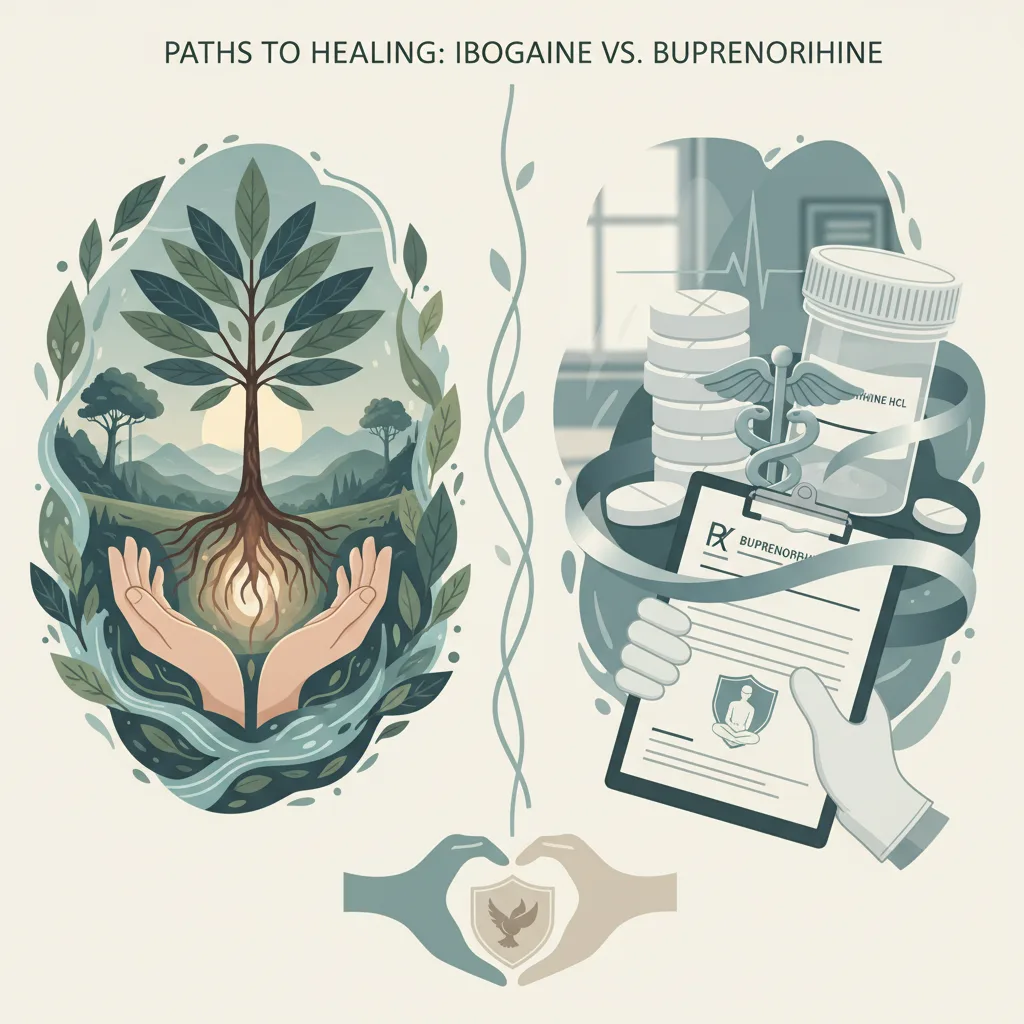
In most ways, yes. Buprenorphine keeps your opioid receptors steadily occupied, so withdrawal and cravings stay quiet for as long as you take it. Ibogaine is a single, medically supervised intervention that in some cases may interrupt withdrawal and offer a chance to live without opioids, though individual responses vary and outcomes cannot be predicted.
Buprenorphine is a partial opioid agonist. It attaches tightly to the brain’s mu-opioid receptors, the same receptors that heroin, fentanyl, and pain pills act on, but it only partly switches them on. That partial effect has a ceiling, which is one reason it is safer than full opioids. Its strong grip on the receptor also keeps other opioids from having much effect. NIDA recognizes buprenorphine as one of the medications that can reduce cravings and withdrawal for people with opioid use disorder. Suboxone pairs buprenorphine with naloxone, which is mainly there to discourage misuse by injection.
What buprenorphine does not do is return your brain to how it worked before opioids. It manages the system rather than resetting it.
That is not a flaw. It is how the medication was designed to work, and for many people that steady management is exactly what keeps them alive and working.
Ibogaine starts from a different idea. It is a psychoactive alkaloid from the root bark of the iboga shrub, and at our Iboga Wellness Institute Cozumel clinic it is given as a single flood dose under physician oversight with 24/7 nursing care. Some people have reported withdrawal easing within hours and cravings going quiet in a way they had not felt in years in their individual cases, though responses vary widely from person to person, these effects may be temporary, and such results are not typical or expected for all individuals. Researchers believe it acts on several brain systems at once. The science is still developing, ibogaine remains investigational and is not FDA-approved, and outcomes differ for each individual.
Neither approach erases the deeper biology of opioid dependence on its own. Ibogaine may interrupt withdrawal and quiet cravings for a window of time in some individuals, but it cannot teach you how to handle a bad day at work. It cannot repair a marriage or rebuild trust with a child. It does not change the people in your phone or the reasons you started using in the first place.
For some individuals, ibogaine may open a window of opportunity, but lasting recovery depends on the choices a person makes afterward, and outcomes vary widely.
Why Can’t You Just Stop Suboxone and Get on a Plane?
Once you understand how differently these two approaches work, the next question is usually about timing. Buprenorphine is long acting and binds strongly to opioid receptors, so its withdrawal can be delayed and drawn out. How you feel a few days after your last dose does not reliably predict how the rest of your transition will go. That is why Iboga Wellness Institute requires a 30-day, physician-supervised detox and transition off Suboxone before ibogaine is even considered.
The most common mistake we see is the assumption that you can quit, grit your way through a rough few days, and be ready to fly. The pattern is predictable. The early days feel tolerable, so the warnings start to sound exaggerated. Then sleep breaks down, anxiety climbs, your body aches, and cravings return harder than you expected. Feeling okay early never established that you were medically ready. It meant the medication had not fully worked its way out.
So the transition has to be managed by the physician you already work with, coordinated with our Iboga Wellness Institute medical team. Many people who call us have tried to stop before and had a difficult experience, or are already dreading withdrawal. We take that seriously. Struggling during withdrawal is not a failure in our eyes, and you do not have to prove how much you can endure.
Depending on your circumstances, our Iboga Wellness Institute physicians can arrange a medically supervised switch to a short-acting opioid during those 30 days. A short-acting medication gives the medical team a more predictable picture of withdrawal before treatment and may make the period easier to get through for some individuals. The physicians prescribe it, monitor it, and set exactly when it must stop before ibogaine. Short-acting opioid transitions have been used in published ibogaine studies. They do not remove the risks of treatment, and they do not guarantee you will be ready.
When the 30 days are complete, our Iboga Wellness Institute physician looks at the whole picture:
- Your Suboxone dose, how long you took it, and when you last took it
- How your body responded during the transition and what withdrawal symptoms remain, including sleep, anxiety, physical discomfort, and cravings
- A 12-lead ECG and your QTc interval
- Electrolytes, especially potassium and magnesium
- Liver function and hydration
- Every other medication you take
Day 30 is part of our Iboga Wellness Institute protocol, not a clearance. Finishing those 30 days does not mean you automatically proceed; our physician makes the final call based on your individual condition. If you need more time or additional medical care, we explain why and plan the next step with you. We would much rather you tell us honestly how you feel than what you think we want to hear.
What Makes Ibogaine Treatment for Suboxone Riskier Than It Looks?
The transition is careful for a reason, and that reason is your heart. Ibogaine can significantly prolong the QT interval, the time your heart needs to recharge between beats, and that can trigger dangerous and sometimes fatal rhythms. Coming off buprenorphine can stack more risk on top, because withdrawal often brings dehydration and electrolyte shifts that leave the heart more vulnerable.
As state lawmakers look more closely at the evidence on ibogaine for opioid use disorder, cardiac safety is the question no honest discussion can skip. Any program that talks about ibogaine without talking about the heart is leaving out the most important part.
Here is why the Suboxone transition matters so much for cardiac safety. Weeks of withdrawal can mean sweating, vomiting, diarrhea, poor sleep, and skipped meals, and each of those can drain potassium and magnesium. Low levels of either can lengthen the QT interval on their own. A person can look and feel fine while their bloodwork tells a different story. Some common medications also lengthen the QT interval, including certain antidepressants, antipsychotics, and antibiotics, as well as methadone.
So before anyone receives a flood dose, our Iboga Wellness Institute physician reviews a 12-lead ECG with a careful QTc reading, potassium and magnesium levels, liver function (the liver is what breaks ibogaine down), hydration, ongoing withdrawal symptoms, and a full medication list. Urine toxicology screening confirms what is actually in your system. Someone who is dehydrated, has abnormal electrolytes, or shows concerning cardiac findings may need additional care first, or may not be eligible. During and after the flood dose, you have 24/7 nursing care and physician oversight. The effects of ibogaine and its main breakdown product can last well beyond the day of the dose, so monitoring does not stop when the most intense hours end.
Some people are not candidates. Serious heart conditions, psychosis, certain bipolar disorder presentations, and active psychiatric or suicidal crises fall outside what we treat. Others may need more medical care first, and applying or paying never guarantees treatment.
Every person who comes to Iboga Wellness Institute in Cozumel is someone’s son, daughter, spouse, parent, sibling, or best friend, and we screen them that way.
What Does Staying on Buprenorphine for Life Actually Ask of You?
Ibogaine is only half of the decision, so the other path deserves the same honest look. Staying on buprenorphine means treating opioid use disorder like a long-term health condition, with a daily medication, regular check-ins, and no set end date. For many people that structure is life-saving stability. For others, it starts to feel like dependence with a prescription.
Federal guidance from SAMHSA supports buprenorphine as a medication for opioid use disorder and does not set a time limit on how long someone can stay on it. If buprenorphine has given you a steady life, a job you show up for, and a family that trusts you again, that is a meaningful outcome for you. It is not a failure, and nobody should shame you out of it.
Still, the daily reality matters. Long-term maintenance usually means:
- Regular prescriber visits and urine drug screens
- Monthly pharmacy trips and refills that must line up perfectly
- Insurance prior authorizations that can lapse or get denied
- Out-of-pocket costs that can run roughly $200 to $500 a month without coverage, depending on dose, formulation, and pharmacy, plus visit fees
- Extra planning for travel, moves, or any gap between doctors
Then there is the weight no pharmacy receipt shows. A relative who says you are “still using.” An employer drug test you have to explain. A custody evaluator who sees a prescription and draws the wrong conclusion. And sometimes, the quiet feeling inside that you are never quite done.
None of this means you should stop. It means you deserve to weigh the real costs of both paths, not just the frightening ones on one side. Whatever you decide, never stop buprenorphine on your own. Any change should be planned with the physician who prescribes it.
Who Handles Each Step Between Your Prescriber, Columbus, and Cozumel?
If you are leaning toward ibogaine, it helps to know exactly who does what. Iboga Wellness Institute splits the work between two places. Our Columbus, Ohio corporate office handles admissions, screening, coordination with your prescriber, and aftercare. All ibogaine treatment happens at our licensed medical clinic in Cozumel, Mexico.
That split exists for a reason. Federal law lists ibogaine as a Schedule I controlled substance, and the FDA has not approved it to treat opioid use disorder or any other condition. It remains investigational. No clinic in Ohio, or anywhere in the United States, can legally provide it. If someone offers it to you here, treat that as a warning sign.
Here is how the process works for someone currently on Suboxone:
- First conversation and screening. Our Iboga Wellness Institute Columbus admissions team learns your substance history, your current dose and how long you have been on it, your mental health history, your other medications, and what happened in any earlier attempts to stop.
- Coordinating the 30-day transition. With your written consent, our medical team works with the physician who prescribes your Suboxone. Together they plan the transition, decide whether a short-acting opioid makes sense for you, and set the timing for labs and an ECG.
- Medical review before travel. Our physician reviews your ECG, QTc, bloodwork, hydration, and symptoms, then decides whether you proceed, wait, or need a different path.
- Treatment in Cozumel. Your stay of about a week includes preparation, the flood dose, 24/7 nursing care, physician oversight, and therapeutic support.
- Coming home. Integration programs and post-treatment follow-up are coordinated from Columbus, so you are not left on your own the day you land.
Your timeline is built around your body, not a calendar. If your numbers are not where they need to be, you do not fly. Safety will always come before filling a bed.
Which Path Fits the Recovery You Actually Want?
Neither path is right for everyone. The choice depends on how you define recovery, how much medical risk you will accept for a chance at living opioid-free, and whether you have the support to keep working after treatment ends.
Some people see buprenorphine as an approach that helped them work, parent, and live without the chaos of active use. They are not wrong. Others feel tethered to the opioid system and want to find out who they are without it. They are not wrong either. This is a values question as much as a medical one.
Be clear-eyed about what happens when opioids stop, by any method. Stopping buprenorphine, through a taper or otherwise, carries a real risk of returning to use. SAMHSA warns that tolerance drops after a person stops opioids, which raises overdose risk if they use again. The same is true after ibogaine, because your body will not handle the amount it once did. That single fact belongs in any plan you make.
Be clear-eyed about the evidence, too. Much of what is published on ibogaine for opioid use comes from observational studies and self-report surveys of people who sought ibogaine for problematic opioid use, not large controlled trials. That does not make ibogaine worthless. It means you should be wary of anyone who talks about it with certainty.
Before you decide, sit with these questions:
- Does recovery mean no opioids at all for you, or a stable life with medication?
- Is your life on buprenorphine truly working, or does it only look that way from outside?
- Can you accept a real cardiac risk, even with careful screening and monitoring?
- Do you have the money, a passport, time off, and people at home to support travel to Cozumel?
- Will you commit to integration and aftercare once you are back?
- Is this your decision, or are you trying to quiet someone else’s pressure?
If you are a family member, these questions are worth asking together rather than for your loved one. The decision only holds if it is truly theirs.
We are not looking for a miracle, and we would ask you not to look for one either. We look for someone who is medically ready, honest about where they are, and willing to keep rebuilding afterward: their relationships, their purpose, their health.
Questions People Ask Before Choosing Ibogaine Treatment for Suboxone
These are the questions people on Suboxone, and the families who love them, ask our Iboga Wellness Institute admissions team most often. We have answered them the way we would on the phone.
How long do I need to be off Suboxone before ibogaine treatment?
Iboga Wellness Institute requires a 30-day, physician-supervised detox and transition off Suboxone first. Time alone does not clear you, though. Our physician makes the final decision based on your ECG, QTc, electrolytes, liver function, hydration, remaining withdrawal symptoms, and medication history. Some people need more time, and that is appropriate for their safety.
Is ibogaine treatment for Suboxone legal in Ohio?
No. Ibogaine is a Schedule I substance in the United States and is not FDA-approved for any condition, so it is not available in Ohio or any other state. Iboga Wellness Institute provides treatment only at its licensed medical clinic in Cozumel, Mexico. The Columbus office handles admissions, screening, and aftercare coordination only.
Can I stay on Suboxone forever, or do I have to get off it eventually?
You can stay on it indefinitely. Long-term buprenorphine maintenance is medically appropriate for many people, and there is no rule that says you must stop. Some people choose to pursue life without opioids through ibogaine or a supervised taper. That is a personal decision to make with your prescriber, never one to make alone.
What happens if I relapse after ibogaine treatment?
Ibogaine may interrupt withdrawal and ease cravings for some individuals, but it does not remove opioid use disorder. A return to use can happen, and your tolerance will be lower, which makes overdose more likely. That is why integration programs and post-treatment follow-up continue after you leave Cozumel. If you do use again, contact us and your local physician right away. Restarting medication is a valid option.
How much does ibogaine treatment for Suboxone cost, and does insurance help?
Because ibogaine is not FDA-approved, US insurance plans do not cover it, and Iboga Wellness Institute does not accept insurance. The total cost depends mainly on your room selection and your medical needs. Our admissions team will give you the full figure and explain exactly what it covers before you commit to anything. Plan for it as a significant personal investment, especially if your family has already spent a great deal on earlier treatment.
Will my doctor help me stop Suboxone so I can do ibogaine?
Some prescribers support the decision and others do not. Either way, coordination between your prescriber and our medical team is essential, because the 30-day transition has to be properly managed by the physician you work with. With your consent, our Iboga Wellness Institute Columbus admissions team can contact your physician, explain our protocol, and share what our medical team will need. If your prescriber will not help, we will talk through safe options with you. Stopping without medical supervision is never one of them.
Start With One Honest Conversation
Your next step is not booking treatment. It is a conversation with people who will tell you the truth about whether ibogaine makes sense for you, or for the person you love, right now.
Contact the admissions team at Iboga Wellness Institute’s Columbus, Ohio office through theibogainstitute.org. We will talk through your current Suboxone treatment, coordinate a physician-supervised transition plan with your prescriber, and determine together whether ibogaine treatment at our Cozumel clinic may be medically appropriate for you.
Before you call, write down four things: your current Suboxone dose, how long you have been taking it, when you took your last dose, and your prescriber’s name and contact information. Those are the exact details our Iboga Wellness Institute physician uses to start evaluating your readiness, and having them ready speeds up the first steps. Whichever path you choose, the goal is the same: a life you no longer feel the need to escape from.
Important legal and safety information: Ibogaine is not approved by the FDA and is not available as a legal medical treatment in the United States. Iboga Wellness Institute provides ibogaine treatment exclusively at its licensed medical clinic in Cozumel, Mexico, under medical supervision. US locations handle admissions, screening, and aftercare coordination only.
Ready to Explore Whether Ibogaine Is Right for Your Journey?
If you’ve been weighing the choice between continuing buprenorphine maintenance and pursuing ibogaine treatment at our licensed clinic in Cozumel, the next step is simply a conversation. Our Iboga Wellness Institute admissions team can walk you through what the detoxification process looks like, answer your questions about tapering or transitioning off Suboxone, and help you understand whether this path aligns with where you are now. You don’t have to have all the answers before you reach out.
Individual responses to ibogaine vary, and outcomes depend on many factors including medical history, adherence to aftercare, and individual circumstances.