Understanding ibogaine legality in the United States
If you are researching ibogaine legality in the United States, you are likely weighing very serious decisions about treatment, travel, and risk. Ibogaine is often discussed as a powerful option for addiction interruption and trauma work, yet its legal status in the U.S. is restrictive and complex. You also see headlines about new state bills and research funding, and it is not always clear what that means for you right now.
In this guide, you explore how ibogaine is treated under U.S. federal law, what is changing at the state level, and how this compares with other countries. You also learn why so many ibogaine treatment centers operate internationally, and what it practically looks like if you are considering traveling abroad for care. If you want a broader context, you can also review resources on ibogaine legal status worldwide, ibogaine regulation worldwide, and ibogaine treatment laws.
Federal classification of ibogaine in the U.S.
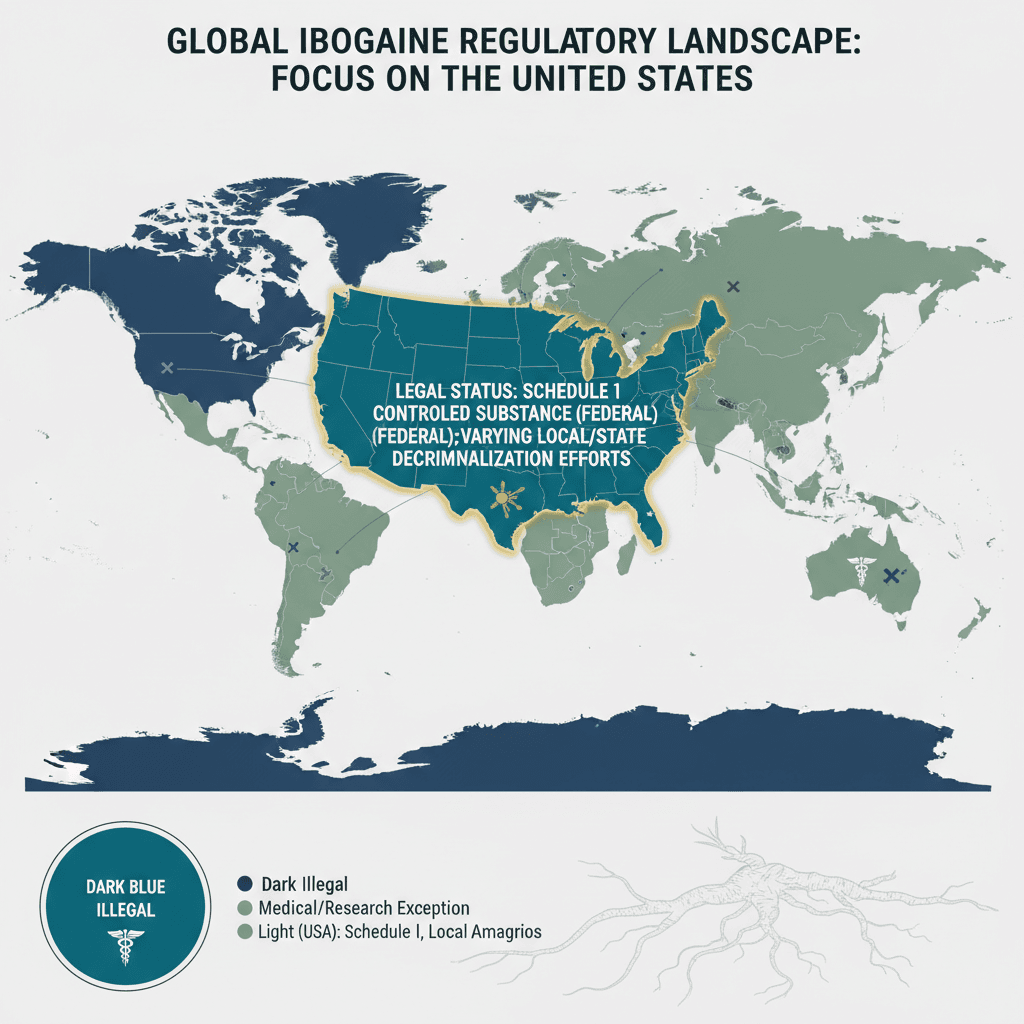
At the federal level, ibogaine is classified as a Schedule I controlled substance under the Controlled Substances Act. This is the most restrictive category. A Schedule I drug is defined as having a high potential for abuse and no currently accepted medical use in treatment in the United States. As of late 2025 and into 2026, this is still ibogaine’s status across the country [1].
This classification has several important consequences for you:
- You cannot legally possess ibogaine in the United States.
- Doctors cannot prescribe or administer ibogaine in clinical practice.
- Clinics inside the U.S. cannot legally offer ibogaine treatment.
- Federal penalties can include fines, arrest, or imprisonment if you are caught possessing or distributing ibogaine [2].
Organizations such as the Partnership to End Addiction note that ibogaine is treated similarly to substances like heroin and peyote under federal law, with no recognized medical benefit and a high perceived risk of misuse as of January 2024 [3]. Advocates argue that ibogaine does not fit this profile, particularly in supervised medical settings, but until the law changes, the legal framework remains the same.
If you are asking, “is ibogaine legal?”, the answer in the United States is no at this time, except within tightly controlled research settings that receive specific federal approvals.
How U.S. federal law affects treatment access
Because of the Schedule I designation, ibogaine is not part of standard addiction or mental health care in the United States. You cannot walk into a hospital, residential rehab, or outpatient program and legally receive ibogaine treatment. It also cannot be legally dispensed by pharmacies or integrated into existing medication-assisted treatment models.
You may come across stories of people attempting to self-treat with ibogaine purchased online or through underground networks. This is illegal and carries several layers of risk:
- Legal exposure due to possession and use of a Schedule I substance
- Unknown substance quality or contamination
- Lack of cardiac screening, which is critical given ibogaine’s potential to affect heart rhythm
- No emergency medical infrastructure if complications arise
The Partnership to End Addiction warns that some individuals illegally obtain ibogaine online for self-treatment, which can be dangerous due to poor quality control and cardiac safety concerns [3]. When you evaluate all options, it is important to weigh not only your desperation for change, but also your physical safety and legal risk.
This legal environment is also why you see many U.S.-based support organizations and educational platforms focus on helping you understand why ibogaine treatment is not legal in the US and what safer, lawful pathways might exist through research or international clinics.
Emerging state-level actions and research
Even while federal law remains strict, some states have started to move in a different direction, mainly around research rather than open clinical use. When you read headlines about ibogaine bills or funding, it is crucial to understand what they do and what they do not change for you right now.
State funding and research initiatives
You see several trends:
- Texas
In June 2025, Texas became the first state to allocate significant public funds for ibogaine research, authorizing 50 million dollars in grants for FDA supervised clinical trials exploring ibogaine’s pharmaceutical applications [4].
For you, this means more formal research data may emerge, but it does not mean ibogaine is legal for personal use in Texas. - Arizona
Arizona passed House Bill 2871 in June 2025, releasing 5 million dollars for phase I clinical trials that examine ibogaine’s potential for conditions like PTSD and traumatic brain injury [4].
Again, this is about early safety and dosing studies, not general treatment access. - Mississippi
In 2026, Mississippi’s House Bill 314 was advanced by the Senate Public Health Committee to allow ibogaine clinical trials for neurological conditions and addiction, including opioid use disorder and PTSD [5]. Trials would be supervised by the state Department of Health, a drug developer, a lead university, and a hospital, with the goal of eventually achieving FDA approval.
Supporters point to preliminary data from 2024 Stanford studies and clinical use abroad, particularly showing potential benefits for withdrawal symptoms and PTSD, while also emphasizing the need for strict medical screening due to heart risks [5].
Several other states, including Ohio, Indiana, New York, Nevada, and Washington, have introduced or considered legislation to facilitate ibogaine research for substance use disorders and related mental health conditions [1].
Decriminalization versus medical legalization
Some states and cities are moving toward decriminalization or changing enforcement priorities for a range of psychedelics, and ibogaine is sometimes included in those conversations.
- Colorado
Colorado voters approved Proposition 122 in November 2022, which decriminalized the possession, cultivation, and sharing of ibogaine for adults 21 and older, and the state has been developing regulations to potentially include ibogaine in a broader natural medicine program [4]. While this reduces criminal penalties for personal possession, it does not create a regulated medical-style ibogaine clinic system yet. - Local decriminalization
Some cities, such as Oakland, have taken steps to decriminalize a range of plant-based psychedelics, including ibogaine. Even in these cities, ibogaine remains illegal under federal law, and there is no regulated medical access [6].
For you, these measures do not translate into sanctioned medical treatment. They primarily change law enforcement priorities around personal possession. Any structured clinical program in the U.S. would still have to operate under federal approvals for research and could not offer ibogaine as a routine therapy.
How ibogaine research may shape future policy
You might wonder how long it could take before ibogaine is legally available in U.S. medical settings. Experts suggest that federal approval, if it happens, is a long-term process.
The Partnership to End Addiction notes that it could take up to ten years before the FDA considers approving ibogaine as a treatment for substance use disorders, reflecting substantial regulatory and safety hurdles [3]. The process typically involves:
- Preclinical studies on safety and mechanisms.
- Phase I trials focused on basic safety and dosing.
- Phase II and III trials assessing efficacy and comparing ibogaine to existing treatments.
- Comprehensive safety monitoring, especially for cardiac effects.
- Formal FDA review, labeling, and scheduling changes if supported by evidence.
There is also active interest in related compounds. For example, in 2023, Delix Therapeutics received a NIDA award to study a non hallucinogenic ibogaine analog, DLX 007, targeting opioid and stimulant use disorders [3]. These “ibogaine inspired” molecules could potentially reach approval faster if they show similar therapeutic benefits with fewer risks.
For your planning, this means you should not expect rapid legalization of ibogaine treatment inside the United States. If you are seeking help now, you are still operating in an environment where ibogaine treatment is not legally accessible domestically outside of research trials.
Why many Americans seek ibogaine treatment abroad
Given the strict federal stance, many Americans look outside the country for ibogaine care. Ibogaine was first criminalized in the U.S. in 1967, then formally placed in Schedule I in 1970 [6]. Since the 1980s, however, it has attracted global attention for potential use in treating chemical dependency, particularly opioid addiction in the context of the HIV/AIDS crisis [6].
Today, you see two major patterns:
- Some countries officially regulate ibogaine as a medicine.
- Others do not regulate it at all, which creates a legal gray area where clinics can operate.
New Zealand, for example, became the first country to legalize ibogaine as a medicine specifically for opioid recovery in 2009 [6]. New Zealand, in particular, are common destinations for Americans seeking ibogaine therapy because they either allow medical use or do not strictly regulate it [7].
If you are comparing options, you may find it helpful to read more about where ibogaine is legal, countries where ibogaine treatment is legal, and ibogaine legal treatment clinics. These resources can provide country by country context that builds on the U.S. overview in this article.
Legal travel versus treatment legality
Traveling from the United States to another country for medical care is not illegal in itself. People routinely travel abroad for operations, dental work, and other procedures. The key legal questions for you are:
- Is ibogaine legal or regulated in the country you are visiting
- Does the clinic operate in compliance with local law and health regulations
- Are you bringing any ibogaine back into the United States, which is illegal regardless of where you obtained it
Many Americans travel to countries where ibogaine is legal or unregulated for treatment, then return to the U.S. without the substance in their possession. This can be lawful travel, even though ibogaine itself remains prohibited domestically [2].
If you want a more detailed walkthrough of this process, including visa, customs, and re entry considerations, you can review can americans get ibogaine treatment abroad and is ibogaine treatment legal.
Comparing U.S. ibogaine policy with other countries
Understanding ibogaine legality in the United States is easier when you contrast it with international models. Globally, ibogaine falls into several broad categories.
| Country / Region type | General approach to ibogaine | What this means for you |
|---|---|---|
| United States | Schedule I, no accepted medical use, illegal to prescribe or possess outside research | You cannot legally receive ibogaine treatment in U.S. clinics. You may only access it through approved clinical trials, if eligible |
| Regulated medical use (for example, New Zealand) | Ibogaine licensed as a medicine for specific indications, such as opioid dependence | You can access ibogaine in tightly controlled medical settings if you meet local criteria |
| Unregulated or gray area (for example, some Latin American or European countries) | No explicit law on ibogaine, or it is not scheduled | Clinics can operate, but quality and safety standards vary significantly |
| Explicitly banned but loosely enforced | Ibogaine is illegal in the text of the law but may not be a high enforcement priority | You face potential legal risk, and clinics may be underground or unstable |
This variation is why it is helpful for you to look at broader guides like ibogaine treatment legality explained and ibogaine legal status worldwide when you are comparing treatment centers and deciding whether to travel.
Safety, ethics, and evaluating ibogaine clinics abroad
Even when you identify a country where ibogaine is allowed, the burden is still on you to evaluate the safety and professionalism of any clinic you consider. Because ibogaine can affect heart rhythm and interacts with other medications, medical oversight is not just a bonus, it is essential.
When you look at international clinics, pay close attention to:
- Medical screening and cardiac evaluation
You should expect pre treatment ECGs, lab work, and a careful review of your medications and health history. Supporters of Mississippi’s bill, for instance, have highlighted that heart complications are a known risk and require thorough screening [5]. - On site medical staff and emergency protocols
Confirm that there are trained medical professionals present during dosing and that the clinic has a clear plan for cardiac events or other emergencies. - Regulatory compliance
Check whether the clinic operating license, if applicable, is valid, and whether the facility is inspected or regulated by local health authorities. - Integration and aftercare
Ibogaine is not a stand alone cure. You need preparation, follow up care, and ongoing support when you return home.
Because ibogaine remains illegal in the United States, you must also remember that any attempt to bring ibogaine, capsules, or extracts back into the country is a criminal offense, regardless of where it was purchased. You can travel for treatment, but you cannot import the substance legally.
For more operational guidance on researching international centers, you may want to consult resources on ibogaine regulation worldwide and ibogaine legal treatment clinics.
Key takeaways about ibogaine legality in the United States
As you navigate ibogaine legality in the United States, it can be helpful to hold a few core points in mind:
- At the federal level, ibogaine is a Schedule I substance and is illegal to possess, prescribe, or use outside of research.
- No state currently offers fully legal, regulated ibogaine treatment programs, although some have decriminalized possession or funded research.
- Clinical trials in states like Texas, Arizona, and Mississippi may expand scientific understanding but do not create immediate access for the general public.
- Internationally, some countries allow medical ibogaine use or leave it unregulated, which is why many American patients seek treatment abroad in places like New Zealand [7].
- Traveling for treatment can be legal if done carefully, but importing ibogaine back into the U.S. is not.
- Experts suggest it may take many years before ibogaine, or related compounds, might be considered for FDA approval as recognized treatments for substance use disorders [3].
If you are evaluating ibogaine as part of your healing path, you are making decisions that carry medical, legal, and ethical dimensions. You do not have to navigate this alone. Exploring additional resources such as ibogaine treatment legality explained, is ibogaine legal, and where is ibogaine legal can help you build a clearer picture, ask better questions of any clinic you contact, and align your choices with both your safety and your long term recovery goals.